Sunday, February 11, 2007
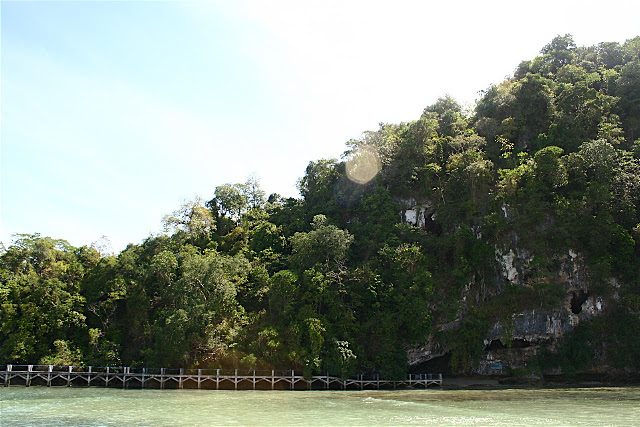 Tabon Approach (Photo by Boy Martin)
Some three weeks ago I had a nice chance to join an out-of-town consultation meeting (with the local academe and other language 'practitioners'—teachers, writers, etc.—in Puerto Princesa, Palawan) of the translation committee of the National Commission for Culture and the Arts. I am not part of the committee but I was requested to join for another assignment, from the committee chairman himself, Mr. Virgilio Almario, or Rio to us—Rio Alma—the national artist for literature. I was to bring along a camera and my amateur photographic skills, to shoot significant local scenes (with or without him in the photograph) that might accompany the planned poem he was to write about the place, which he was to compile in a book. The place had been pre-selected by him together with others in many parts of the Philippines, on the basis of what I didn't know about but perhaps his poet's sense of place.
Puerto Princesa has always been a fine place for me, something I'd never miss every time I got the chance to visit. It reminds me of—no actually it feels like—the hometown I have long left but which continues not just to live in my memory but is a living source of memory itself, like a spring under a stream, feeding the current. Then of course, like any common tourist, I'd have had the chance to sail through the famous underground river, which I'd never seen. (The first time I was in Palawan, I missed going to the River since I did not join the team that was to do photography there. I was still in advertising then, I was the head of creative but I was to supervise another team that would shoot in the Dos Palmas resort. This was almost exactly two months before the kidanapping that would begin the fall of the Erap presidency.)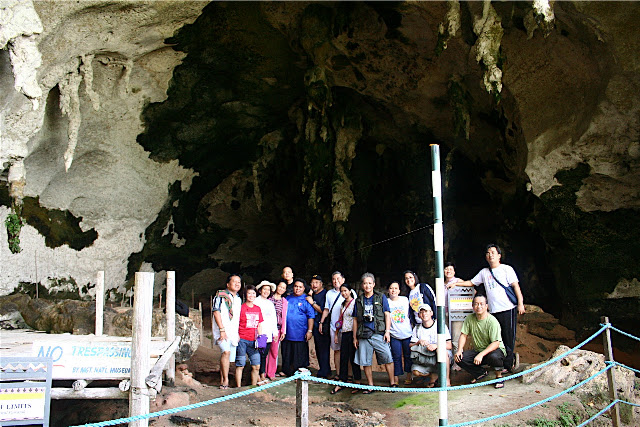 The Tabon Group with National Artis Rio Alma, center (Photo by Boy Martin)
So back to the recent trip. The bad thing was I not able to go the to St. Paul Underground River this time either. The sea was rough and the Coast Guard won't risk us being bashed and spilled from out little outriggers into the sharp rocks that lined the shoreline leading to the mouth of the river. So I never saw St. Paul. The excellent thing was the Mayor (Hagedorn), despite his absence due to an urgent Manial trip—he was just ready for boarding when we deplaned—had left instructions for his people to be on hand whenever we needed them, e.g., to dispatch for our use vans and SUVs and their gracious drivers. Rio, Mike Molina (my long-time friend from Bikol, who happened to be on one of his frequent trips to Puerto), had both been long-time and common friends of the Mayor's.
The other more rewarding experience, of course, was stepping into Filipino prehistory, where a 50,000 year-old cranium was found among other fossils and artifacts. This was at the Tabon Cave in Quezon town, where the American archaeologist Robert Fox first dug and found human remains, tools and other items of early civilization dating back fifty millenia. Getting there was a folur-hour ride over mainly rough road, while the Undergorund River was jus two hours away within Puerto boundaries, so we scheduled to Tabon trip ahead, on our first day. 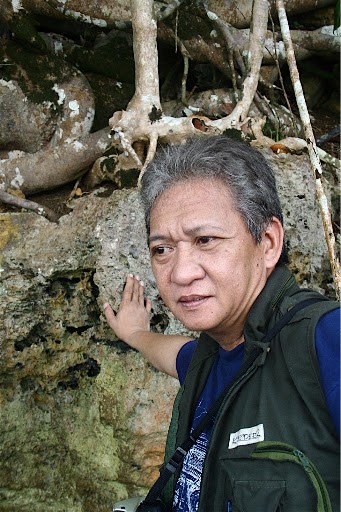 Tabon Man, c. 2007 (Photo by Boy Martin)
Tabon is acutally a network of caves, with the almost equally famous Manunggul among them, where the burial jars and Charon's boat with two passengers adorning the lid were found, now to be seen at the National Museum. Caves have been cathedrals before Gothic Christianity was invented. Sanctuary to pre-religious man who faced only the threat of storm or wild animal, a warm shelter from howling winds. For us who have virtually no memory of who we were beyond a few hundred years, the entry of a cave like Tabon almost induces us to genuflection, and we look around for fonts of holy water. There are, in fact, drops of water trailing along crevices and roots and vines descending from the ceiling of the cave. And we fall silent. The drops refresh us—baptize us, convert us to the religion of memory.
The shallows stretch far from the shore, and we must wade across, over mossy and sharp stones and coral, to get to the foot of the cliffs, the karst precipices. Gingerly we tread along, our arms raised as we keep our camera equipment above water. We do the same going to and rom the network of caves facing part of the China Sea, anticipating, perhaps, the arrival of boats ridden by strange men, driven not by squall but by wind caught on bulging bellies of tough fabric. We kept our cameras high and dry, we could not let the sea drown or lick away the fragile impressions impression of fleeting memory.


0 Comments:
Post a Comment