Monday, April 2, 2007
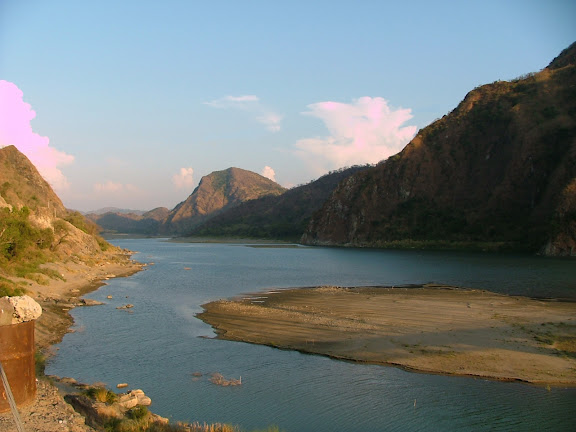 from Quirino Bridge, at the doorstep of the Ilocos
Hey, the working tour was more than I bargained for. It turns out it was an all-Ilocos Tour, at least of the most historical parts of the region. We—Boy, Rio's driver, Eilene, his student assistant, and I—riding in Rio's recently acquired Toyota Innova, which gives quite a comfy ride for long drives, picked up Rio from the the UP Writers's Workshop venue within Camp John Hay and after a short pause among the Baguio pines off we went again along Marcos Highway down to La Union and turned west and up north again as we headed for Laoag, which was to be our base. After a good night’s rest a La Elliana Hotel (Chinese-owned despite its name, and as typically parsimonious) we motored the following morning to Pagudpud (before then only a tourism name for me), down the Patapat Viaduct with its magnificent view of the Luzon’s northernmost sea, looking out into the Batanes Channel beyond the horizon.
But there was a sour note to all the mountain splendor. The postcard-pretty viaduct hugging the mountainside with a sheer drop to the bay on the other side was marred by a caved-in section and only a bailey bridged had seemed strung over it. The bailey bridge creaked as we drove over it, and below us between the planks we could see the rubble and chunks of concrete of the caved-in span and its foundations that had given in maybe to erosion or corruption. On the way back we passed by once more the Bangui wind turbines and looked with some awe at the spindly shapes of the nine spinning giants arranged along a stretch of shoreline, their white metallic and knife-like blades being spun by the wind, nowhere like the latticework of the windmills of Don Quixote. Again we passed by Cape Bojeador but missed stopping to climb up its classic lighthouse, one of the few still working—beacon and beckon to merchant and pirate ship alike. Then over the next two days we drove around and over to the other historic towns and site of Ilocos, of which I will write later as soon as I am able to sort and upload some of the pictures I could use without pre-empting the new Rio Alma book in the making.
An even sourer note was added to our otherwise pleasant perambulations over Ilocano grounds hallowed and dry in the peaking summer and Lenten season. An amateur photographer’s nightmare. My three-year old 3.1 megapixel Fuji FinePix S5000 refused to work after some tell-tale sounds from it small zoom lens every time it was turned on. Calling all Fujistas out there, before I even check in my FinePix to the Fuji hospital (I hope it’s just some dust in the aperture, shutter or the lenses). What could have happened to my toy? It looks like its zoom mechanism has got an obstruction somewhere, so that when it is turned on the aperture or zoom stops at some point leaving small opening that exposes the image-recording medium (a digital storage card, xD for Fuji), and all you see in the viewfinder is white light which ends up in the xD picture card if you shoot). I tried charging fully my batteries and later bought a new set of rechargeables, thinking half-full or half-spent batters my not supply enough voltage to enable the zoom mechanism to work. So I had to retire the Fuji for the moment to the cozy insulation of its bag, and resorted to the ever reliable, my old faithful Nikon F60, an analog with one lens. And the whole Ilocos tour, back into our mestizo memory, was recorded via an analog Nikon on analog Kodak film. And only some of the pictures, without pre-empting the book in which they will be used later, I will share with you in future postings. In the meantime, here is the last picture my Fuji FinePix S5000 took before it crunched down into desuetude, Quirino Bridge at the doorstep of the Ilocos provinces, along one flank of the Cordilleras.
THE POETRY EVENING
And here, too, is my first poem in Filipino in ages (with my quick translation), written on my shaky Moleskine as we drove to the Ilocos, as I contemplated that billboard verse so beloved of Loren Legarda (and of our old English teachers, excepting Ms. Linda Reyes, my high school teacher who I recall wouldn’t countenance such pretty mush as Kilmer’s. I bet she was the one who also introduced us to Ogden Nash’s “…unless a billboard fall, I’ll never see a tree at all”). Now the accursed verse is displayed ad nauseam in a series of billboards (how much do they cost?) along our highways as lip service to the environment, in fact marring our view of the trees (Nash was a prophet), and so ubiquitous and insistent that the billboards inhabit our nightmares. Jun Balde has always complained that why can’t a Filipino poem about trees replace this ‘monstrosity’ and said it as a sort of challenge to the poets around. Teo Antonio and Bobby Añonuevo would protest that there are ‘tree poems’ in Tagalog though these are just not popular. Well, I have written my own, I know it can’t be popular, much less join the league of Kilmer’s “Trees,” (farthest from my mind), just something to think about. And this poem I might read tonight (I write this on a Monday morning) at the invitation of young literary lion and Bridport Prize-winner Joel Toledo (my co-teacher at Miriam) and his group who will launch the now biweekly poetry reading event at Mag:Net (gallery and bar) on Katipunan, the event courtesy of artist and owner Rock Drilon.
PROBLEMA NI KILMER
May tula nga kayang
Kasing ganda ng punongkahoy?
Wala.
Kasi, ang tula ay hindi punongkahoy.
Kung sa ganito lang,
Talagang walang silbi ang tula.
Pero,
Kahit na ang tula ay di punongkahoy,
Ang punongkahoy
Ay maaaring maging tula.
Sa isip, halimbawa,
Kung saan
Ang bagay ay salita
(O ang salita ay bagay),
Ang tula
ay nagiging punongkahoy.
(Samantala,
maraming walang pakialam
Sa tula,
Na wala ring pakialam
Sa punongkahoy.)
Kaya,
Maniwala ka, kaibigan,
Maaaring mawala ang punongkahoy
Kapag wala ang tula.
KILMER'S DILEMMA
Can a poem
Really be
As lovely as a tree?
No.
Because a poem is not a tree.
Thus
A poem is truly useless.
But,
Even if a poem is not a tree,
A tree
Can be a poem.
In the mind, for example,
Where
Things are words
(Or words are things),
A poem
Can be a tree.
(Meanwhile,
Many, who couldn’t care less
About poems,
Care even less about trees.)
So,
Believe me, friend,
Trees could vanish
If there were no poems.
Marne L. Kilates
March 28, 2007
Laoag, Ilocos Norte


4 Comments:
hello sir marne,
no, we haven't actually been introduced but i was at the reading last monday. your tree poem had a child-like whimsy to it. hope to hear more of your poetry at the readings.
denise alibudbud
labs ko talaga both versions, sir. sana binasa mo rin yung ingles. hehe.
Hi wander-cat & ramblingsoul:
Thanks, Denise and Joel for liking my tree poem. Some poems really get their lease on life after the first encounter with their readers (like Osip Mandelstam's message in a bottle--long before Sting--where after the poem is tossed about in the ocean it is washed ashore and found by its reader, its 'secret addressee').
Anyway Denise, you're no longer a secret reader (my daughter is your tocayo, after Denise Levertov). See you next Happy Monday.
Joel, I though my English version (written almost immediately after) was a bit lame. But Jimmy Abad liked it (he asked for a copy).
This Happy Mondays of yours will compel us to have newer poems every time. Ha ha. Good problem!
Marne
haha! sige sir, confrim na kita as reader next monday! april 16. already confirmed so far are: marc gaba, issy reyes, mabi david, ramil gulle, javie bengzon, and marie la vina. :)
Post a Comment