Tuesday, May 29, 2007
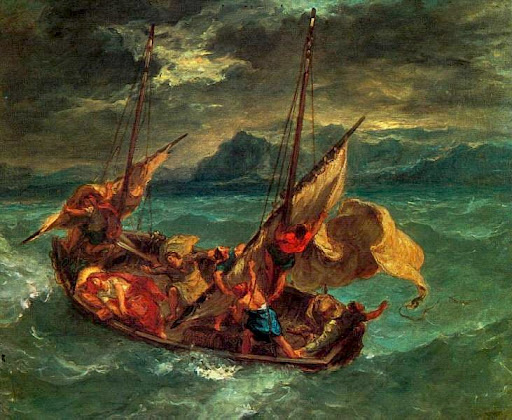
CROSSING GALILEE WITH DELACROIX & MANDELSTAM
“At a critical moment, a seafarer tosses a sealed bottle into the
ocean waves, containing his name and a message detailing his fate.
Wandering along the dunes many years later, I happen upon it in
the sand… The message in the bottle was addressed to its finder.
I found it… I have become its secret addressee.”
Osip Mandelstam
When and how to get
Ashore, the tempest being
What it is, certainly
Is nothing to scoff at.
Simple men have little faith
When no one can tell
The shore cliffs from the waves.
But we know the story.
Delacroix shows only
The marvel of the storm
(And the wonder of his pigments),
With the Savior still asleep.
Now, what if the fishermen’s boat
Is not a boat but the bottle
Carrying Mandelstam’s message
(Before Sting ever thought of it—
But he read Mandelstam, of course),
And I appropriate Delacroix’s
Tempest because it reminds me
Of the bottle being tossed
In time and the cosmos?
And there is no Savior
But the ocean (or the cosmos),
And the shore is not Galilee,
Nor even Boracay with its
Half-naked tourists, but
Under the incandescent light
Of the lamp at your desk,
The random page of the book
Where you found this poem
(When this has become a book),
And you have become,
In the words of Mandelstam,
Its secret addressee?
Would you read and believe
What you read? Don’t laugh now,
But poets and apostles
Are men of little faith.
Marne L. Kilates
April 26, 2007
Now this is two jumps away. Going back to the classics (the French Romantics, actually) but away from the Filipino mode. Or maybe not. Nothing is ever away from the Filipino mode or there is no Filipino mode at all. But there is. The former statement is true, nothing is ever away from whatever mode. Perhaps this is what this ekphrastic process told me, as I was writing the poem. Nothing is ever cut off from something. Not Eugene Delacroix (more famous for the painting “Liberty Leading the People”), who perhaps painted in all Romantic innocence a scene from the New Testament, and my rather romantic infatuation with an idea from Osip Mandelstam (introduced to me by the late Alfrredo Navarro Salanga), no matter that Osip’s speculation about the writing and reading of poetry is cold comfort for many of us who insist on writing it—on making language useful, actually.


2 Comments:
sir, Edward Hirsch also quoted/paraphrased this Mandelstam idea in his book, How To Read a Poem (and Fall in Love with Poetry).
I like this poem's tone, sir, because it seems to adopt the opposing and pragmatic position of the poet who now mocks (or challenges) the reader to re-imagine the romantic idea and consider the now-written poem instead, outside the artwork and the quote. i think i'm beginning to understand the process of ekphrasis. :)
Oo nga, pala, Joel, Edward Hirsch's book was where I first got the Mandelstam quote (or was it?). We have the same book. But Freddie Salanga was the one who introduced me to Mandelstam. I saw him reading a Penguin of the man's poems and I asked to read some and I liked it. That was eons ago.
Glad you liked the poem. But maybe not all ek-ekphrastic poems are like that. I thought it was a bit funny when I finished it, straying away too much from its sources, unlike "Leda and the Swan" and "Musee de Beaux Arts," both my favorites even when I didn't yet know what an ekphrastic poem was.
And then in this Galilee poem, there are two sources or subjects. I guess you cannot always be doing it this way, but it was fun.
Post a Comment