Thursday, October 18, 2007
Explaining the title of this entry reminds me that this is a journal after all. And this is an entry. I have never kept a diary—not even during primary and secondary school when we were occasionally reminded by our English teachers to keep one, to “practice our English”—but writing into cyberspace has finally persuaded me to. Still, this is an imperfect journal (meaning, not kept religiously), but let it do for now. Let the poems mark both special and the usual days—special enough to be commemorated in a poem, whatever the reason, or simply just “one of those days.” On the other hand, the writing of poetry in neither special nor ordinary. It is simply the world demanding something of language (like Adam calling out the names of all Creation). And language must do it “in ordinary time,” neither the Church’s season of Cuaresma nor Advent. Thus this post and others of similar nature appropriate the title of my friend Gémino H. Abad’s book, In Ordinary Time: Poems, Parables, Poetics, 1973-2003.
I am not addressed to time,
Posthaste, as it were,
Relevant for the nonce…
Thus Jimmy begins his first poem in the book. It is a poet’s conceit, in both senses of the word—an extended trope but also absolute belief in oneself, at least in his power of language, which he somehow counterpoints with his scribbled dedication: “for all nameable days of lightsomeness.”
Here are some nameable days, in ordinary time. And two more posts (this and the next) under the present title of this blog, which will change in subsequent postings.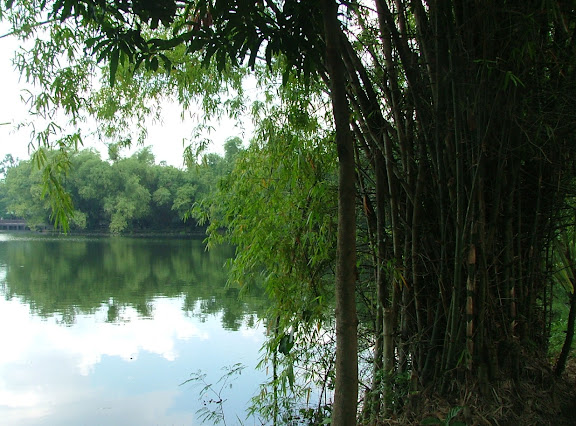
Haibun from the Wildlife Park
Parts of the week I spend on a part-time job that pays modestly but affords me generous moments of communion with nature. I step out for a smoke from the office, after a bout with the computer tapping out somebody else’s speech or a slogan or a press release. Before me is a pond straight out of Basho. Around it are the park’s lush vegetation and clumps and clumps of bamboo. The pond stretches out to the near horizon where beyond the treetops the tips of city can be seen: the skeleton of an unfinished building, the latticework of a radio tower, the spindly, lopsided arm of a construction crane. The pond may be crystal clear or murky or shimmering depending on the weather or time of day. I smoke silently or share the silence with a colleague, or he breaks it with shoptalk reminding me that for him, this precious scene is part of every day. I linger before going back to slogans because there is a poem here somewhere. And I take some notes on a little notebook.
Not a Haiku
Bamboo are creaking.Leaf ripples the sun
On lagoon.Words are an excess
In this haiku afternoon.
That was this afternoon. Tonight under the incandescent brightness of a lamp, on a dining table I have appropriated as my writing desk, I am adding and snipping and restoring and again snipping away lines. And counting syllables. Five. Seven. Five. English, or perhaps any other language, is a bother, when the form is Japanese. I think of a solitary monk walking from a monastery hidden among the slopes of paint-brush mountains…Ah, to have one thought, one image, one particle of memory in the few strokes of a brush…
Almost a Haiku
Bamboo sway dripping.Sun on lake breaks the grey
Sky of the monsoon.
Thunder rumbles somewhere. It is now pouring. Outside my closed window I can imagine the rain slanting across the funnel light of a lamppost. The light creates a circle on the sidewalk. But lamppost lights, with the advent of mercury or xenon, are no longer like that. It is a memory borrowed from a book or a movie. Which image, borrowed or no, of course I can’t see because my window is closed. The whirr of the electric fan on the floor drowns in the hissing and rattling of the rain. I know it is whirring because it did before the sound was drowned by the rain. I wonder what the pond looks like in this weather. But it is night and there is no poet there. And it is storming. No moon to shimmer or shatter on the water. Are the bamboo there? Or, before the storm, was a frog jumping? In my memory it is daylight. I can see it. I am there. And I snip and restore and snip away my lines and syllables again.
Perhaps a Haiku
Bamboo leaf spinning,Ripples the sun on lagoon.
Words are an excess.
I rest my pen. But it is not a pen. It is a keyboard. And a mouse. I click, I save. I light a cigarette.
Marne L. Kilates
September 7, 2006
Kilmer’s Dilemma
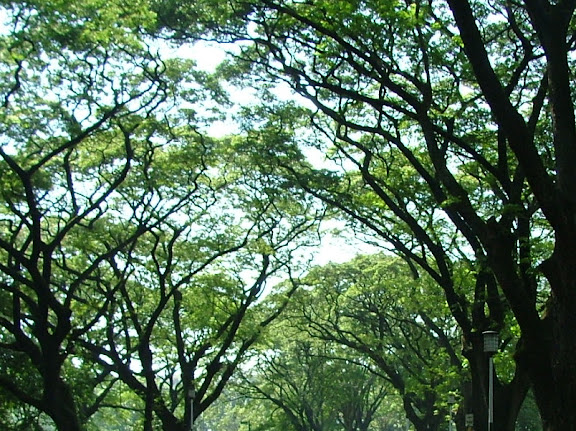
Can a poem
Really be
As lovely as a tree?
No.
Because a poem is not a tree.
If only for this,
A poem is truly useless.
But,
Even if a poem is not a tree,
A tree
Can be a poem.
In the mind, for example,
Where
Things are words
(Or words are things),
A poem
Can be a tree.
(Meanwhile,
Many, who couldn’t care less
About poems,
Care even less about trees.)
So,
Believe me, friend,
Trees could vanish
If there were no poems.
Marne L. Kilates
March 28, 2007
Laoag, Ilocos Norte
Something about Sunlight
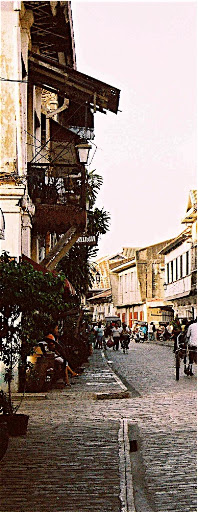
Something about sunlight—
Slanting behind trees
Streaming into windows
Glancing on walls
Dappling the peeling paint
Glinting on the steel railings
Gilding the new buildings
Dancing in the dust eddies
As if calling out the name
Of everything it touches—
Reminds me
Of some childhood afternoon
When I was alone.
Marne L. Kilates
December 4, 1998
The Title of this Blog, after "Mostly in Monsoon..."
The last poem above is the opening poem in my new book, Mostly in Monsoon Weather, the namesake of this blog. The book recently came out of the presses, published by the University of the Philippines Press. The title of this blog has been mainly to announce the coming of the book. Now that it has finally eclosed from its chrysalid stage (it is flying about in “real,” physical time, and it initially alights on the shelves of the UP Press Bookstore at Balai Kalinaw on UP campus), the blog has to give up its name and start the metamorphosis of another, new, book now in the pupa stage. But this chrysalid is not enclosed in a cocoon—or its cocoon is the universe itself. What it needs is to make itself whole by being able to name things (because it is the first time it’s seeing them): the sun, the sea, the stars, the moon, the disasters and the wars. Then, literate and no longer blind, it becomes a fully human handiwork.
PHOTOS: (mine) from pevious posts.


4 Comments:
ining something about sunlight na ini. whew. when you let me read this in ICW, all the brightest memories of my childhood in Bikol came back.
Thank you, Vic. Magayunon an pagmati kan sarong poeta kun naaaraman niya tulos an epekto kan saiyang tula sa minabasa, lalo na kun sarong poeta man.
Uy, exciting baga su piggigibo ta duman sa libro mo. Sige lang nin sige, gibo ning gibo, daing sawa (dai puwede pagsawaan ang paghiling sa mahiwas na mundo).
Marne
manoy, igwa akong pagmati na apwera sa mga libro ki mga rawitdawit magayon man na magluwas ka ki mga paghorop-horop. may parating gabat, giromdom an mga letra mo. ano daw ining kapung'awan na ini na lataw parati sa mga bago asin dating tingog ngonyan. mabalos na kadakula sa mga tabang. nahiling ko naman nanggad si libro, dakula an kaibahan, makahibion sa parte ako, kaya tama na ako duman ki joey b. na sa laog na sana magbawi. alagad kaipuhan na dai ini pabayaan na maglihis, dai na dapat ini mautro dawa aram ta na mapapangyari. inuman ta!
Kristian, siguro an poeta natural na mamundo (hehe), ta an gibo kan tataramon pirming kulang sa pagpatotoo na makugos an bilog na kinaban na ginibo kan Diyos. Sige, inom ta!
Post a Comment