Friday, February 16, 2007
It used to be called Galo’s. A garden restaurant that afforded one a view of the slopes dropping down to Laguna de Bay, including bird’s-eyes of the elegant homes of Posadas, now called La Posada as it became part of the upscale Brittany Bay properties of Senator Villar (an example of how our real estate developments are named). Garden restaurants (or just restaurants) customarily turn into beer gardens in the evening. Galo’s in that sense was typical, where you ate and, if you stayed long enough, got drunk. Even then it had always been known to feature some of the town’s best performing bands. Either you went in to its bar and performance area, which was amply equipped with audio and video systems, to listen to the bands or the gay standup comics, or you had your beer and pulutan in the canopied area of the garden that overlooked the flickering lights of the Laguna lake shoreline.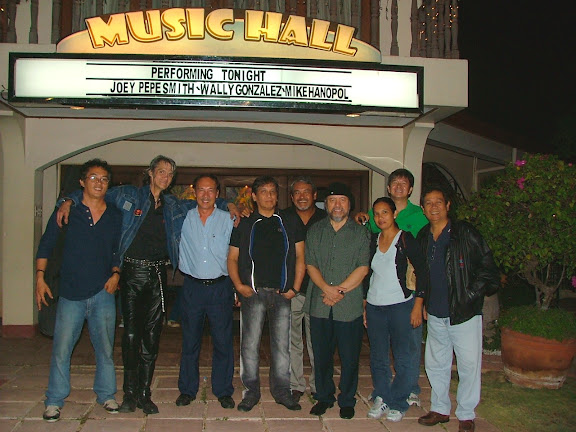 L-R: Bassist, Pepe Smith, Edsel of the Hammond, Wally Gonzales, the Architect, Mike Hanopol, Pamela, Greg and Mike
AN EARLIER REUNION
Galo’s sat right next to Laguna Bay Inn going south, on East Service Road after the Bicutan exit, but nearer actually to Sucat. (The Bay Inn had been many a philanderer’s secret refuge away from the brisk and risky business of the “Flower Motels” of Pasig, but now seems rundown and decrepit.) I used to have some hastily called meetings at Galo’s (not the Inn). It was the perfect place to meet with moonlighting composers of advertising jingles. And here, too, I had a grand reunion of three—Jojo Napay who was on a quick visit from the States, Noel Esquela who seemed to have materialized from nowhere in his singing/composing/marketing/NGO career, and myself, then working in advertising—who last saw each other maybe halfway through college. The place was convenient since Jojo would be coming from her brother Johnny’s place along Sucat Road, and I from nearby Makati South Hills along East Service Road. Noel, who is from Quezon City, agreed to make the longest trip. I suggested the place because I thought it would be the perfect setting for long lost friends who would probably enjoy the music and savor the nostalgia above what seemed like Tower of Power’s “City Lights.”
We were three of about six college buddies back in Divine Word College in Legazpi City, who formed a folk singing group called The Scions (formerly Adam’s Curse, which I culled from a Yeats poem, but the SVD priests disapproved). That was during the ‘golden age’ of folk and folk rock and our tender and callow youth. So we were serious imitators of the likes of Peter, Paul & Mary and Crosby, Stills, Nash & Young (we struggled through and mastered “Suite: Judy Blue Eyes” but were never able to get the correct copy of the Graham Nash’s—or was it Stephen Stills’—Portuguese ad lib). Now, even master guitarist, classic and folk, Lester Demetillo (son of the great poet Ricaredo) who formed the 70s famous folk group Silvergrass, expresses some surprise when I request him or his current group to play/sing something as exotically ancient as “Polly Von.”
CONFLUENCES
That was some six years ago (the reunion). The next time I had the chance to visit 19 East was on the invitation of old friend Mike Molina.
Another flashback. Mike was a later member of The Scions, taking the place of Noel when he left the group to continue his studies in at UP, and this was also the time his (Noel’s) brother Rolando, also from UP, superb on guitar and piano, joined us. We then had a fairly strong folk group together with another Rolando, ‘Boy’, Carranza, who was an original member and an untrained virtuoso on plucked guitar. Later, together with Mike, we were joined by Nats Ravalo, a veteran band member (combo, as we used to call it) of, maybe it was, the Crunchers. Thus there were five of us (Jojo, Lando, Boy, Mike, Nats and myself). Singing at functions, representing the school in competitions, choosing our songs well and simply enjoying ourselves, we were 'famous'.
Everybody seemed to be going in and out of Divine Word College at this time. This was after the two-month suspension of classes after the declaration of Martial Law. Noel was going the opposite way. Everybody I knew seemed to be fresh from a stint with activism, mainly at the national capital. Lando had to come home to Tabaco from the UP hotspot, although he was at the College of Music there; Mike had come from the Ateneo (he kicked himself out, as he says) because the military was hot on his heels; another long-time friend from Daraga Elementary School days was Obet Ador, who had to ‘come home’ likewise, for the same reasons, together with (the late) Diego Oñate, Mike’s classmate and batch-mate from Daraga Elementary to Divine Word high school (Obet went to Albay High). Obet and Diego were alumni of Fort Bonifacio detention center. I too had returned from one semester at University of Nueva Caceres, at the city of my father’s later life (he was born in neighboring Pili), after graduating from Divine Word College high school department, the former Liceo de Albay. With me in this 40-odd boys' class were with the likes of Chito Baldo, Alfrancis Bichara and Gil Amador. And now after maybe a couple of years at nearby Aquinas University, Chito was back with us at the College. Also joining us from Aquinas was (now Bikol poet) Jun (Juan Rafael) Belgica and another poet who stayed the whole time in Divine Word, Raffi Banzuela. Everbody from proximate high-school and college years was coming together at Divine Word. Even guys from Ateneo de Naga, such as Jun Ragragio (who earlier was the visiting Khi Rho representative) and Oscar Sta. Cruz, whom Dennis Lee and I (when we were editors of The Dove high school publication) knew from a press conference with the College Editor’s Guild (then led by Tony Tagamolila) had crossed paths with us at Divine Word. Before everybody came over Toy Llaguno was there and we worked together on the college publication called Outspeak, losing sleep on the first issue as we listened to the then brandnew album Abbey Road. It was a time of convergence and collisions, arrivals and departures. Lives were joining, friendships were being welded.
Back to the present. Mike seems to be always on the prowl for where his favorite bands might be playing some nights or weekends, and he’d trace me anywhere to join him for a night of the kind of live music that we liked. The place was now called 19 East after it closed, it was said, after a tax dispute with the local government. (Businesses, like people, are born, live, and die with or because of taxes.) Mike wanted me to join him to watch a hybdrid jazz and rock band, but mainly to enjoy the featured soloist, formerly of another band, who not only was a good singer but a looker as well. Pamela and I were coming from a get-together at Dan Pinto’s place in San Pedro, where we were joined by Jun Balde. So it was no problem dropping by at 19 East on the way home, from the highway via Sucat exit.
MIKE'S NIGHT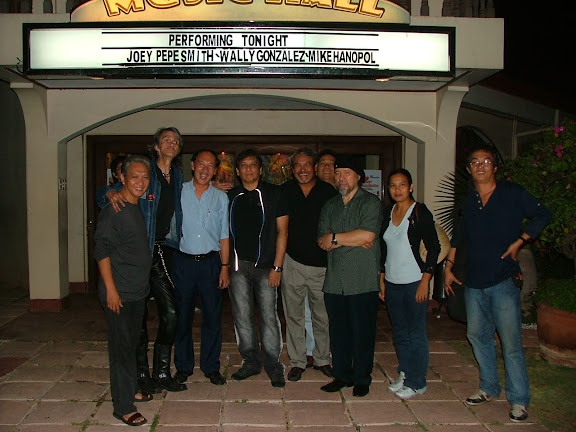 That's me, Pepe's 'close friend' (Photo by Greg)
Now it is this 19 East night once again. Mike had mentioned the Juan de la Cruz (the band) reunion gig some two nights before—it was of course right down from where I lived. It also happens that Mike had requested some help to write an important letter. So he drops by at the house at about 6pm that Saturday, we discuss some refinements to the letter while watching a Pat Metheny video, and then listened to a group called Noon Jazz as we had dinner. Then he, Pamela and I are off to 19 East, formerly Galo’s. It is during this drive (Mike had let his driver go ahead to the place to make sure everybody was there, so he was riding with Pamela and me) that Pamela remarks why it was called 19 East. It was sitting right where they stuck kilometer post number 19—19 km. on East Service Road—or 19 kilometers from 0 point in the Philippines, the Rizal monument at the Luneta. At which I remember Jun Balde, the writer who’s also a veteran engineer, remarking that you don’t get lost anywhere in the Philippines if you just keep in mind that if the kilometer markers are on your left, you are moving away from Manila (or Kilometer Zero at the Rizal Monument), or if they are on your right you are moving towards. So we were off to just 19 kilometers east from the statue of the greatest Filipino.
Mike tells me two of his friends, an engineer and an architect (Mike is in construction), would be joining us. And, one of them Edsel, turns out to be what his friends term a “showbiz” guy—meaning he had been playing (keyboards) with bands in his youth, before he became an engineer—and he was friends with Juan de la Cruz. During their gigs at Eduardo’s or some other famous watering hole on Roxas (Dewey at that time) Boulevard, Edsel is remembered by everybody as the first guy with the latest Hammond organ, which they all marveled at. Edsel had belonged to the same generation of musicians who were pioneer OFWs, out on a limb on stints of contract band-playing in Japan in the 70s. He knows whereof he speaks when he reminisces that Juan de Cruz had started as the Downbeats and they were really cool, but even then Pepe Smith, Wally Gonzales and Mike Hanopol were shining on their own, so that when they eventually broke up and joined or formed other bands, each of these bands would actually stand out, play better because of their presence, their contagious talent. “Anyone or any band that has a member from the former Juan de la Cruz would actually become better,” Edsel says.
THE BAND
An Eric Clapton video (probably obtained from the Quiapo digital piracy row) is their front act. The size of the screen (and the audio system set up for live performance) makes a DVD concert video, perhaps pirated, a totally different experience. But the audience is clearly waiting for Juan de la Cruz. First to come on is Wally Ganzales with his new (to me) band of relatively younger musicians. Cool as Clapton, so sure of himself, and really good. For me, who was never a rock music expert and never been a rocker (with a son that’s growing up to be one, after a little classical training), Wally is the quintessential solo rock guitarist, artist. I am not familiar with their numbers—early or late apocalyptic ‘hard’ rock electronica, but their soloist, screaming but hitting his high notes and jumping all over the place, deserves an A for effort. All heads turn as Pepe Smith is called up the stage. He is nowhere, but is soon up there with, we are later told, his trademark stage antics. He makes fun of his drug experience, asking who’s into all these sorts of uppers or downers anyway, not him. The way I remember him, in his lanky form, he’s still in his black leather jeans, boots, denim jacket, but the red bandana hanging from his nape gives him a sort of rock star look which he is anyway. He goes into what I recognize is a melodic variation to his seminal “Ang Himig Natin,” whose title I miss, then actually segues into the song (despite its redundant lines that go “Ako’y nag-iisa, at walang kasama”) that made Juan de la Cruz worthy of its name, the rock band that for most of us of the late seventies, was one of those who first created and played rock music that was aware of its Filipino self.
Program break. Mike Hanopol comes up by his lonesome, or with two side players of his own. He sings his own popular compositions and solo numbers in his still solid and powerful voice, and for a while most wonder if he would be joining up at all with the first two. But he does, because as Edsel reports after sitting at Pepe’s table outside, Pepe was just waiting to be called in. And then all three—Wally, Pepe and Mike—are onstage, high-fiving, tuning, and making adjustments to their instruments. “Ang Himig Natin” is finally sung after other rousing numbers. And the night is complete. The audience is a motley group of generations, including children and a couple of male foreigners who must be Pepe’s friends and familiar with Pinoy rock. Appreciative audience, but never expressive, for no-one ever got up to dance or rock with the group.
It is almost three o’clock a.m. At the end of the concert we go out for coffee in the garden overlooking the flickering lights of the Laguna de Bay shoreline. We all become fans as we go and strike up small talk with the stars. Edsel introduces us and Pepe Smith announces to everybody that this guy Edsel here was the first ever to have the latest Hammond among the bands that inhabit our early but living memories of Pinoy rock music.
I drive home with Pamela a little tired but refreshed in memory, thankful for old friends like Mike and new ones like Edsel, wondering where this listless, insistent memory comes from, to which we return constantly (or stumble upon it 19 kilometers east of our beginnings), where the past and the present cross paths, this looped and endless soundtrack that accompanies us wherever we go, which we hum on an odd morning or before going to sleep, that cheers us along and enables us to go on with our lives.


0 Comments:
Post a Comment