Monday, February 19, 2007
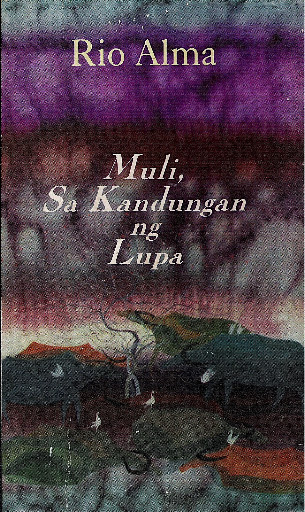 Original book cover (out of print); bilingual edition being prepared by Anvil
From my Introduction to Heartland (English title of Rio Alma’s Muli sa Kandungan ng Lupa)
The one peculiarity of contemporary poetry is its extreme self-awareness, its constant grappling with its own “relevance,” in a world that casually ignores it. And Rio Alma is the “thoroughly modern” poet who is a creature of both the past and the present—he “suffers” from the modern burden of a reflexive consciousness only too aware of its location at the end of a culture’s body of knowledge, and with that knowledge demanding to be distilled. It is this burden that informs his respect for traditional Tagalog forms and themes, those of the West as well as those coming from the world at large, and provides him the points of departure for deeper reflection.
The reader (and translator) to be equally “modern,” must share this burden, for him to reflect, for his own inner health, on his own location in history. This burden elicits another characteristic of modern literature and art—its own laughter at itself. This, of course, is really nothing new but a continuing thread in the human creative act as part of looking back at himself. Comedy and satire are as old as literature itself, e.g., from Aristophanes to Rabelais to Marcelo H. del Pilar, but in relatively newer times such a laughter had degenerated into a scream, a raging, or a pained moan from the overwhelming incomprehensibility of existence, of the extremes on hope and despair and the individual’s (or the masses’) apparent irrelevance in the heedless march of history. Today’s rather more healthy laughter is perhaps the sign of a world wisdom that is either maturing or growing more cynical, which nevertheless makes poetry capable of laughing at itself instead of committing suicide, as the nihilists and Dadaists were wont to do.
This laughter partly springs from the inward-looking notion that poetry and literature is firstly a game of language—the strange mix of gravity and light, as in “let’s pretend” and “what if”—in the deciphering and knowing of life itself. Knowledge is a code, a series of signs, an instructional game where the rules are both simple and vague, to be learned and discovered only during the playing itself. And poetry’s function, if any, is known lastly by its effect, its epiphany or irony, which is so dependent on its medium and intermediation of words, which in turn are signs and constructs, conventions and accidents of culture and society. Amid all this is the poet as master gamer, in whom if the interested reader will look closely enough, will find something of himself. A felicitous discovery for the serious reader is that poetry not just imitates life but intimates it, makes it sharper in our apprehension. And in the hands of a poet like Rio Alma, that it is capable of acting like life itself—touching, provoking, enlightening us, wounding our consciousness short of death, by making us laugh and think (instead of killing ourselves).
The other difficulty of translating poetry stems from the language of poetry itself. In the costume play that is literature, poetry is the most disguised. It is the one that takes most pleasure in its guises, but each item and trinket of its dress is in fact a hint of what it conceals. Thus, translating the ‘costume’ of poetry would be the unraveling of the original dress, but only to re-tailor it as if it were sewn in the shape and manner—of disguise and concealment—of the translating language. If the translation gets anywhere near that manner of dress (and wear it with any amount of ease or grace), then the translator, and that reader situated in another culture, another world, familiar with another manner of dress, might be justly rewarded.
• • •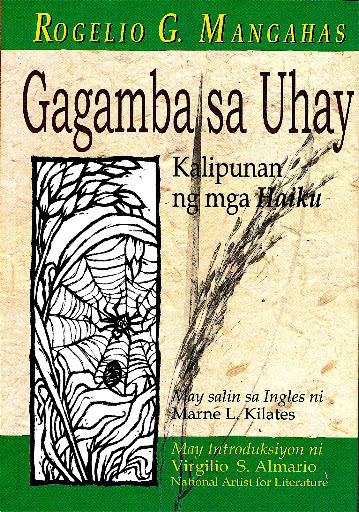 From my Introduction to Rogelio G. Mangahas’ Gagamba sa Uhay (Spider on a Stalk), a collection of Haiku
So much has been made of the loss in translation, especially of poetry. Allow me, Reader, to digress a bit into the technical. In English, for instance, the first thing a haiku loses is a few syllables. This is a function of both language and writing. The shift from Japanese to English (or to most other Western languages) is firstly from ideographic to phonetic writing (from symbols for ideas to symbols for sounds). Almost like from pictures to sounds. Ideographs, or ‘characters’ as we call them, correspond to definite syllables with definite meanings or images. Haiku, for example, stands for hai (meaning ‘unusual’ or ‘special’) and ku (‘lines’ or ‘stanza’), and the word needs only two characters. On the other hand, phonetic writing requires a number of symbols (letters) to form one syllable of a word. Thus, in the English translation of a Japanese haiku, the number of syllables is less crucial as the import—in both senses of the word—the meaning and the trading of meaning.
A different story happens when only the form of haiku is imported into a foreign language. Then the poet in English or Filipino can count his syllables. Even then, the original Tagalog haiku must struggle with its own polysyllabic nature in assuming the shape of the monosyllabic, ideographic Japanese vessel. Its English translation, in turn, must inevitably lose its syllables. But it (the translation as well as the language) has gained a new set of meanings, ideas and images from such a strange world as spoken in Tagalog.
This is so because translation (to ‘trans-relate’, or tell across) involves not only words, but languages and cultures, different ways of looking at, uttering and writing the world. It is the transposition and relocation of diction, idiom, texture and experience into a different set of teeth, so to speak. It demands the reinvention of native speech in an alien set of habits of the tongue that comes from a different set of habits of mind and heart. Nationalities and nationalism spring from far deeper roots than politics and economics. Translation, when it works, is all about gaining, not loss.
(Examples of my translations, and their originals, in the next post)


0 Comments:
Post a Comment