Thursday, September 20, 2007
Samples from Gagamba sa Uhay/Spider on a Stalk & Translator’s Note
0 comments Posted by Marne L. Kilates at 2:49 AM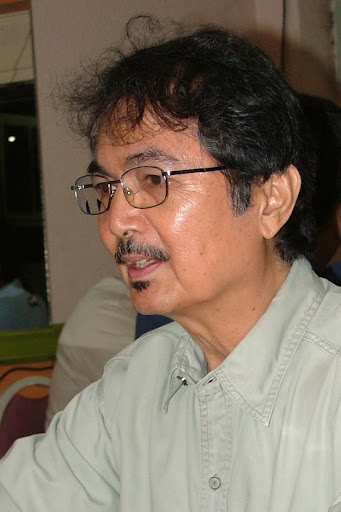

Maybe everyone, who has any bit of appreciation for words, gets to be smitten by the brevity of a haiku. Every would-poet would have tried writing haiku, if not hiding somewhere in a box of juvenilia, a sheaf of haiku. But few persist doing it up to their adult years, especially if they had come into the more attractive complexities of modern poetry for which the equally complex modern experience (sometimes) cannot be embraced with three lines of five, seven, and five syllables. One exception is my literary “senior,” Koyang Rogelio (Roger) G. Mangahas, a passionate haiku writer whose self-same same passion drives his other modern, lyrical, socially-engaged poetry. Thus, Gagamba sa Uhay (Spider on a Stalk in translation), is not a collection of juvenilia hidden in a box, but a winner of the National Book Award 2007 for best book of poetry, and the same award for best book of translation. In fact it is a bilingual book, with me as translator, the story of which I wrote a bit about in the last posting. I share not a small honor in the award, so let me share with you the translator’s introduction I wrote for the book, and some samples of the haiku, for your appreciation. (In a previous posting long ago I excerpted this introduction, but here it is now in full.)
The World from the Level of Grass & Rice Stalk
Between us, Native Reader, I would rather enjoy first the original Tagalog text. Why would you need a translation?
But if you are a foreigner or a native pretending not to know or refusing to know the national language, here is Rogelio Mangahas in two tongues. Koyang Roger (elder brother, Sir—a reverential term of address) to us younger writers. The same one who, together with Rio Alma and Lamberto Antonio in the late 60s, moved Tagalog poetry not only into the open air of modernism, but into its rigors and complexities as well.
Here he is, after a relatively long absence, presenting us with more than two hundred pieces in the most traditional haiku, from his apparently ‘secret’ life. After all, he had been known more for his eloquent experiments (though again with traditional Filipino forms made to bear the burdens of the social realist mode), during the turbulent 60s, when Filipino literary consciousness was coming to grips with the realities of the period, and the world at large.
No, do not look askance or let down, asking why a major voice in contemporary Filipino literature would ‘bother’ with this briefest of forms.
Why not? The haiku is not an easy form. Its length deceives and disguises, though it may appeal to the impatient contemporary reader who is more comfortable with the sound bite, the datum, the fragment. But its ascetic length demands contemplation, it is the kind of poetry that stands next or aspires to the ineffability of the world. Or nature. Or society.
Tradition distinguishes between the haiku and the senryu, the one always alluding to the seasons and nature, the other more to human foibles, though with the same syllabic count and structure. Both are here represented with blurred borders (as they have always been), and both are constantly, eternally ‘coming to grips’ with the dumbfounding complexities and inconstancies of nature and people.
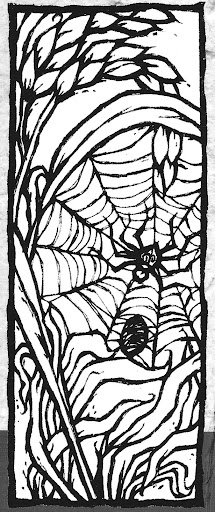 Inconstancy and complexity are two of the themes of Gagamba sa Uhay (Spider on a Stalk), as much as loss and holding on to what remains simple—as deceptively simple perhaps as three lines of five, seven and five syllables. It is poetic language closest to experience, and in the sense of all poetry, of the words themselves wanting to be the experience. As when the farmer debates whether to reap his ripened grains while a spider (guardian against pest) clings to the tremulous stalk:
Lingkaw ko’y pigíl:
may gagamba sa uhay,
bilot ang balang.
(I hold back my sickle:
spider on stalk has locust
wrapped in its web.)
… thus meditating (in three ephemeral, or eternal, lines) on power, debt of gratitude, and the precariousness of existence.
 The poet of Duguang Plakard (Bloodied Signs) is very much present among these pages, no matter the tastes or temperaments of current readers, or what they expect. Not toned down but certainly more severe in his grasp of pain or joy (like any other poet) but, like no other, pruning meticulously his naturally luxuriant language, or cutting with merciless precision into translucent gems the stones of his experience.
He marvels at the beginning of a life:
Uha mo't hugong
ng sigwa'y nagkasalpok.
Yakap ka namin.
(Your birthcry
and the stormhowl clashed.
We held you tight.)
or grieves over untimely death:
Mike, sa kabaong
mo, hulog ko’y anthurium—
sugatang kabog.
(Mike, into your coffin
I cast an anthurium—
my wound echoes.)
or recalls with slightest irony an unpleasant experience:
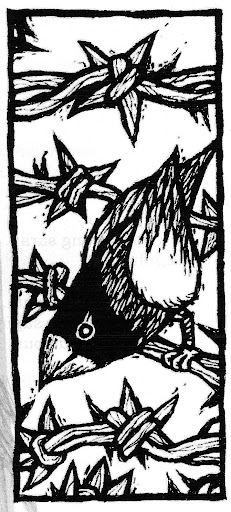
Maya sa barbed wire,
katitigan ang kosang
hubad sa araw.
(Ricebird on barbed wire,
cellmate sunning naked,
catch each other’s stare.)
And here lies the crux of both the polysyllabic Tagalog language, and the translation: how to stay within the constraints of Basho’s pond, frog jumping and sound of water. Would the translator, like Ezra Pound, say kerplash instead of ‘sound of water’? (He was joking of course.) Or would he opt to approximate the serenity of the old pond and the frog almost not disturbing it as it leaps and making only the merest flop because that is the spirit of Basho’s writing?
So much has been made of the loss in translation, especially of poetry. Allow me, Reader, to digress a bit into the technical. In English, for instance, the first thing a haiku loses is a few syllables. This is a function of both language and writing. The shift from Japanese to English (or to most other Western languages) is firstly from ideographic to phonetic writing (from symbols for ideas to symbols for sounds). Almost like from pictures to sounds. Ideographs, or ‘characters’ as we call them, correspond to definite syllables with definite meanings or images. Haiku, for example, stands for hai (meaning ‘unusual’ or ‘special’) and ku (‘lines’ or ‘stanza’), and the word needs only two characters. On the other hand, phonetic writing requires a number of symbols (letters) to form one syllable of a word. Thus, in the English translation of a Japanese haiku, the number of syllables is less crucial as the import—in both senses of the word—the meaning and the trading of meaning.
A different story happens when only the form of haiku is imported into a foreign language. Then the poet in English or Filipino can count his syllables. Even then, the original Tagalog haiku must struggle with its own polysyllabic nature in assuming the shape of the monosyllabic, ideographic Japanese vessel. Its English translation, in turn, must inevitably lose its syllables. But it (the translation as well as the language) has gained a new set of meanings, ideas and images from such a strange world as spoken in Tagalog.
This is so because translation (to ‘trans-relate’, or tell across) involves not only words, but languages and cultures, different ways of looking at, uttering and writing the world. It is the transposition and relocation of diction, idiom, texture and experience into a different set of teeth, so to speak. It demands the reinvention of native speech in an alien set of habits of the tongue that comes from a different set of habits of mind and heart. Nationalities and nationalism spring from far deeper roots than politics and economics. Translation, when it works, is all about gaining, not loss.
And this gain is made even more distinct with the presence of the poet. Authorial presence is a luxury seldom available to the reader or translator. It is not supposed to premise the reading of poems, since the reader might be in another time or another world. But it was a luxury granted. It meant being able to know authorial intent (as we must in translation, in haiku), and to correct gender references because Tagalog pronouns are genderless. It is most helpful in choosing and refining diction because there is little room for play in three lines and seventeen syllables. It meant a direct exchange between author and translator, practically relieving me of the risks of misjudging the tone, weight or magnitude of words said in another language (even if it was also my own).
In a few instances I was even present in the poem, or at least in its conception. In one exchange of notes, the poet reminded me of a full moon he glimpsed behind a curtain of light rain as we rode in a van towards Rio Alma’s old house in San Miguel, Bulacan. We were entering the town after a visit with Koyang Bert Antonio, who was recuperating from an ailment in his hometown of Cabiao in Nueva Ecija. It reminded me of the memory, helped me recreate it in the memory of another language. Off and on, for over a year, over the Internet, by cell phone text, the exchange took place, in between the hours of our day jobs. Our periodic assignations over coffee and beer were high points.
It was this exchange—negotiations as it were—that for me made the process even more meaningful. On one side was the author, native and up close, looking at the world from the level of grass and rice stalk, possible perhaps only in haikus: minimalist, mesmerizing, and with a lot of Zen. On the other was the translator, no native of the translating language but pretending to know its habits—with a lot of karma. I was shuttling between cultures (and incarnations) and feared ending up a native of neither, if I hadn’t already.
Charge that, Reader, to the experience of many of us who persist in writing (and reading) in English. But include, too, the hope that the foreign or unfamiliar tongue might have a taste of the finest in our native speech.
Marne L. Kilates
July 24, 2006
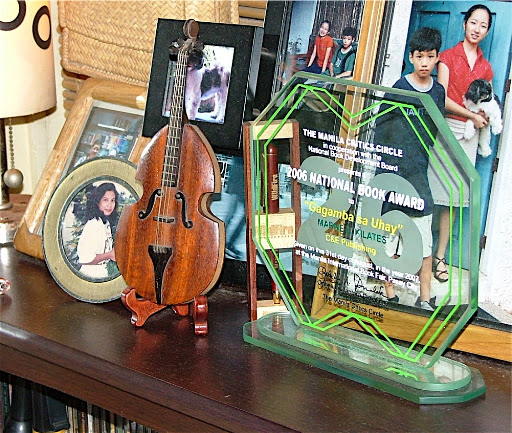
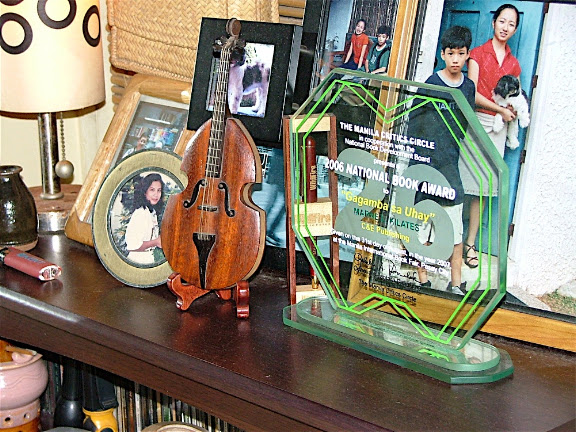
PHOTOS: Koyang Roger on his birthday a few months ago; the translator; illustrations from the book by Albert Gamos; National Book Award glass trophy similar to Koyang Roger's among my memorabilia.
Wednesday, September 19, 2007
Two Critics' Awards for R.G. Mangahas' Book (and Mine)
3 comments Posted by Marne L. Kilates at 4:56 PM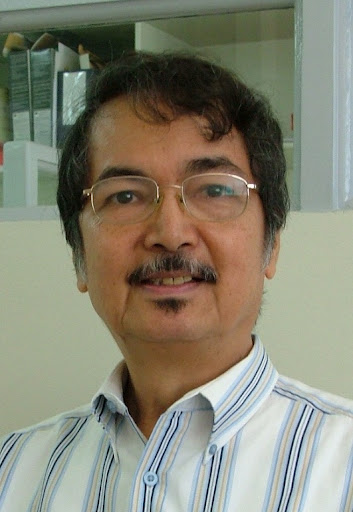
1) “Debonair” at the Palanca Awards
The main story (of the title) happens just before just about everybody who can say “Philippine Star” and “Krip Yuson” started calling me “debonair” of late. “Just about” meaning everyone in the Internet—at least the Banggaan fellows (who went “whoa” about it)—or have access to email, since the newspaper column where the adjective was used before my name is usually reproduced or forwarded in that other e-group I am a member of, the lively Plarider Papers, founded and usually moderated or refereed by Pete Lacaba. Or, it went the rounds in the more brazen eyeballing in writer’s birthdays (e.g., Jun Balde’s last August 11th), and the usual after-class retreat to Sarah’s or Conspiracy or Newsdesk—in the case of UP teacher-writers). Poet-friend Teo Antonio, who will never miss things like this, takes me aside at the Conspiracy smoking section during that birthday party and conspiratorially mutters, “Debonair ka na pala ngayon!” And gives his classic guffaw, “Mwahahahaha!” And I, who was secretly relishing the appellation, am justly mortified. Of course, as in cell phone texting convention, “debonair” would be followed by “hehe,” as perhaps Krip chuckled to himself as he appended the modifier when he was narrating the Palanca judging process in his Philippine Star column “Kripotkin.” (No strict judging procedure, really. No two judging panels of three are alike, just as no judge is like any other judge. Writers’ eccentricity privilege, I presume.) Being chairman of the panel, like winning a Palanca prize, is mainly a consensus thing. Krip and the venerable (aha!) Jimmy Abad, fellow judges this year, have been chairmen themselves in other contest years. It was more or less my turn, and Krip couldn’t let the chance pass to be an imp and rib a red-faced friend (in a national daily column).
2) A Week (More or Less) of Literary Awards
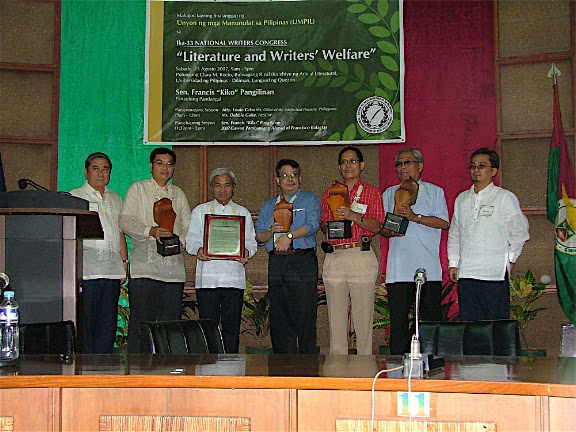
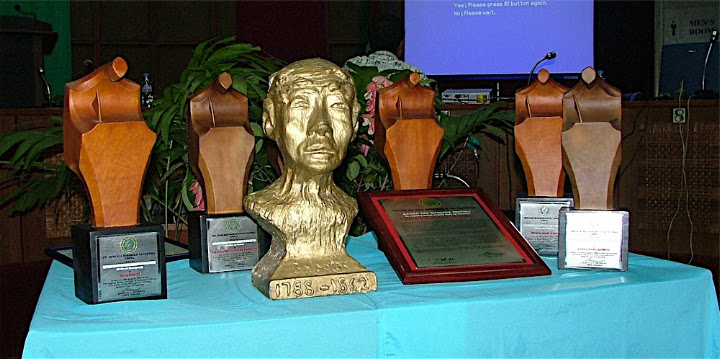
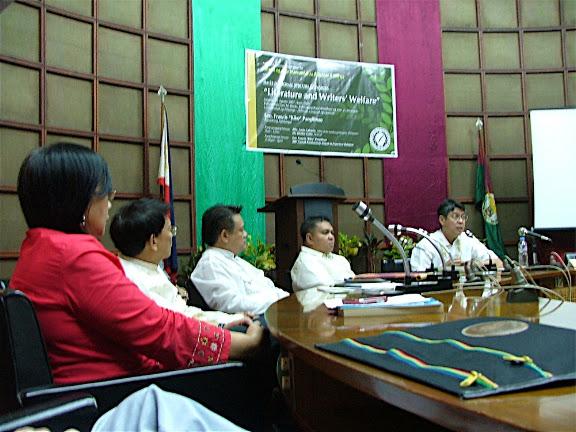
The awards week or weeks in the Philippine literary scene come just before the end of August and in the first week of September. The Union ng mga Manunulat sa Pilipinas (Umpil) holds its yearly congress on the last Saturday of August, as one of the culminating activities of the National Language Month (Buwan ng Wika), usually observed in elementary schools by letting the children wear the national costumes—patadyong, mestiza dress or Maria Clara dress for girls, the barong tagalog for boys—and skits or pageants with the token recitation of Tagalog poems or an excerpt from Francisco Balagtas’ Floranted at Laura. The National Writers Union (the English name of Umpil) gives out, after the Congress, the Gawad (Award) Pambasang Alagad ni Balagtas (a sort of Knight of Balagtas), for life achievement in various genres and languages. This year the winners were Joey Munsayac for the Novel in Filipino, Joaquin Sy for the Essay and Translation (Chinese into Filipino), Prescillano Nisperos Bermudez for Fiction in Ilocano, and Charlson Ong for the Novel in English. Umpil also recognizes teachers with the Gawad Paz Marquez Benitez for Outstanding Educator in Literature. This year the award was given to Fr. Roque S. Ferriols, S.J., mainly for pioneering in the teaching of Philosophy in Filipino.
 The yearly Don Carlos Palanca Memorial Awards for Literature is held on the first day of September, usually at the Manila Peninsula Hotel, and it is also more or less a party for writers. The judging period is usually three months before (June to August, after an entries submission deadline sometime at the end of April). Everyone who is a name in the local literary scene is either a contestant or a judge, a several-time or first-time winner, or first-time joiner, in any of the categories or divisions (Filipino and English, some regional languages, play, essay, short story or poetry, the novel every two years, or the special category of the youth essay). For the complete list of winners, read Alfred “Krip” Yuson’s series of columns on the awards, or go the Palanca Awards website, http://www.geocities.com/palanca_awards/.
3) “Double Happiness” at the National Book Awards
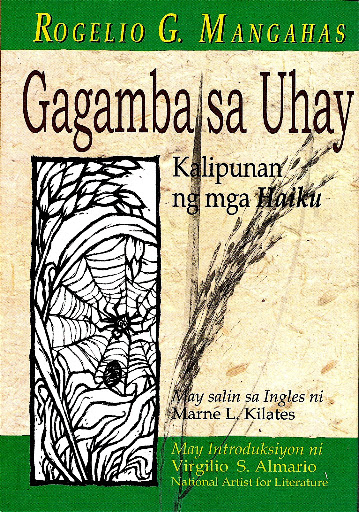
Now to Koyang Rogelio (Roger) G. Mangahas’ book. I am part-owner, as its translator into English. Gagamba sa Uhay (Spider on a Stalk): Kalipunan ng mga Haiku is quite unique in several ways. First, it is a coming out of sorts from a long period of hibernation of R.G. Mangahas, poet of the turbulent period in contemporary Philippine history, culminating with the so-called First Quarter Storm and the declaration of Martial Law. Second, what a distance, it seems, from poet of street protests to the poet serenely contemplating nature , counting syllables in the foreign form of the haiku.
But, as I remember from one of his earlier poems, “ako’y hindi nangangamba sa kagandahan,” he has never, in fact, been afraid of beauty. Thus, I wrote in the translator’s introduction: “The poet of Duguang Plakard (Bloodied Signs) is very much present among these pages… Not toned down but certainly more severe in his grasp of pain or joy (like any other poet) but, like no other, pruning meticulously his naturally luxuriant language, or cutting with merciless precision into translucent gems the stones of his experience.”
Lastly, the book is a real and intertextual exchange between two poets and, yes, between two languages, by email as well as over coffee or beer over a period of roughly one year—creating the haikus, translating, revising and translating and revising the translation… So that when the Manila Critics Circle gave it two National Book Awards, for best poetry book of the year and for best translation of the year, it was for Roger and me, as the Chinese would say, a double happiness.
 “Minimalist and mesmerizing indeed,” Alfred A. Yuson wrought in his blurb, this time as a critic and not as an imp, “is this bilingual collection of over 270 haiku in Filipino by Rogelio G. Mangahas with translations into English by Marne L. Kilates. That a superb Tagalog poet would appropriate a foreign form and make much of it with requisite brevity—the have his jewels re-rendered in another foreign language—is itself a marvel of transposition and juxtaposition. That the translation bespeaks, as it were, belief rather than betrayal makes this tripartite coalition a triumph of poetic globalization.”
Publishers nominate, as well as the individual members of the Circle, who mark the significant new local titles of the year ranging from biographies, scientific and technical books to art and literary books, and the nominees are invited to the Awards night not knowing if they had won or not, unless there is a leak caught by the grapevine. Koyang Roger was never sure he had won, but I texted him that we have been asked to be present at the Awards night and I sounded I as if I had advanced news, and Koyang and lovely wife, writer Fe Mangahas, were endlessly wondering why the citiation should go to translation and not, it seemed, to the original book.
National Artist Virgilio S. Almario, founding member of the Manila Critics Circle, penned the citations for the awards for the literary book entries, and especially, for the National Book Awards for best poetry book of the year, and for best translated book of the year:
"Best Book of Poetry
"Gagamba sa Uhay, Rogelio G. Mangahas (Lungsod Quezon: C & E Publishing, Inc., 2006).
"Ang Gagamba sa Uhay ay isang katangi-tanging koleksiyon ng tula. Ipinakita dito ni Rogelio G. Mangahas ang kaniyang pambihirang talino upang disiplinahin ang wikang Filipino at ihulma sa isang napakaestriktong anyo—ang haiku ng mga Hapones. Hindi lamang nagtagumpay si Mangahas sa naturang layunin. Naisaloob niya ang isang banyagang anyo upang maging tanghalan ng kaisipan, damdamin, at karanasang Filipino."
and
"Best Book of Translation
"Spider on a Stalk, a translation of Gagamba sa Uhay by Rogelio G. Mangahas, translated by Marne L. Kilates (Lungsod Quezon: C & E Publishing, Inc, 2006).
"Marne L. Kilates is now gaining a unique reputation in Philippine literature. Aside from being a major poet himself in English, he is now the most sought after literary translator from Filipino to English. His delicate translation of Gagamba sa Uhay attests to his efficient and effective maneuvers to transform the haikus in Filipino of Rogelio G. Mangahas into new though similar haikus for readers in English."
Double Happiness!
(A sampler of the haikus and the translator’s introduction will be in the next posting.)
PHOTOS: The real debonair, poet Rogelio G. Mangahas; Gagamba sa Uhay / Spider on a Stalk book cover. Pambansang Alagad ni Balagtas awardees (from 2nd from left): Joaquin Sy, Ateneo Dean Leo Garcia (on behalf of Fr. Roque Ferriols), Charlson Ong, Jose R. Munsayac, and Prescillano N. Bermudez; flanking them are Umpil Chairman Emeritus and Nationa Artist for Literature Virgilio S. Almario (leftmost) and Umpil Chairman Roberto Anonuevo (rightmost). The Gawad trophies by Manny Baldemor, with Balagtas bust by Raul Funilas. Open Forum at Umpil Congress with Senator Kiko Pangilinan as Keynote Speaker (right), from left are Anvil Publisher Karina Bolasco, UP Prof. Mario Miclat, UP Institute of Creative Writing director Jose Carmelo Vim Nadera, and Ateneo Prof. Michael Coroza; and Pareng Heber Bartolome emoting with his song "Edukasyon" (sorry for the shaky camera). Glass trophy similar to R.G. Mangahas' on display at my memorabilia shelf.
Friday, August 24, 2007
Poems of Travel & the Poetry of Place in Rio Alma: A Translator’s Introduction
0 comments Posted by Marne L. Kilates at 6:40 PM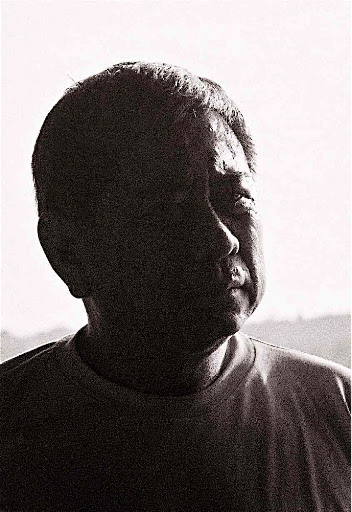
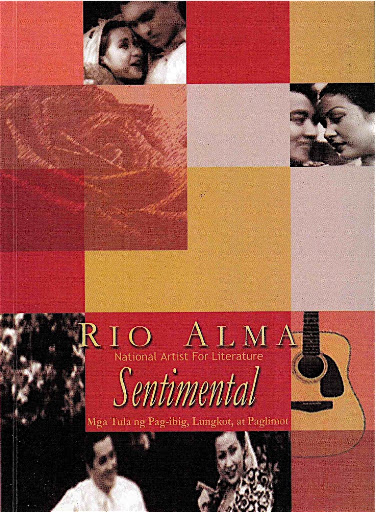
(My translation work sometimes overtakes my original work, but that’s okay. They nourish each other ultimately. Coming out soon from Anvil is the bilingual “Journeys, Junctures / Mga Biyahe, Mga Estasyon,” a collection of poems of travel from the last ten poetry books of National Artist Virgilio S. Almario, or Rio Alma in his poetry byline. The introduction led me to a newer summarization of my thoughts on translation, especially of poetry, and, for the interested reader, gives examples of Almario’s travel poetry in English. Here it is in whole.)
Translating the Lessons of the Sole
by Marne L. KilatesTravel, it has been said, educates us like no other. And nowhere is it a more effective educator than in poets. For poets, no matter how far into the world they venture, are forever looking inside—themselves and their surroundings. Whether travel is for work or leisure or survival, the strange places poets visit are always becoming intimate, because the act of poetry cannot stand strangeness.
The act of poetry is an act of knowing, often in a manner where the least words contain the most sense, and out of a few lines arise the magnitude of meaning—of a thing, a person, a place. And travel stretches taut the act of knowing because it is an act of movement, while poetry, in the words of Wordsworth, “slows us down.” And while travel wrests us away from the familiar, the poet is, in a manner of saying, continually trying to make himself feel at home.
Even while wearing his many hats as educator, activist, editor, journalist, university professor and cultural administrator, National Artist for Literature Rio Alma (Virgilio S. Almario in his role as critic and literary historian) has always been a poet and a traveler. The poems in this collection, the [fourth?] in Anvil’s series of Rio Alma poetry compiled by subject, are culled from his last ten poetry books that individually and invariably includes a poem or a group of poems on places where the poet has traveled.
Among these poems, too, might be felt most the characteristic tension between home and destination, the past and the present, and the febrile twilight zone in-between where the poet-traveler finds himself, whether it is in Vigan or Davao, Sta. Fe or at the foot of Mayon, or away from home shores in Sofia, Tbilisi, or Stonehenge.
And because Rio Alma is Rio Alma, the persona in these poems of wandering, sometimes of displacement and alienation, is always Filipino. It is this Filipino-ness, which governs all his poetry and resides naturally in the original, that the translator must, with any merit at all, transpose, “trans-relate” into this sometimes cumbersome, sometimes wanting, second language of ours.
Maybe it is the words themselves, often in their ruminative voice, especially on the Philippine places, that lend themselves well to another language. One will notice the length of many of the “local” poems. It is the voice of the advocate of the Filipino language speaking there. It is the intense voice of the student of Philippine history and society examining and reliving the Filipino experience. And it is, too, the voice of the philosopher meditating, amplifying an idea without the tight rein of form.
Finding himself in a remote village or a big regional city in the Philippine south, where war and poverty are parts of the landscape, the poet-traveler is a stranger in his own country. Tentatively he explores the landscape from his boarding house window: it is a market street of a garrisoned city where no smile “could be spread open like a palm branch… to drive away the stench of gunpowder” and “Nightfall comes early and the silence is / Deafening for the uninvited guest.”
On visiting Dapitan, “once the stop of stormy journeys,” the poet-traveler tries to recall the agony of the one who, more than a century before, in a nearby locale but under different circumstances at the birthing of our nation, sought a retiro. This was Talisay, where
The sighing of the surf seduced him to dreams of greenness,
To be safe and apart from his own published belief…
and its stolen, fleeting beauty gave rise to the heaviest guilt:
It became a sweet and fugitive love nest
While the social cancer spread
And he who diagnosed it had no cure to give…
Let us swing up the Philippine north in this most absorbing guided tour.I will confess to two old favorite poems when I first began translating Rio Alma (which should be more than a decade ago). “Vigan” and “Sta. Fe,” appear in this book together and in sequence. The opening lines of each for me crystallize his poetics that always begins with his being Filipino but which, I think, are some of his poems that perhaps will read the same way in any language.
Travel is like memory, like this journey
Of the eyes among old adobe, tile roof, narra
Spared by storm, temblor, fire, and war.
Every corner is archive, every stone a page of history.
(“Vigan”)
The pure, the fresh, the green you seek;
The precipice, the precipitous sense you expect.
Etched in every nook and cranny of the scene
Are the scar and shadow of some intense suffering…
(“Sta. Fe”)
We leave the “local” poems on this note—how the poet can awake for us emotions and memories that otherwise we cannot or would not speak about, like Theseus looking for his thread after “crossing the line” with nothing to declare for the local customs.
In the “foreign” poems, the voice becomes more satirical, self-deprecating, ironic. The poet-traveler retraces and reflects not with little irony on his own influences (as he does on borrowed memory in the Paris art district of Montmarte), his continuing journey as poet and artist in the changing world of the 21st century.
Still it is the same Filipino who wanders the globe in this age where everything seems to be happening all at the same time across the planet, and finds himself in a New York winter where everything “seems tall… and heavy.” He compliments the prompt arrival of the bus, looks over a passenger’s newspaper where he reads the headlines on “trouble in Iran.” The question he longs to ask another passenger is something out of Dante, “From what circle are you?”
In Asia’s two “sin cities” the poet-traveler takes up once more (or encounters) the theme of Hell. In the case of Singapore, hell is as much the loss of sex and as the loss of history. “Prosperity has no country,” and in that non-country everything and everyone is reduced to a number, and even death is “sentimental contraband.” Thailand’s Patpong is the more obvious hell, and there it is history—the noble memory of Siam and Ayuthhaya—buried in sex, whose viscid grime even the great Chao Phraya cannot wash away.
Art is its own hell, though perhaps a bit rarified, in the poet’s pilgrimage to Montmarte. He is unable to reclaim his own esthetic memory of it because his “…veneration is interrupted / By the flash of cameras / And the raucous commerce of colors.” Rain threatens:
When I sought shelter
I glimpsed an invitation
From a bit of bosom
Peeking from between the lapels
Of a slightly open overcoat.
(“Reclaiming Montmarte”)
Stranded in Vienna, the poet-traveler perhaps experiences his own hell. Like most Filipinos, he cannot help comparing things back home with those before him where “Everything moves to a single beat / In spite of the political / Debate on TV.” He listens to Mozart or Shoenberg “choked with envy: / Philosophic, Asiatic…”
Perhaps China is a better, more sympathetic memory, for even the language emulates the imagistic manner of Chinese poetry:
All day it was raining.
On the way back from Tian Gong,
I gazed back
At the fading moon
Behind a branch of lu-tong.
(“Last Night in Nanjing”)
A kind of liberation and redemption is contemplated in the long poem on Stonehenge. Cinematic and modern, “Stonehenge” is like an intervalometer or time-lapse sequence in a movie that meditates on history through a montage of dream images. Here perhaps does the poet-traveler conquer strangeness with words that address this strange and foreign monument with an intimacy that is only possible in poetry. What if poetry, like the building of monuments, is also the building of dreams, as when the poet-king of these ancient peoples that built Stonehenge suddenly awoke and spoke “I dreamed I was making a mountain.”
And in the middle of a war the poet-king conferred with the enemy “…in the noblest words and metaphors told them // His dream.”
The angels must have come to his help
For everyone agreed to stop the fighting and the killing…
And in the end, in the building of the dream, everyone forgot the remote cause of the endless killing, and
… pasture and field
Thrived and flourished, and in ten centuries
They were able to raise a Monument of Peace. Travel, in foreign lands as much as within the home of our race or family, in poetry and into ourselves, is indeed a great educator. If we have time for poetry, if we bother about what it tries to tell us in words that demand not little of our attention, we can travel in place, we can stay even while in motion. Then the poetry of travel, beyond the exotic and the strange, becomes the poetry of place.“Every star is home.”
Sometimes the poet-traveler wakes in the morning
…with three
Thorns stuck in your heart
And all your dreaming reaped
Were three strands of gray.
No matter. What will matter are the lessons the soles of our feet learn after getting tired of “thorns and nails.” And they are, first, shoes are necessary, and second, feet have to “break the rules / of palm lines and moles.”
And so at night when the world is still
And dew is intimate with leaf,
I would douse my bonfire,
Sling upon my shoulder the small backpack of my life,
And squint up ahead at what might be
The path to the nearest star.
“Every star is home.” Every language, I dare say, in poetry, is native (if poetry must not stand strangeness). My own experience “re-writing” all this wandering (again physically, geographically, cosmically, and within ourselves), in our second language was (and is) a most instructive and exhilarating one. It is an instruction and exhilaration that I hope the reader experiences as well.
Makati South Hills
August 19, 2007
PHOTOS: Rio Alma on our trip to the Ilocos; Sentimental, one of the Anvil series on the National Artist, similar in concept and design to Journeys, Junctures / Mga Biyahe, Mga Estasyon. The latter, however, is bilingual. "Old Luggage" by Willa Dios
Thursday, March 15, 2007
Speaking in Tongues in the Purple Season (III): Excerpts from my Translator's Intro to Sonetos Postumos
0 comments Posted by Marne L. Kilates at 10:46 AM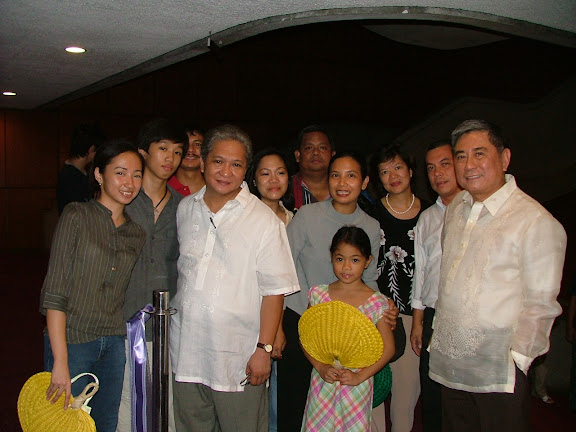
Launch crowd: My kids Denise & Miki, Laurence Banez (partly hidden), Grace Aday Banez, Makati South Hills friend and neighbor Edmund Jocson, my significant other Pamela Grace Banez, Laurene Banez, MSH neighbor-friends Belle & Noel Sayson, Rio Alma
A strange animal, the sonnet. The strictest of the so-called “closed” forms (poems with a prescribed number of lines and a well-defined structure of rhymed stanzas), it has survived the tests of fashion and passions. Translating poetry (and the sonnet) is a curious act itself. The language of poetry is itself the form. It is a tight conspiracy of devices. Within its rhythm and under its verbal surface, it “conceals” symbols and clues, it mimics voices and visages, it affects poses and temperaments, it employs feints and disguises. To translate poetry is first to disintegrate these devices, then to “re-conspire” them once more, only to half-reveal—hint and betray—them (and the poem’s truth), in the translating language.
The “strangeness” of Rio Alma’s sonnets begins with the collection itself being conceived as a biblical baedeker, which should lead the reader to a deeper, internal tour of a parallel landscape—that of a consciousness anticipating its own End of Days or Second Coming, a masque that self-consciously refers to its own script and utterances as “posthumous.” Exploratory glimpses into the territory of this masque or extended conceit we shall leave to the editor’s introductory notes. Our proper concern is the form as used by the author, to which the translator pays homage only by its violation, apart from his earnest attempts at approximating Alma’s use of language-as-form.
The sonnet is here presented in all its imaginable variations and reinventions, but in translation, as the reader will soon find out, all that remains of the form is the regulatory fourteen lines. Not the rhyme scheme, not the metrical discipline that Tagalog prosody imposes in terms of syllable count (in English it is the succession of stressed and unstressed syllables that gives metrical form), and sadly not the engaging structural and stylistic filigree that Alma works and reworks in his innumerable variations of the sonnet.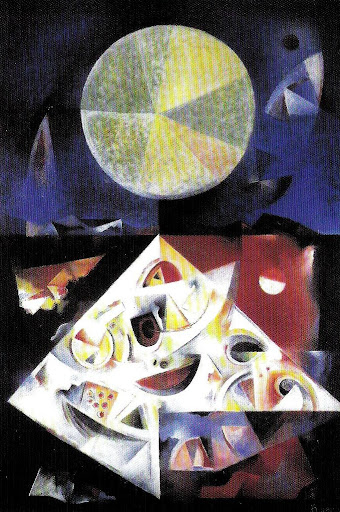 Still Life by Ang Kiukok (from the book)
Why so? We must hark back to the translator’s divided loyalties. To believe that poetic meaning can be transposed between languages is an act of faith (in both languages). To actually do so is to betray both. The translator’s loyalty (the question often asked is Is the translation faithful?) to the sense and qualities of the original language compels him to strip away or discard many of its disguises and devices. Inevitably he must choose to give up its rhyme and meter, its overall formal scheme, for him to be able to re-assume, “re-conspire,” them under the rules and habits of the translating language. Somewhere in between he betrays each of the languages’ own powers and inadequacies. Translation, in this instance, is an equalizer of languages.
(One more example)
NEFTALI
Namumugto ngayon sa lungkot ang dayap
Dahil walang silbi; nakatirik lamang
Sa gitna ng isang gasgas na sangkalan
Habang ang kusina'y larangan ng sipag.
Ibig niyang maiyak, lalo't nalalanghap
Sa siwang ng kalan, kutsara at pinggan
Ang pumpon ng rosas. Ano ba ang dangal
Ng palamuti lang at parang bulaklak?
Kutsillyo, mamaya'y ingat sa paghiwa.
Samyo n'yang maaskad ay biglang bubukad
At magpapasikip sa ilong at bibig.
Kung ipansisigang, pagbiyak sa gitna,
Pakataliman mo't nang di sumambulat
Ang saganang katas at asim ng inggit.
NAPHTALI
Swollen, the lime is near tears
Because she’s useless, sitting idle
At the center of a battered chopping board
While the whole kitchen is in battle.
She wants to weep as she catches,
Among stove, silver and porcelain,
The scent of roses. What honor
If only to be garnish, like flowers?
Knife, take care as you slice.
Her tart bouquet will suddenly swell
And make nose and lips pucker. Cutting across
Her middle, if she’s to be squeezed
On sour-stew, be extra sharp or you’ll
Let loose the acid spurt of envy’s sting.
Readers, especially Filipino-speaking readers, will experience for themselves how Rio Alma creates and recreates the sonnet. How, in form, he pays tribute to the Italian or the English varieties, or how he stands them on their heads. He may clip the sonnet’s wings only to leap into his own manner of flight. Within the strictures of Tagalog prosody, he may weave his meaning among seven, eight or twelve-syllable lines, or in one case, whip it into a slim, alternating four- and three-syllable verses. Then in the relative comfort of the more conventional duodecameters, he may revert to quatrains, octaves or sestets, or close with the feints and finalities of a couplet. His use of epigraphs as elements of form may also be noted: either they are separate from the poem, hinting at his agenda in the lines that follow, or they become the poem’s integral parts as first line or lines.
All these while he works within the self-imposed scheme of inviolable end rhymes, with words familiar or strange, or while getting away even with prepositions and articles at the line breaks. He marks precise midline caesuras, or does away with them altogether with lines and thought units pruned or cut to the quick. He violates the quatrains and couplets with “hanging” opening or terminal phrases (one sonnet has 22 lines if the “hanging” phrases are counted). Through all these the idea or argument cavorts or half-conceals itself, but always with the effect of sending the imagination spinning.
Nowhere, however, do these poems assume a strictly formalist or traditionalist mode, nor do they ever regress in style and spirit to the medieval origins of their form (unless they are called upon to do so as part of the disguise). With and despite their biblical conceit (the reinvention of the provenances and destinations of his ideas necessitate their cross-cultural transmutations), Alma’s sonnets are modern and mordant. His persona keeps peering like an ironic god or harlequin between the lines—sad or severe, mocking or carnivalesque—laughing at the reader’s quandary and shock.
Characteristic of most modern sonnets, Alma’s seldom argue for or about some archaic notion of love. Instead, these sonnets somehow revisit and revise the concept of courtly love. Perhaps like a time-warped “Passionate Pilgrim,” his persona sweeps his gaze across his new, strange and barren Holy Land, and finds there the swirling contrary forces of love and death in all its modern disguises: the clash of cultures, the impositions of religion and politics, the lopsided march of so-called progress pursued by dominant cultures and economies, and humanity falling on the wayside like (to use one of his images) the discarded pits of figs. It is against these forces that the pilgrim poet must muster all his creative energies.
Monday, February 19, 2007
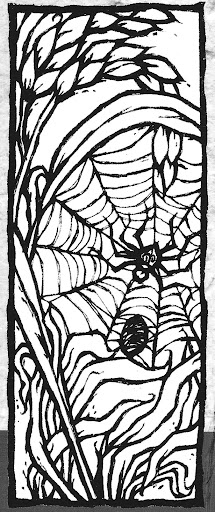 FOUR HAIKU from GAGAMBA SA UHAY
by Rogelio G. Mangahas
Illustrations from the book by Albert Gamos
1.
Lingkaw ko’y pigíl:
may gagamba sa uhay,
bilot ang balang.
I hold back my sickle:
spider on stalk has locust
wrapped in its web.
2.
Uha mo't hugong
ng sigwa'y nagkasalpok.
Yakap ka namin.
Your birthcry
and the stormhowl clashed.
We held you tight.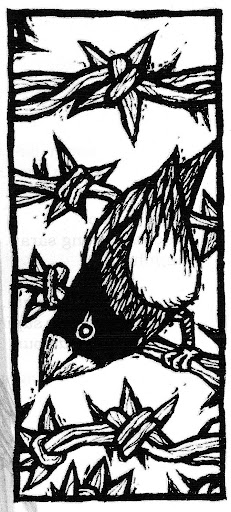
3.
Mike, sa kabaong
mo, hulog ko’y anthurium—
sugatang kabog.
Mike, into your coffin
I cast an anthurium—
my wound echoes.
4.
Maya sa barbed wire,
katitigan ang kosang
hubad sa araw.
Ricebird on barbed wire,
cellmate sunning naked,
catch each other’s stare.
Sanga-Sangang Dila (2): My Thoughts on Translating Poetry
0 comments Posted by Marne L. Kilates at 9:18 AM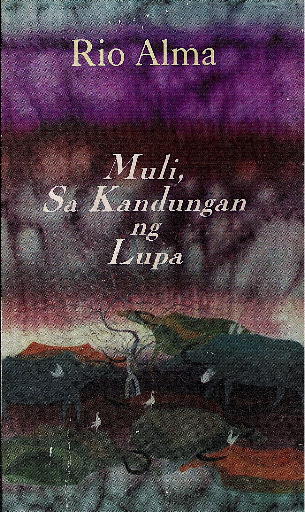 Original book cover (out of print); bilingual edition being prepared by Anvil
From my Introduction to Heartland (English title of Rio Alma’s Muli sa Kandungan ng Lupa)
The one peculiarity of contemporary poetry is its extreme self-awareness, its constant grappling with its own “relevance,” in a world that casually ignores it. And Rio Alma is the “thoroughly modern” poet who is a creature of both the past and the present—he “suffers” from the modern burden of a reflexive consciousness only too aware of its location at the end of a culture’s body of knowledge, and with that knowledge demanding to be distilled. It is this burden that informs his respect for traditional Tagalog forms and themes, those of the West as well as those coming from the world at large, and provides him the points of departure for deeper reflection.
The reader (and translator) to be equally “modern,” must share this burden, for him to reflect, for his own inner health, on his own location in history. This burden elicits another characteristic of modern literature and art—its own laughter at itself. This, of course, is really nothing new but a continuing thread in the human creative act as part of looking back at himself. Comedy and satire are as old as literature itself, e.g., from Aristophanes to Rabelais to Marcelo H. del Pilar, but in relatively newer times such a laughter had degenerated into a scream, a raging, or a pained moan from the overwhelming incomprehensibility of existence, of the extremes on hope and despair and the individual’s (or the masses’) apparent irrelevance in the heedless march of history. Today’s rather more healthy laughter is perhaps the sign of a world wisdom that is either maturing or growing more cynical, which nevertheless makes poetry capable of laughing at itself instead of committing suicide, as the nihilists and Dadaists were wont to do.
This laughter partly springs from the inward-looking notion that poetry and literature is firstly a game of language—the strange mix of gravity and light, as in “let’s pretend” and “what if”—in the deciphering and knowing of life itself. Knowledge is a code, a series of signs, an instructional game where the rules are both simple and vague, to be learned and discovered only during the playing itself. And poetry’s function, if any, is known lastly by its effect, its epiphany or irony, which is so dependent on its medium and intermediation of words, which in turn are signs and constructs, conventions and accidents of culture and society. Amid all this is the poet as master gamer, in whom if the interested reader will look closely enough, will find something of himself. A felicitous discovery for the serious reader is that poetry not just imitates life but intimates it, makes it sharper in our apprehension. And in the hands of a poet like Rio Alma, that it is capable of acting like life itself—touching, provoking, enlightening us, wounding our consciousness short of death, by making us laugh and think (instead of killing ourselves).
The other difficulty of translating poetry stems from the language of poetry itself. In the costume play that is literature, poetry is the most disguised. It is the one that takes most pleasure in its guises, but each item and trinket of its dress is in fact a hint of what it conceals. Thus, translating the ‘costume’ of poetry would be the unraveling of the original dress, but only to re-tailor it as if it were sewn in the shape and manner—of disguise and concealment—of the translating language. If the translation gets anywhere near that manner of dress (and wear it with any amount of ease or grace), then the translator, and that reader situated in another culture, another world, familiar with another manner of dress, might be justly rewarded.
• • •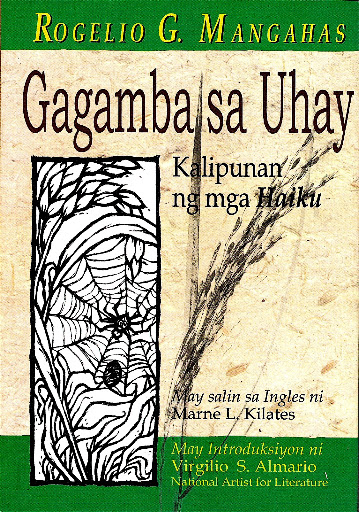 From my Introduction to Rogelio G. Mangahas’ Gagamba sa Uhay (Spider on a Stalk), a collection of Haiku
So much has been made of the loss in translation, especially of poetry. Allow me, Reader, to digress a bit into the technical. In English, for instance, the first thing a haiku loses is a few syllables. This is a function of both language and writing. The shift from Japanese to English (or to most other Western languages) is firstly from ideographic to phonetic writing (from symbols for ideas to symbols for sounds). Almost like from pictures to sounds. Ideographs, or ‘characters’ as we call them, correspond to definite syllables with definite meanings or images. Haiku, for example, stands for hai (meaning ‘unusual’ or ‘special’) and ku (‘lines’ or ‘stanza’), and the word needs only two characters. On the other hand, phonetic writing requires a number of symbols (letters) to form one syllable of a word. Thus, in the English translation of a Japanese haiku, the number of syllables is less crucial as the import—in both senses of the word—the meaning and the trading of meaning.
A different story happens when only the form of haiku is imported into a foreign language. Then the poet in English or Filipino can count his syllables. Even then, the original Tagalog haiku must struggle with its own polysyllabic nature in assuming the shape of the monosyllabic, ideographic Japanese vessel. Its English translation, in turn, must inevitably lose its syllables. But it (the translation as well as the language) has gained a new set of meanings, ideas and images from such a strange world as spoken in Tagalog.
This is so because translation (to ‘trans-relate’, or tell across) involves not only words, but languages and cultures, different ways of looking at, uttering and writing the world. It is the transposition and relocation of diction, idiom, texture and experience into a different set of teeth, so to speak. It demands the reinvention of native speech in an alien set of habits of the tongue that comes from a different set of habits of mind and heart. Nationalities and nationalism spring from far deeper roots than politics and economics. Translation, when it works, is all about gaining, not loss.
(Examples of my translations, and their originals, in the next post)
Monday, December 25, 2006
Sanga-Sangang Dila: My Translations from Bienvenido Lumbera's "Mga Kulay ng Lumbay"
0 comments Posted by Marne L. Kilates at 6:01 PM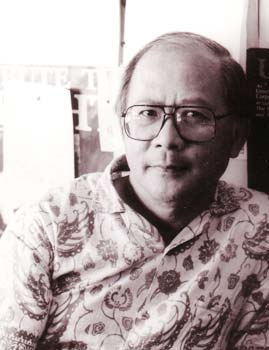
National Artist Bienvenido Lumber
“MGA KULAY NG LUMBAY”
by Bienvenido Lumbera
The Colors of Sadness
Translation
by Marne L. Kilates
Himala
Dumadaluyong ang mga salita
Inaanod ako sa daloy ng wika.
May isinasampa sa pampang ng dila,
Lunday na may lulang babasaging tula.
Laot ng hiwaga‘y tila walang hanggan,
Karatig ng langit ang tubig na bughaw.
Sa aking ulunan, halos abot-kamay
Ang sutlang bandila ng isang balangaw.
Subalit, ay, aba, ang kristal na tula,
Tulad ng balangaw, kaydaling mawala.
Malikmata yatang sindupok ng bula,
Kasisilay lamang, mamaya’y gunita.
Halina, hiwaga ng mga salita,
Nais kong malunod sa inyong himala!
Magic
Words are the surge of a tide,
In its swift current I am adrift.
It washes on the shore of the tongue
A dugout bearing a fragile poem.
This sea of mystery is without end:
Blue of water touches blue of sky.
Above I can reach for the rainbow,
A banner fluttering its silken hem.
But, oh, behold the fragile poem,
Like the rainbow how soon it is gone.
Flimsy as froth, it vanishes in a blink,
A memory no sooner than the glimpse.
Come, mystery and magic of words,
Drown me in your wonder.
Ang Lumbay
Ang kinakatha ko ay mumunting awit,
Awit na matimyas, tigib ng pag-ibig.
Taong umibig pag kimi at umid,
Aking binibigyan ng pusok at tinig.
Minsan may salitang inaanyayahan
Upang makabuo ng tulang mainam,
Mula sa malayo sa kung saan-saan,
Papagpasok sa tula’y may dalang ligamgam.
Dinadalisay ko ang bawat salita,
At hinuhugasan ang dilang dalita.
Ang ungol at daing ay sinasawata
At binubura ko ang bakas ng luha.
Subalit ang lumbay ay di-maitaboy,
Lalayo-lalapit na mumunting alon.
Sa pampang ng puso’y aahon-lulusong,
Ngayo’y bumubulong, mamaya’y daluyong.
Sadness
Sweet little songs I make,
Tunes so pure and full of love.
When lovers are timid and mute,
I give them voice, I make them bold.
Once I bid a word to come
And help me put together a poem.
From far and near, from wherever,
The word brought the poem warmth.
Each word I painstakingly refine,
And I wash the impoverished tongue.
I soothe and salve the cry of pain,
I banish any trace of tears.
But sadness I cannot send away—
Its little waves lap and leave,
Lap and leave the shore of the heart,
This moment a whisper, next a storm.
September 4-19, 2006


