Wednesday, September 19, 2007
1) “Debonair” at the Palanca Awards
The main story (of the title) happens just before just about everybody who can say “Philippine Star” and “Krip Yuson” started calling me “debonair” of late. “Just about” meaning everyone in the Internet—at least the Banggaan fellows (who went “whoa” about it)—or have access to email, since the newspaper column where the adjective was used before my name is usually reproduced or forwarded in that other e-group I am a member of, the lively Plarider Papers, founded and usually moderated or refereed by Pete Lacaba. Or, it went the rounds in the more brazen eyeballing in writer’s birthdays (e.g., Jun Balde’s last August 11th), and the usual after-class retreat to Sarah’s or Conspiracy or Newsdesk—in the case of UP teacher-writers). Poet-friend Teo Antonio, who will never miss things like this, takes me aside at the Conspiracy smoking section during that birthday party and conspiratorially mutters, “Debonair ka na pala ngayon!” And gives his classic guffaw, “Mwahahahaha!” And I, who was secretly relishing the appellation, am justly mortified. Of course, as in cell phone texting convention, “debonair” would be followed by “hehe,” as perhaps Krip chuckled to himself as he appended the modifier when he was narrating the Palanca judging process in his Philippine Star column “Kripotkin.” (No strict judging procedure, really. No two judging panels of three are alike, just as no judge is like any other judge. Writers’ eccentricity privilege, I presume.) Being chairman of the panel, like winning a Palanca prize, is mainly a consensus thing. Krip and the venerable (aha!) Jimmy Abad, fellow judges this year, have been chairmen themselves in other contest years. It was more or less my turn, and Krip couldn’t let the chance pass to be an imp and rib a red-faced friend (in a national daily column).
2) A Week (More or Less) of Literary Awards
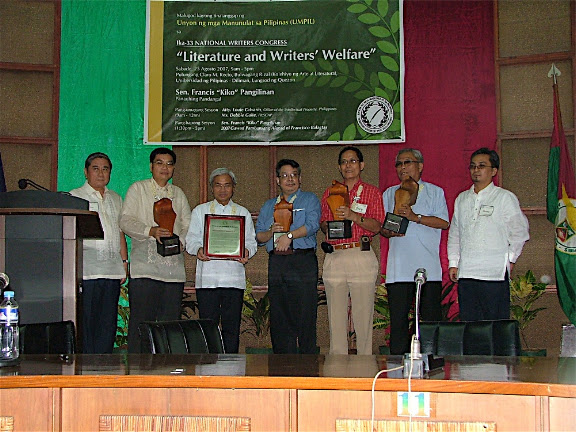
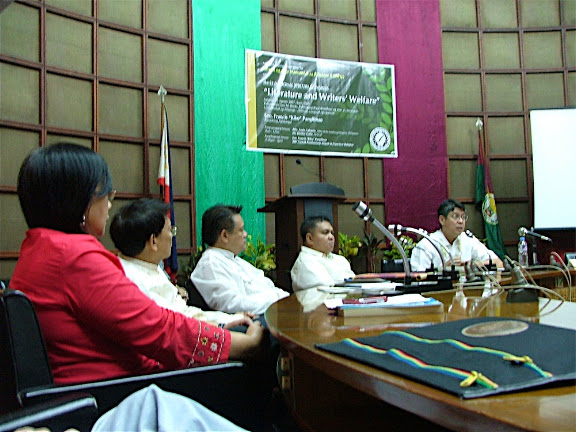
The awards week or weeks in the Philippine literary scene come just before the end of August and in the first week of September. The Union ng mga Manunulat sa Pilipinas (Umpil) holds its yearly congress on the last Saturday of August, as one of the culminating activities of the National Language Month (Buwan ng Wika), usually observed in elementary schools by letting the children wear the national costumes—patadyong, mestiza dress or Maria Clara dress for girls, the barong tagalog for boys—and skits or pageants with the token recitation of Tagalog poems or an excerpt from Francisco Balagtas’ Floranted at Laura. The National Writers Union (the English name of Umpil) gives out, after the Congress, the Gawad (Award) Pambasang Alagad ni Balagtas (a sort of Knight of Balagtas), for life achievement in various genres and languages. This year the winners were Joey Munsayac for the Novel in Filipino, Joaquin Sy for the Essay and Translation (Chinese into Filipino), Prescillano Nisperos Bermudez for Fiction in Ilocano, and Charlson Ong for the Novel in English. Umpil also recognizes teachers with the Gawad Paz Marquez Benitez for Outstanding Educator in Literature. This year the award was given to Fr. Roque S. Ferriols, S.J., mainly for pioneering in the teaching of Philosophy in Filipino.
 The yearly Don Carlos Palanca Memorial Awards for Literature is held on the first day of September, usually at the Manila Peninsula Hotel, and it is also more or less a party for writers. The judging period is usually three months before (June to August, after an entries submission deadline sometime at the end of April). Everyone who is a name in the local literary scene is either a contestant or a judge, a several-time or first-time winner, or first-time joiner, in any of the categories or divisions (Filipino and English, some regional languages, play, essay, short story or poetry, the novel every two years, or the special category of the youth essay). For the complete list of winners, read Alfred “Krip” Yuson’s series of columns on the awards, or go the Palanca Awards website, http://www.geocities.com/palanca_awards/.
3) “Double Happiness” at the National Book Awards
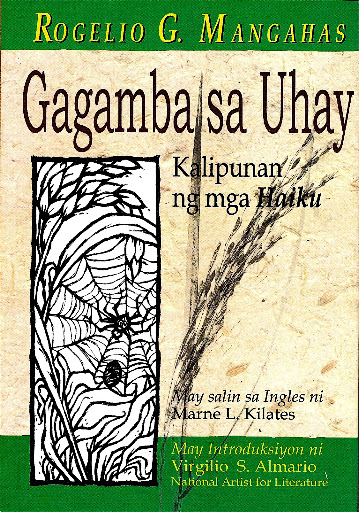
Now to Koyang Rogelio (Roger) G. Mangahas’ book. I am part-owner, as its translator into English. Gagamba sa Uhay (Spider on a Stalk): Kalipunan ng mga Haiku is quite unique in several ways. First, it is a coming out of sorts from a long period of hibernation of R.G. Mangahas, poet of the turbulent period in contemporary Philippine history, culminating with the so-called First Quarter Storm and the declaration of Martial Law. Second, what a distance, it seems, from poet of street protests to the poet serenely contemplating nature , counting syllables in the foreign form of the haiku.
But, as I remember from one of his earlier poems, “ako’y hindi nangangamba sa kagandahan,” he has never, in fact, been afraid of beauty. Thus, I wrote in the translator’s introduction: “The poet of Duguang Plakard (Bloodied Signs) is very much present among these pages… Not toned down but certainly more severe in his grasp of pain or joy (like any other poet) but, like no other, pruning meticulously his naturally luxuriant language, or cutting with merciless precision into translucent gems the stones of his experience.”
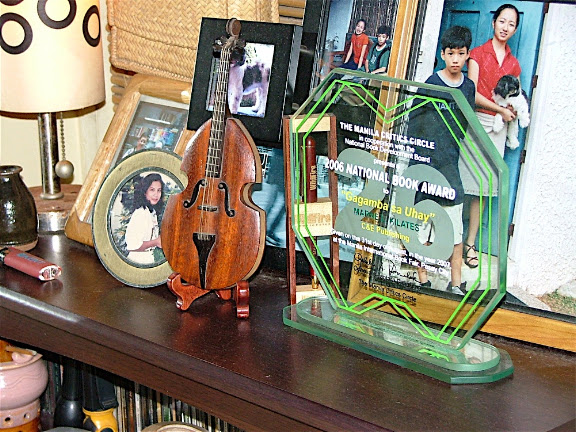
Lastly, the book is a real and intertextual exchange between two poets and, yes, between two languages, by email as well as over coffee or beer over a period of roughly one year—creating the haikus, translating, revising and translating and revising the translation… So that when the Manila Critics Circle gave it two National Book Awards, for best poetry book of the year and for best translation of the year, it was for Roger and me, as the Chinese would say, a double happiness.
 “Minimalist and mesmerizing indeed,” Alfred A. Yuson wrought in his blurb, this time as a critic and not as an imp, “is this bilingual collection of over 270 haiku in Filipino by Rogelio G. Mangahas with translations into English by Marne L. Kilates. That a superb Tagalog poet would appropriate a foreign form and make much of it with requisite brevity—the have his jewels re-rendered in another foreign language—is itself a marvel of transposition and juxtaposition. That the translation bespeaks, as it were, belief rather than betrayal makes this tripartite coalition a triumph of poetic globalization.”
 Publishers nominate, as well as the individual members of the Circle, who mark the significant new local titles of the year ranging from biographies, scientific and technical books to art and literary books, and the nominees are invited to the Awards night not knowing if they had won or not, unless there is a leak caught by the grapevine. Koyang Roger was never sure he had won, but I texted him that we have been asked to be present at the Awards night and I sounded I as if I had advanced news, and Koyang and lovely wife, writer Fe Mangahas, were endlessly wondering why the citiation should go to translation and not, it seemed, to the original book.
National Artist Virgilio S. Almario, founding member of the Manila Critics Circle, penned the citations for the awards for the literary book entries, and especially, for the National Book Awards for best poetry book of the year, and for best translated book of the year:
"Best Book of Poetry
"Gagamba sa Uhay, Rogelio G. Mangahas (Lungsod Quezon: C & E Publishing, Inc., 2006).
"Ang Gagamba sa Uhay ay isang katangi-tanging koleksiyon ng tula. Ipinakita dito ni Rogelio G. Mangahas ang kaniyang pambihirang talino upang disiplinahin ang wikang Filipino at ihulma sa isang napakaestriktong anyo—ang haiku ng mga Hapones. Hindi lamang nagtagumpay si Mangahas sa naturang layunin. Naisaloob niya ang isang banyagang anyo upang maging tanghalan ng kaisipan, damdamin, at karanasang Filipino."
and
"Best Book of Translation
"Spider on a Stalk, a translation of Gagamba sa Uhay by Rogelio G. Mangahas, translated by Marne L. Kilates (Lungsod Quezon: C & E Publishing, Inc, 2006).
"Marne L. Kilates is now gaining a unique reputation in Philippine literature. Aside from being a major poet himself in English, he is now the most sought after literary translator from Filipino to English. His delicate translation of Gagamba sa Uhay attests to his efficient and effective maneuvers to transform the haikus in Filipino of Rogelio G. Mangahas into new though similar haikus for readers in English."
Double Happiness!
(A sampler of the haikus and the translator’s introduction will be in the next posting.)
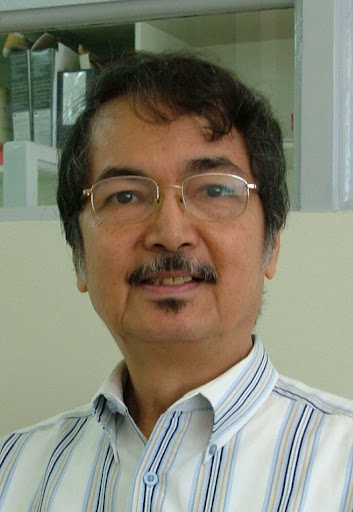
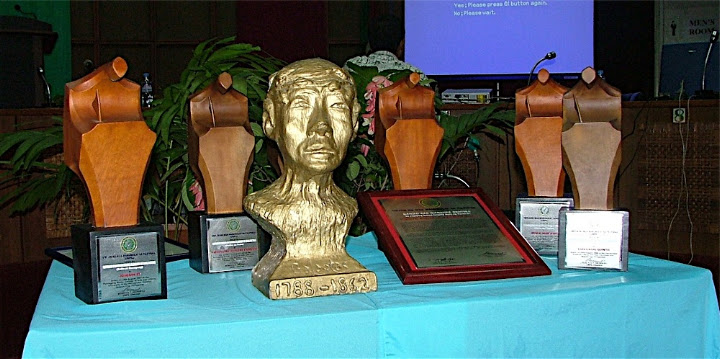
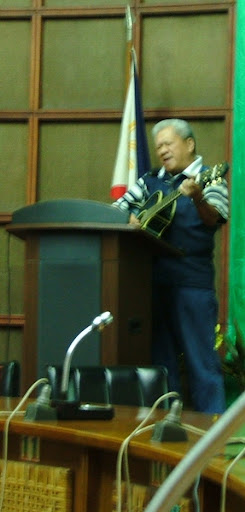
PHOTOS: The real debonair, poet Rogelio G. Mangahas; Gagamba sa Uhay / Spider on a Stalk book cover. Pambansang Alagad ni Balagtas awardees (from 2nd from left): Joaquin Sy, Ateneo Dean Leo Garcia (on behalf of Fr. Roque Ferriols), Charlson Ong, Jose R. Munsayac, and Prescillano N. Bermudez; flanking them are Umpil Chairman Emeritus and Nationa Artist for Literature Virgilio S. Almario (leftmost) and Umpil Chairman Roberto Anonuevo (rightmost). The Gawad trophies by Manny Baldemor, with Balagtas bust by Raul Funilas. Open Forum at Umpil Congress with Senator Kiko Pangilinan as Keynote Speaker (right), from left are Anvil Publisher Karina Bolasco, UP Prof. Mario Miclat, UP Institute of Creative Writing director Jose Carmelo Vim Nadera, and Ateneo Prof. Michael Coroza; and Pareng Heber Bartolome emoting with his song "Edukasyon" (sorry for the shaky camera). Glass trophy similar to R.G. Mangahas' on display at my memorabilia shelf.
Subscribe to:
Post Comments (Atom)


3 Comments:
Congratulations po!:)
Uy, thanks, Zaldy. Ang bilis mo!
Hi Mr. Roger Mangahas!
May we have your contact details for invitation?
JPaul Manzanilla
Amado V. Hernandez Resource Center
Post a Comment