Thursday, September 20, 2007
Samples from Gagamba sa Uhay/Spider on a Stalk & Translator’s Note
Posted by Marne L. Kilates at 2:49 AM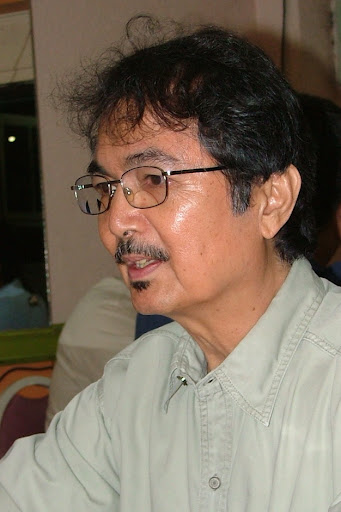

Maybe everyone, who has any bit of appreciation for words, gets to be smitten by the brevity of a haiku. Every would-poet would have tried writing haiku, if not hiding somewhere in a box of juvenilia, a sheaf of haiku. But few persist doing it up to their adult years, especially if they had come into the more attractive complexities of modern poetry for which the equally complex modern experience (sometimes) cannot be embraced with three lines of five, seven, and five syllables. One exception is my literary “senior,” Koyang Rogelio (Roger) G. Mangahas, a passionate haiku writer whose self-same same passion drives his other modern, lyrical, socially-engaged poetry. Thus, Gagamba sa Uhay (Spider on a Stalk in translation), is not a collection of juvenilia hidden in a box, but a winner of the National Book Award 2007 for best book of poetry, and the same award for best book of translation. In fact it is a bilingual book, with me as translator, the story of which I wrote a bit about in the last posting. I share not a small honor in the award, so let me share with you the translator’s introduction I wrote for the book, and some samples of the haiku, for your appreciation. (In a previous posting long ago I excerpted this introduction, but here it is now in full.)
The World from the Level of Grass & Rice Stalk
Between us, Native Reader, I would rather enjoy first the original Tagalog text. Why would you need a translation?
But if you are a foreigner or a native pretending not to know or refusing to know the national language, here is Rogelio Mangahas in two tongues. Koyang Roger (elder brother, Sir—a reverential term of address) to us younger writers. The same one who, together with Rio Alma and Lamberto Antonio in the late 60s, moved Tagalog poetry not only into the open air of modernism, but into its rigors and complexities as well.
Here he is, after a relatively long absence, presenting us with more than two hundred pieces in the most traditional haiku, from his apparently ‘secret’ life. After all, he had been known more for his eloquent experiments (though again with traditional Filipino forms made to bear the burdens of the social realist mode), during the turbulent 60s, when Filipino literary consciousness was coming to grips with the realities of the period, and the world at large.
No, do not look askance or let down, asking why a major voice in contemporary Filipino literature would ‘bother’ with this briefest of forms.
Why not? The haiku is not an easy form. Its length deceives and disguises, though it may appeal to the impatient contemporary reader who is more comfortable with the sound bite, the datum, the fragment. But its ascetic length demands contemplation, it is the kind of poetry that stands next or aspires to the ineffability of the world. Or nature. Or society.
Tradition distinguishes between the haiku and the senryu, the one always alluding to the seasons and nature, the other more to human foibles, though with the same syllabic count and structure. Both are here represented with blurred borders (as they have always been), and both are constantly, eternally ‘coming to grips’ with the dumbfounding complexities and inconstancies of nature and people.
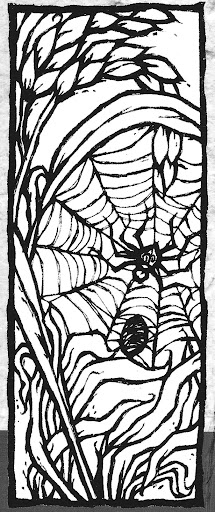 Inconstancy and complexity are two of the themes of Gagamba sa Uhay (Spider on a Stalk), as much as loss and holding on to what remains simple—as deceptively simple perhaps as three lines of five, seven and five syllables. It is poetic language closest to experience, and in the sense of all poetry, of the words themselves wanting to be the experience. As when the farmer debates whether to reap his ripened grains while a spider (guardian against pest) clings to the tremulous stalk:
 Lingkaw ko’y pigíl:
may gagamba sa uhay,
bilot ang balang.
(I hold back my sickle:
spider on stalk has locust
wrapped in its web.)
… thus meditating (in three ephemeral, or eternal, lines) on power, debt of gratitude, and the precariousness of existence.
 The poet of Duguang Plakard (Bloodied Signs) is very much present among these pages, no matter the tastes or temperaments of current readers, or what they expect. Not toned down but certainly more severe in his grasp of pain or joy (like any other poet) but, like no other, pruning meticulously his naturally luxuriant language, or cutting with merciless precision into translucent gems the stones of his experience.
 He marvels at the beginning of a life:
Uha mo't hugong
ng sigwa'y nagkasalpok.
Yakap ka namin.
(Your birthcry
and the stormhowl clashed.
We held you tight.)
or grieves over untimely death:
Mike, sa kabaong
mo, hulog ko’y anthurium—
sugatang kabog.
(Mike, into your coffin
I cast an anthurium—
my wound echoes.)
or recalls with slightest irony an unpleasant experience:
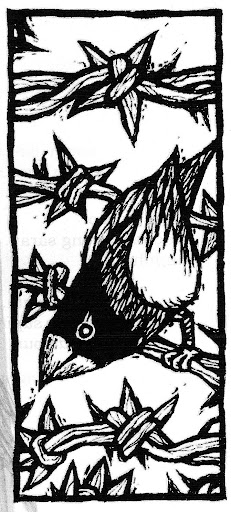
Maya sa barbed wire,
katitigan ang kosang
hubad sa araw.
(Ricebird on barbed wire,
cellmate sunning naked,
catch each other’s stare.)
And here lies the crux of both the polysyllabic Tagalog language, and the translation: how to stay within the constraints of Basho’s pond, frog jumping and sound of water. Would the translator, like Ezra Pound, say kerplash instead of ‘sound of water’? (He was joking of course.) Or would he opt to approximate the serenity of the old pond and the frog almost not disturbing it as it leaps and making only the merest flop because that is the spirit of Basho’s writing?
So much has been made of the loss in translation, especially of poetry. Allow me, Reader, to digress a bit into the technical. In English, for instance, the first thing a haiku loses is a few syllables. This is a function of both language and writing. The shift from Japanese to English (or to most other Western languages) is firstly from ideographic to phonetic writing (from symbols for ideas to symbols for sounds). Almost like from pictures to sounds. Ideographs, or ‘characters’ as we call them, correspond to definite syllables with definite meanings or images. Haiku, for example, stands for hai (meaning ‘unusual’ or ‘special’) and ku (‘lines’ or ‘stanza’), and the word needs only two characters. On the other hand, phonetic writing requires a number of symbols (letters) to form one syllable of a word. Thus, in the English translation of a Japanese haiku, the number of syllables is less crucial as the import—in both senses of the word—the meaning and the trading of meaning.
A different story happens when only the form of haiku is imported into a foreign language. Then the poet in English or Filipino can count his syllables. Even then, the original Tagalog haiku must struggle with its own polysyllabic nature in assuming the shape of the monosyllabic, ideographic Japanese vessel. Its English translation, in turn, must inevitably lose its syllables. But it (the translation as well as the language) has gained a new set of meanings, ideas and images from such a strange world as spoken in Tagalog.
This is so because translation (to ‘trans-relate’, or tell across) involves not only words, but languages and cultures, different ways of looking at, uttering and writing the world. It is the transposition and relocation of diction, idiom, texture and experience into a different set of teeth, so to speak. It demands the reinvention of native speech in an alien set of habits of the tongue that comes from a different set of habits of mind and heart. Nationalities and nationalism spring from far deeper roots than politics and economics. Translation, when it works, is all about gaining, not loss.
And this gain is made even more distinct with the presence of the poet. Authorial presence is a luxury seldom available to the reader or translator. It is not supposed to premise the reading of poems, since the reader might be in another time or another world. But it was a luxury granted. It meant being able to know authorial intent (as we must in translation, in haiku), and to correct gender references because Tagalog pronouns are genderless. It is most helpful in choosing and refining diction because there is little room for play in three lines and seventeen syllables. It meant a direct exchange between author and translator, practically relieving me of the risks of misjudging the tone, weight or magnitude of words said in another language (even if it was also my own).
In a few instances I was even present in the poem, or at least in its conception. In one exchange of notes, the poet reminded me of a full moon he glimpsed behind a curtain of light rain as we rode in a van towards Rio Alma’s old house in San Miguel, Bulacan. We were entering the town after a visit with Koyang Bert Antonio, who was recuperating from an ailment in his hometown of Cabiao in Nueva Ecija. It reminded me of the memory, helped me recreate it in the memory of another language. Off and on, for over a year, over the Internet, by cell phone text, the exchange took place, in between the hours of our day jobs. Our periodic assignations over coffee and beer were high points.
It was this exchange—negotiations as it were—that for me made the process even more meaningful. On one side was the author, native and up close, looking at the world from the level of grass and rice stalk, possible perhaps only in haikus: minimalist, mesmerizing, and with a lot of Zen. On the other was the translator, no native of the translating language but pretending to know its habits—with a lot of karma. I was shuttling between cultures (and incarnations) and feared ending up a native of neither, if I hadn’t already.
Charge that, Reader, to the experience of many of us who persist in writing (and reading) in English. But include, too, the hope that the foreign or unfamiliar tongue might have a taste of the finest in our native speech.
Marne L. Kilates
July 24, 2006
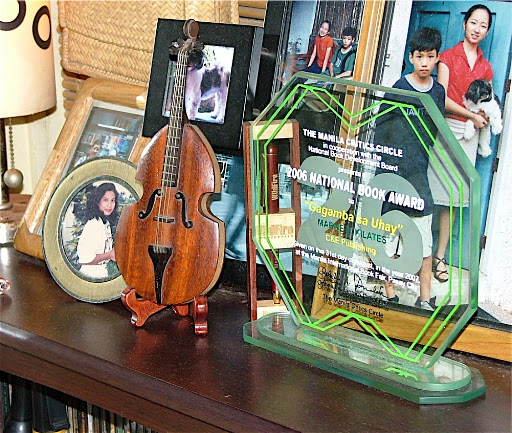
PHOTOS: Koyang Roger on his birthday a few months ago; the translator; illustrations from the book by Albert Gamos; National Book Award glass trophy similar to Koyang Roger's among my memorabilia.


0 Comments:
Post a Comment