Wednesday, August 29, 2007
Picture Poem: Delotavo's Stunning Take on the Filipino Diaspora
Posted by Marne L. Kilates at 12:55 PM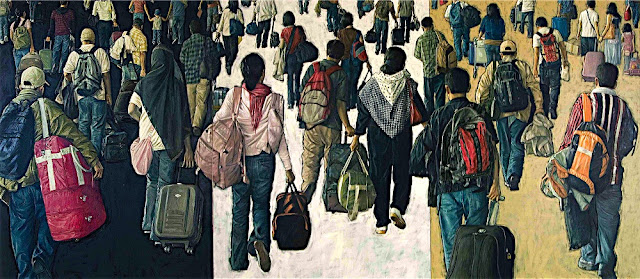
Delotavo’s Diaspora
They take good care of their luggage,
The contents and the bags.
The contents because those are what they are,
Including what they’ve left,
The bags because those will take them places.
We do not see their eyes,
Not because they’ve turned their backs on us
But only because they must look ahead
And get where they’re going,
Or death would mock us, if they never left.
Beyond the glass panes of pre-departure
We follow them with our eyes.
They walk alone or in two’s,
Glad for the company, or they leave
As whole families, taking with them everything,
Roots, branches, memories,
If they have not abandoned them,
If indeed they had chosen to become
Their destinations. For then they will shed
Everything, luggage and all, and the past is a blur.
Ingat, be careful, we intone
As we send them off. We have never been
Where they are going, where time and life,
And even God, is different. They kiss our hands,
We give them rosaries, scapulars, anting-anting.
Between them and us, a widening
Gulf, no matter how we cling to memories
Like flotsam. For we do not know,
Of refuse to know who, between them and us,
Are the survivors of a wreck.
Marne L. Kilates
April 29, 2007
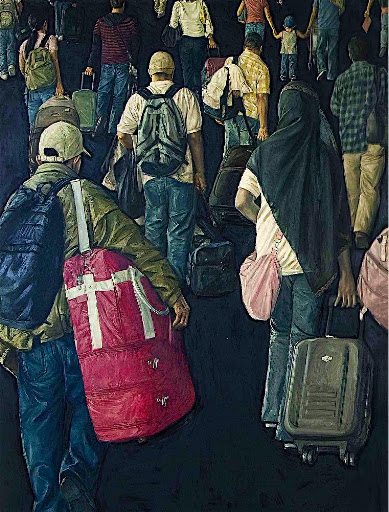
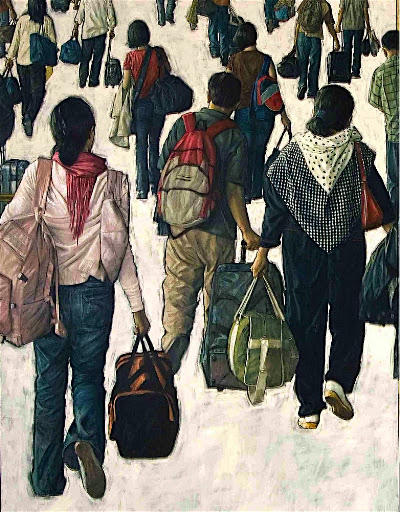
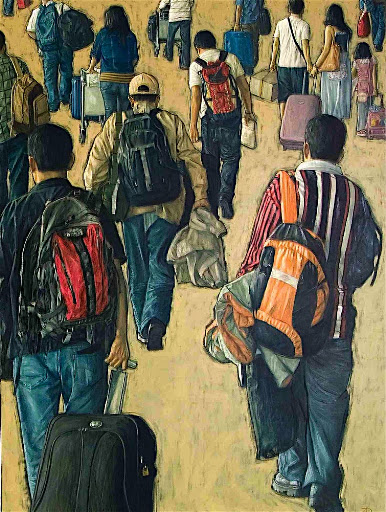 Something must be said—not in poetry—about this painting that stood out in a big group show at the Art Center of SM Megamall in Ortigas about the middle of this year. It was a show by many of the well-known and respected names in the local social realist movement, although the name is not a strict categorization of the group. And standing out didn’t mean just size. I am not a good estimator of measurements, but “Diaspora,” a triptych that quite disregarded the edges of the panels, perhaps stood seven by eighteen feet, and many of the other pieces were of mural proportions, some wall-to-ceiling. (Just too bad the reproduction here, courtesy of the painter, constrained by the blog template, cannot give us an idea of the actual visual magnitude of the painting.) The centerpiece was two or three huge panels by another stalwart, Adi Baens Santos—powerful swaths of color commenting on the times. “Diaspora” you won’t even notice, as it was mounted on the wall to your right, not within your line of vision, when you enter the gallery. But it stood out. Or rather, it wrested your gaze, it attracted close attention. Many of the viewers seemed actually rooted to the floor, mesmerized, stunned by multitude of human backs in mass migration. That is simple enough. Even the title is quite simple and straightforward. What attracted the eyes firstly, perhaps, was the photographic detail of the human subjects, from their clothes to their luggage, to whatever item of their personal paraphernalia that were rendered in loving detail. Then this realistic image is seemingly pressed or pasted onto the unrealistic smudge of the background. The migrating multitude are disappearing as it were, individually, not in the distance of perspective, but into a fuzzy blank, actually almost black in the right panel, almost white in the middle, and an indeterminate beige in the third. The well-defined figures are being absorbed by a smudge of uncertainty. Perhaps it is the loving detail of the human figure that reminds us that these are objects of our love, and they are, well, fading away, leaving. Antipas “Biboy” Delotavo tells me he never expected the kind of the reactions the painting elicited. Many whispered their praises or wanted to talk to him about the painting. Many kept returning to look at it even when the cocktail bar opened. Some dabbed their eyes as they watched the figures “leave.” I choked in my drink.
 DETAILS: Sorry Biboy, but I have to do a little cut-up of your great painting (and it's a triptych anyway), but only to show our readers the rich details which the reduced reproduction above cannot give justice to.
Subscribe to:
Post Comments (Atom)


3 Comments:
dai ko naman mapugulan na mapung'aw.
Mapung'awun baga.
napakaganda po ng painting :) na-feature po siya sa reader's digest asia - july 2008.
ask ko lang, yung poem po ba is description for the painting? or kayo po ang gumawa? :)
Post a Comment