Thursday, March 15, 2007
Speaking in Tongues in the Purple Season (III): Excerpts from my Translator's Intro to Sonetos Postumos
Posted by Marne L. Kilates at 10:46 AM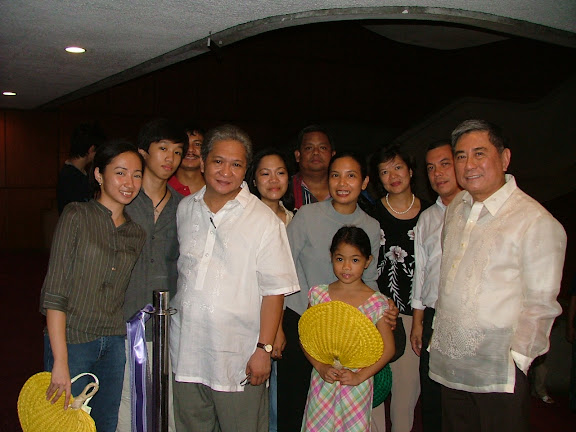
Launch crowd: My kids Denise & Miki, Laurence Banez (partly hidden), Grace Aday Banez, Makati South Hills friend and neighbor Edmund Jocson, my significant other Pamela Grace Banez, Laurene Banez, MSH neighbor-friends Belle & Noel Sayson, Rio Alma
A strange animal, the sonnet. The strictest of the so-called “closed” forms (poems with a prescribed number of lines and a well-defined structure of rhymed stanzas), it has survived the tests of fashion and passions. Translating poetry (and the sonnet) is a curious act itself. The language of poetry is itself the form. It is a tight conspiracy of devices. Within its rhythm and under its verbal surface, it “conceals” symbols and clues, it mimics voices and visages, it affects poses and temperaments, it employs feints and disguises. To translate poetry is first to disintegrate these devices, then to “re-conspire” them once more, only to half-reveal—hint and betray—them (and the poem’s truth), in the translating language.
The “strangeness” of Rio Alma’s sonnets begins with the collection itself being conceived as a biblical baedeker, which should lead the reader to a deeper, internal tour of a parallel landscape—that of a consciousness anticipating its own End of Days or Second Coming, a masque that self-consciously refers to its own script and utterances as “posthumous.” Exploratory glimpses into the territory of this masque or extended conceit we shall leave to the editor’s introductory notes. Our proper concern is the form as used by the author, to which the translator pays homage only by its violation, apart from his earnest attempts at approximating Alma’s use of language-as-form.
The sonnet is here presented in all its imaginable variations and reinventions, but in translation, as the reader will soon find out, all that remains of the form is the regulatory fourteen lines. Not the rhyme scheme, not the metrical discipline that Tagalog prosody imposes in terms of syllable count (in English it is the succession of stressed and unstressed syllables that gives metrical form), and sadly not the engaging structural and stylistic filigree that Alma works and reworks in his innumerable variations of the sonnet.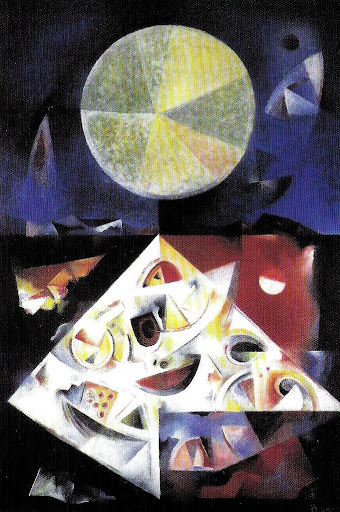 Still Life by Ang Kiukok (from the book)
Why so? We must hark back to the translator’s divided loyalties. To believe that poetic meaning can be transposed between languages is an act of faith (in both languages). To actually do so is to betray both. The translator’s loyalty (the question often asked is Is the translation faithful?) to the sense and qualities of the original language compels him to strip away or discard many of its disguises and devices. Inevitably he must choose to give up its rhyme and meter, its overall formal scheme, for him to be able to re-assume, “re-conspire,” them under the rules and habits of the translating language. Somewhere in between he betrays each of the languages’ own powers and inadequacies. Translation, in this instance, is an equalizer of languages.
(One more example)
NEFTALI
Namumugto ngayon sa lungkot ang dayap
Dahil walang silbi; nakatirik lamang
Sa gitna ng isang gasgas na sangkalan
Habang ang kusina'y larangan ng sipag.
Ibig niyang maiyak, lalo't nalalanghap
Sa siwang ng kalan, kutsara at pinggan
Ang pumpon ng rosas. Ano ba ang dangal
Ng palamuti lang at parang bulaklak?
Kutsillyo, mamaya'y ingat sa paghiwa.
Samyo n'yang maaskad ay biglang bubukad
At magpapasikip sa ilong at bibig.
Kung ipansisigang, pagbiyak sa gitna,
Pakataliman mo't nang di sumambulat
Ang saganang katas at asim ng inggit.
NAPHTALI
Swollen, the lime is near tears
Because she’s useless, sitting idle
At the center of a battered chopping board
While the whole kitchen is in battle.
She wants to weep as she catches,
Among stove, silver and porcelain,
The scent of roses. What honor
If only to be garnish, like flowers?
Knife, take care as you slice.
Her tart bouquet will suddenly swell
And make nose and lips pucker. Cutting across
Her middle, if she’s to be squeezed
On sour-stew, be extra sharp or you’ll
Let loose the acid spurt of envy’s sting.
Readers, especially Filipino-speaking readers, will experience for themselves how Rio Alma creates and recreates the sonnet. How, in form, he pays tribute to the Italian or the English varieties, or how he stands them on their heads. He may clip the sonnet’s wings only to leap into his own manner of flight. Within the strictures of Tagalog prosody, he may weave his meaning among seven, eight or twelve-syllable lines, or in one case, whip it into a slim, alternating four- and three-syllable verses. Then in the relative comfort of the more conventional duodecameters, he may revert to quatrains, octaves or sestets, or close with the feints and finalities of a couplet. His use of epigraphs as elements of form may also be noted: either they are separate from the poem, hinting at his agenda in the lines that follow, or they become the poem’s integral parts as first line or lines.
All these while he works within the self-imposed scheme of inviolable end rhymes, with words familiar or strange, or while getting away even with prepositions and articles at the line breaks. He marks precise midline caesuras, or does away with them altogether with lines and thought units pruned or cut to the quick. He violates the quatrains and couplets with “hanging” opening or terminal phrases (one sonnet has 22 lines if the “hanging” phrases are counted). Through all these the idea or argument cavorts or half-conceals itself, but always with the effect of sending the imagination spinning.
Nowhere, however, do these poems assume a strictly formalist or traditionalist mode, nor do they ever regress in style and spirit to the medieval origins of their form (unless they are called upon to do so as part of the disguise). With and despite their biblical conceit (the reinvention of the provenances and destinations of his ideas necessitate their cross-cultural transmutations), Alma’s sonnets are modern and mordant. His persona keeps peering like an ironic god or harlequin between the lines—sad or severe, mocking or carnivalesque—laughing at the reader’s quandary and shock.
Characteristic of most modern sonnets, Alma’s seldom argue for or about some archaic notion of love. Instead, these sonnets somehow revisit and revise the concept of courtly love. Perhaps like a time-warped “Passionate Pilgrim,” his persona sweeps his gaze across his new, strange and barren Holy Land, and finds there the swirling contrary forces of love and death in all its modern disguises: the clash of cultures, the impositions of religion and politics, the lopsided march of so-called progress pursued by dominant cultures and economies, and humanity falling on the wayside like (to use one of his images) the discarded pits of figs. It is against these forces that the pilgrim poet must muster all his creative energies.


0 Comments:
Post a Comment