Friday, March 16, 2007
Speaking in Tongues in the Purple Season (IV): Excerpts from Fidel Rillo’s Intro to Sonetos Postumos
Posted by Marne L. Kilates at 10:23 AM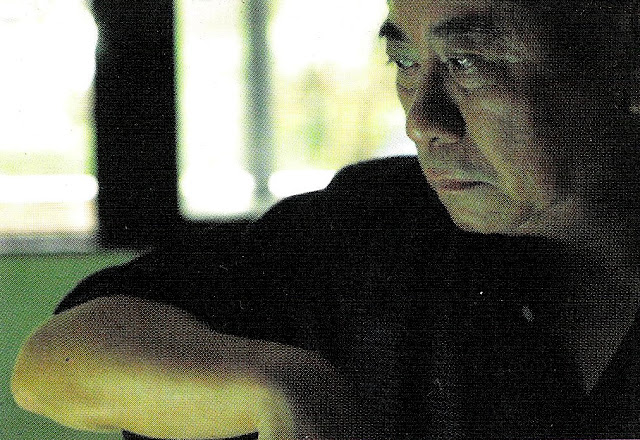 National Artist Rio Alma by Nap Jamir
There is a recurring line in Rio Alma’s poetry that has framed much of his themes in a career that spans nearly five decades of inspired creativity. That line, sa pagitan ng hininga’t kamatayan (literally between breath and death), encapsulates a universe that blasts and expands into infinite poetic possibilities once triggered by the poet’s imagination. It is, in a way, a simple tool that allows the poet to alter to whatever forms he wants the conventions and limits of the form itself to push his agenda of expressing what to him is a truly Filipino experience. 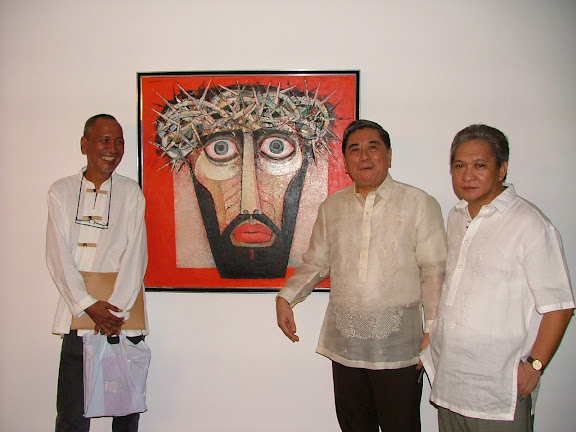 Fidel Rillo, Rio & me during the launch at CCP
The line itself is of course culturally conventional and the linear time implied is quite universal in bookending human experience. Birth and death anyway are the two ends of a pole upon which hangs man’s entire existence, though death is said to be a concept acquired quite late in the long history of the species. As commonly thought, man is the only living thing conscious of the concept of time and is thus the only being aware of its own mortality. This time-consciousness, considered an essential factor of rationality, has since formed man’s concept of himself and his environment, and his ventures into and explorations of the temporal wilderness of past, present and future have produced countless meditations on the inevitability of death and its finality.
This is not the case, however, in the time-consciousness of Rio Alma’s recurring line. His is socially engaged, using man’s concept of mortality to frame a gamut of experiences from the common to the sublime. This in itself is nothing new as far as Filipino poetics is concerned, which carries a load of works not lacking in value as far as social significance is concerned but is often weighed down by the pomposity of its aesthetics. Rio Alma bears no such baggage, and his poetry often steers clear of deadends, embarking instead on a journey through time and consciousness that intersect in aesthetics wide enough to accommodate his and his people’s experience. Sa pagitan ng hininga’t kamatayan is that frame of time and space, universal in scope and breadth but always grounded in the Filipno experience. 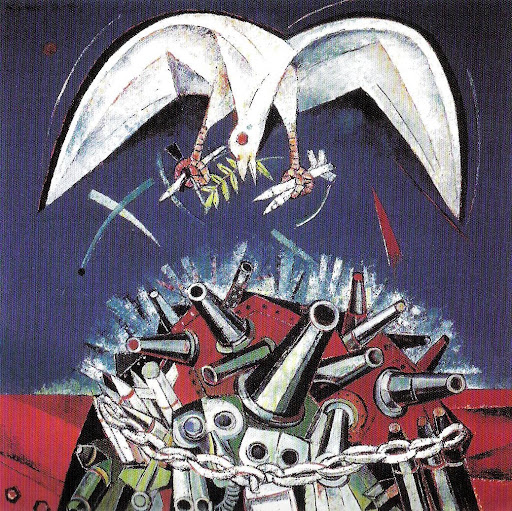 Junkscape with Dove by Ang Kiukok (from the book)
It is the same time-consciousnes that supplies the knowledge that nourishes the politics of his works, from the apocalyptic cogitation of Makinasyon (his first book), the journey through the heart of darkness of Peregrinasyon, the partisanship of Doktrinang Anakpawis to the self-assessingf Palipad-hangin (his most personal, and his best) and Mga Retrato at Rekwerdo (which includes “Sa Iba’t Ibang Panahon,” to my mind the best poem in Filipino ever written, bar none).
More elaborately, through his literary criticism (bylined Virgilio S. Almario, his real name)—which proposes—Rio Alma has outlined a dynamic program that draws inspiration from the works of writers of the past while conducting investigation among the works of young writers to ensure a continuum that will elevate Filipino poetry to the level he envisions, and to which his own poetic output—which disposes—contributes a lot.Truly, Rio Alma is deserving of the National Artist recognition bestowed upon him by a grateful nation.
• • •
Sonetos Postumos… is not a journey into the unknown and, despite its somewhat otherwordly title, is certainly not beyond the linearity of the hininga’t kamatayan of the poet’s earlier works. “Posthumous” or postumo, a word used to signify something that continues or arises after death, could also refer to someone born after the death of the father. If so, could that someone be the present with its technology-driven concepts of life, sins, salvation, resurrection and mortality, themes which inhabit this collection? And could the father be the past with its slew of saviors, messiahs, prophets, magi, poets, artists and philosophers who had extolled virtues and damned the consequences of sins? Notice that these are the very same concepts that share commonalities among the major religions of the world, the foundation of which stemmed from human needs and fears. Whose death then does the postumo signify? Could it be that point in history when the human mind ceased to wonder about the terrifying aspects of unexplained phenomena hitherto ascribed to gods? The time perhaps when someone like Epicurus (referenced somewhere) exposed the pernicious nature of religion? Or the time when Nietzche declared the death of God? And what is it that continues after death?
• • •
By relocating the drama of these themes to the significant places in the land from which sprang three major religions, Rio Alma has provided the transcendent thread to which can be stringed, like rosary beads, his interpretations of the significance of human life and destiny without falling into the traditional traps set upon those whose incremental approach to the truth often ends up in archaic subjectivism. Likewise, he conceptualizes time and memory, using that which is familiar, to anticipate, interpret, structure, and control his present environment.
Thus, the use of Biblical sites as titles to the poems does not fundamentally universalize the experience in a doctrinal way but renders a temporal line that engages both the past and the present while providing a space that provides as much ironies since most of these are the sites of present-day conflicts. And also, since landscapes are always multitemporal, these ancient holy grounds provide for the present not only specific memories associated with particular objects of material culture but also cultural traces and remains from different ages.
I presume Rio Alma is a Christian, as most of his readers are, and the convenience of historical and theistic grounding adds accessibility to the meanings of the poems since this is the central axis around which the poet makes loops in time that effortlessly enlarge and expand to suggest movement in time though viewed from different perspectives. As tangible metaphors, the landscapes are useful in thinking abstractly of concepts such as time itself. By moving the actions many generations back, the age-old concepts in the poems are once again experienced, thus making more sense to the present and becoming real to set the mind on future things. But since relationships to the past are metaphorical, the real is not represented but created.
In a way, Rio Alma’s “version of history” can be considered as what some Western literary critics call an “invented tradition,” defined as “a set of practices, normally governed by overtly or tacitly accepted rules and of a ritual or symbolic nature, which seek to inculcate certain values and norms of behavior by repetition, which automatically implies continuity with the past.” One of the functions of this is to socialize people into particular social contexts. Rio Alma’s method was the same one used by the early Christians, including the writers of the gospels, who tried to fortify their collective memories of events in the life of Jesus by connecting them with locations that were already meaningful in the Jewish religious tradition of the Old Testament.
The same is true of historicity which, by the way, is never claimed in any of the poems. Rio Alma is not concerned about giving testimony of past events that took place somewhere else, as accurately and truthfully as possible, but is, instead, making meaningful statements about the past within the cultural context of the present, his present. Connections of experience are made through sheer etymology or the physical characteristics of the sites as in, for example, Aenon (literally a place having a great quantity of water) in the poem voiced by John The Baptist.
Clearly, the poet aims to make his “version of history” meaningful to the collective subjectivities and self-identities of the particular group he addresses. There is not even a coherent methodology in the poet’s presentation, but rather a consensus of assumptions and prejudices he shares with his audience. Thus, various references from different doctrinal and cultural sources are often cleverly intertwined to create a unifying bond of philosophies. Such referential knowledge come in forms like chants, mantras, quotations and allusions derived from such diverse sources like the Egyptian Book of the Dead, the Tibetan Book of the Dead, the Bhagavad Gita, The Bible, Divina Commedia, the Pasyon, Florante at Laura, Ibong Adarna, Sufi poetry, ancient proverbs, popular songs and historical figures like Plato, Nietzche, Alejandro G. Abadilla, etc.
The technique used by the poet to achieve this aim was probably what the critic Walter Benjamin had in mind when he described his method of work as literary montage and collage, the former as the cutting and reassembling of fragments of meanings, images, things, quotations, borrowing, to create new juxtapositions; the latter as direct quotation, literal repetition or citation of something taken out of its context and placed in another, a simple questioning of the notion of representation as finding some correspondence with an exterior reality. The aim is to construct something new out of old, to connect what may appear dissimilar in order to achieve new insights and understanding. The result is transcendence, which enables the poet to relocate even texts paraphrased or translated from sources such as Psalm 23 and Shakespeare’s Sonnet XVIII and make them integral to particular locations.
Like the Internet’s hyperlinks, these separate entities or diverse aspects of knowledge from different cultures become doubly meaningful and make better sense once connections are made. Much of what the poet is trying to forward or argue is self-contained in the individual poems but can only be fully comprehended and appreciated by considering all the poems in the cycles and in the context of the entire collection.


0 Comments:
Post a Comment