Tuesday, November 27, 2007
Pictura Poiesis: An Ekphrastic Edition of Mag:Net's Happy Mondays, a Sparkling Night of Pictures, Poems & Friends
0 comments Posted by Marne L. Kilates at 10:33 AM
A LL OUR FRIENDS CAME, and gallery owner Rock Drilon commented, as I fiddled at the mixing console back of Mag:Net Bar above the first floor art gallery, that it looked like a real production. The longish hall was full. All silhouettes faced the screen onstage (where the band played or people read their poems). Among these shadows were National Artist Rio Alma and wife Lyn, Kaibigan Dr. Jimmy Abad (without our friend, Krip Yuson, who had to be at Ka Pete Lacaba’s second Salinawit concert at Capisce over at Metrowalk in Ortigas), Anvil Publisher Karina Bolasco, two beautiful Susans—angel-voiced Susan Fernandez and fictionist Susan Lara, poet and book designer Donat Alvarez, and a host of Marj Evasco’s artist and academic friends and students whose names I missed. And, the bigger-than-usual literary crowd from the UP-Ateneo-Miriam academic triangle. By coincidence, award-winning film director Mark Meilly was there behind me as I tested the projector. He was a working acquaintance from my advertising days when he directed one of my forgettable TV commercials. He had come in late and missed the showing of his indie film before our “show,” and stayed to watch ours perhaps a mite curiously. Picture Poiesis was an attempt at something different and mildly thematic—a slightly structured and sequenced reading, of poems accompanied by pictures projected onscreen. This was a necessity, for they were the source art of the readers’ the ekphrastic poems, poems taken from, reacting to, or inspired by art and that night it was paintings. One could also be ekphrastic from other forms of art, mainly the non-verbal ones, like sculpture, music, dance, or even scenes from a play or movie.
 And ekphrastic was quite ecstatic, as the readers commanded the audience’s attention, captive now by the images onscreen. (And thanks, too, to some of the smooth transition effects and themes of the Keynote presentation—the electronic presentation program to be preferred over the other brand’s popular one.) Marj Evasco of La Salle, the inspiration of the show (and who gave it its intriguing title), had, the week before, handed over to me CDs prepared by the poets from her graduate class, with the text and digital files of the paintings. They were the main readers of the show. I had no choice. My co-organizer Joel Toledo, initiator of Happy Mondays, is a techie who doesn’t do presentations. Now I had been “forced” to do it myself. In retrospect, while I was still in advertising, doing digital presentations was a job we “creatives” usually left to the AEs (account executives). Out of the comfort zone, when I left my ad agency job, I had to do presentations myself to chase after projects, and I had gotten adept at the Mac Keynote. It was a chance to show off how something as mundane and prosaic as Keynote might become a tool for poets, on my old Powerbook, or simply, as a fine, and rather refined, alternative to the PowerPoint which everybody does.
As it turns out, by audience reaction and text messages after the show, Keynote might yet come in handy for the literary mind unaffected by technophobia. But what you will see here are the paintings and the poems (for surely we cannot blog a presentation). They are, in themselves, the actual objects of beauty that provided the reason for the show, and made the Mag:Netic night sparkling. There were twelve paintings, two photographs, and eight poets, some of them having written poems on one painting. My poems based on the photographs may be accessed in a recent posting ("Continuing My Adventures...", link under Previous Posts in the right column of this blog), so I will not include them in this series of postings. One poet read, as opener of the show, and perhaps more as a recent example or tribute to ekphrastic poetry—Lawrence Ferlinghetti’s “Short Story on a Painting of Gustav Klimt.” I will feature in this series only the original poems read in Pictura Poeisis.
Here, first, is Marj Evasco’s poem on a Picasso. Marj, of course, is Dr. Evasco of La Salle’s Literature Department, right now among the leading in her generation of Filipino poets in English (without referring to gender), who chose to stay and build her work here. Neither Picasso’s colors nor Evasco’s lines need elaboration.
Solsequiem
(after Pablo Picasso’s Maternidad, 1905)by Marjorie Evasco
She had known ever since she felt
the miracle of his heart quickening in her;
it would end the way it began, her arms
gathering his hurt body again and again
into her indigo mantle, the shield of her love
bringing the world to complete silence.
Today, when the boy limped into the room
of her mending, she laid the ball of thread,
needle and pair of scissors on the footstool
near her ebony chair, and held him close,
right hand tilting his face for her blessing,
her left covering his, cupping a ball,
red and small as his heart upon
his lightsome shoulder. As she bent
to soothe him, death quietly slipped out
and into the world’s double horizon
of sienna and cyan, cyan and cerulean,
primary hues of earth meeting sea,
and sea meeting sky. Anchoring his vision
on the woman at the center of a room
mending a child’s heart, Picasso tends
to the world before it completely shatters,
has hands shaping a small blue universe
illuminating the script, enfleshing the Word.
❦
Post-Posting: The Anchor of “Solsequiem”
I will take back my words. The colors and lines of two masters need no elaboration, but they can stand appreciation. I had to say something about this poem, how you and I might not just “like” it but find reason to, among and between its lines. I hadn’t the time to look up solsequiem (which I misspelled and corrected above), to be able to say something competent about the poem—the title, of course, is the first clue—so I went to the primary source. And across the microwave traffic of Globe and Smart, I asked Marj—
TEXT MESSAGES (italics provided):
Me: Maayong buntag, Marj… So, what’s ‘solsequiem’?
Marj: Maayong buntag, Marne. From the “Blue” chapter of “The Primary Colors” by Alexander Theroux: Solsequiem is the blue tinta used by the medieval monks in illuminated manuscripsts. Lovely, no?
Me: Lovely, lovely! I will do my own research.
Marj: “A blue called turnsole (sometimes called solsequiem) was commonly used by monks for putting gorgeous pen flourishes around letters (usually red) in illumination books.” (A. Theroux, 1994:9)
I looked it up. “Turnsole,” according to the Oxford Dictionary bundled in my Mac, is “a Mediterranean plant of the spurge family, whose flowers are said to turn with the sun. Chrozophora tinctoria (family Euphorbiaceae), from which a blue or purple dye was formerly obtained. ORIGIN late Middle English: from Old French tournesole, based on Latin tornare (see turn) + sol ‘sun.’" I love this. I can see the sol in the Spanish (or Latin?) name, but I don’t have a Latin dictionary and my Spanish-English one is a tiny Pocketbook edition. So let’s leave it at that for the meantime.
The texting continues.
Me [half of the research done]: I can imagine Eco’s monk [Adso, I remember now] in ‘Rose’. I could have been an illuminator in another life.
Marj: Ah, The Name of the Rose! Me, too, I KNOW I was a monk, but in Tibet.
A word can transport us not just through the cell sites of Metro Manila but through time and space, to the medieval Italy of Benedictine monks illuminating manuscripts (thanks in part to Umberto Eco), and the ancient Himalayas, among the ancestors of Swami Vivekananda in their Lotus positions. Marj’s soul prefers to be Oriental.
Now, let me just attempt go to the heart (or anchor) of “Solsequiem.” I know Marj won’t mind my partially formalist reading (one of many, of course), but notice how the poem creates a narrative—illuminating Picasso’s visual and manifest subject—around Motherhood. The mother in the first stanza is the mother we all know (or forget?), who finds the fulfillment of her womanhood when “She had known ever since she felt / the miracle of his heart quickening in her…” The part about motherhood that we are familiar with comes from the child’s inherently selfish appreciation: “…her arms / gathering his hurt body again and again.”
But the narrative is already extracted as text from the painter’s visual subject. Do we or I know, whether we have researched the circumstances of Picasso’s painting and subject or not, that the child’s was a “hurt body”? Here starts, I think, the extractive process of ekphrasis. The poem now is reading the painting. The “shield of her love” (our “typical” mother’s infinite virtue) is not just any comfortable embrace but an “indigo mantle”—a Picasso mantle painted in his early “blue” period.
The second stanza, up to the first two lines of the third, ending in “his lightsome shoulder” extends the narrative based solely on the images and details of the painting, despite the fact that the poem has introduced a new element about the boy that we don’t know or cannot immediately see in the painting. So we are told that he “limps,” his body was “hurt” perhaps not just in play but permanently. Between the painting and the words of the poem all we see are the white body of the delicate child, his face “tilted” for her blessing (such diction!), almost enclosed in the indigo mantle of her love. If he limps or was permanently hurt, is she too the permanently Grieving Mother, perhaps a post-Christian Mater Dolorosa anticipating the global disturbances after 1905 (the date of the painting)—the War of 1914-18, the Spanish Civil War (that killed another poet, Federico Garcia Lorca), and even Picasso’s Guernica—the source and signified of the archetypal blue of suffering?
We are, of course, reading all these into (or around) the painting and the poem. Or are we? We must ask Marj (the only advantage of having a living author; when the author is no longer there—some people don't want her or him to be there at all—the poem becomes a true artifact, and there will be as many readings as there are readers), or you can send your comments. Our excursions into its external contexts make a complete revolution as the poem takes us back to the painting itself, which I think is the whole point of ekphrasis:
…As she bent
to soothe him, death quietly slipped out
and into the world’s double horizon…
and we find that the “double horizon” is composed of Picasso’s pigments: “…sienna and cyan, cyan and cerulean,” (lovely colors, lovely names!) the primary colors of our perceiving the shimmering borders and non-borders of our physical world, “earth meeting sea, // and sea meeting sky.” And “anchoring” all these (Picasso’s and our vision) is the Mother, the “woman at the center of a room / mending a child’s heart.” But the poem insists it is the vision, or the process of seeing through art or from the eyes of the artist, that enables us or Picasso to “tend… to the world before it completely shatters…” Such optimism.
Perhaps art or the perception (the search and the finding) of beauty is our only salvation?—as Picasso “[shapes] a small blue universe / illuminating the script, enfleshing the Word”? Can we “un-shatter” the world? Can we “tend” to it before it annihilates itself, through art? Or is this “simply” the creation (and reading) of art, the voice in the wilderness of the world’s prosaic pain, representing (again) the idea that if the world had listened to the (illuminated) Word—in red and gold and solsequiem—Picasso might not have had to paint Guernica?
We all know what war, pain, and death look like (or a child's limp). They have been with us since the beginning. Artists have painted them, poets have told about them, made us experience them, in words. We forget. Ekphrasis is an amazing reminder.
Marne L. Kilates
November 28, 2007
❦
PHOTOS: From top, the backdrop and first slide, in Keynote "Leather Book" theme, with detail from Klimt; the Mag:Net sign from the smoking deck, where one might see the Poet's Alcove, that week with a Maningning Miclat poem on display; gallery owner and painter Rock Drilon; and Picasso's Maternidad.
A Pictura Poiesis Second Edition is in the works, featuring known poets writing on other art forms—sculpture & music, from classical to jazz.
Thursday, October 11, 2007
Arm yourself against waiting. Bring books. In this traffic-plagued times of ours, when everything is left hanging because there is a general exodus—of all sorts, from home to office, from office to the weekend respite, from country to city, from country to another country—one must be able to wait. Because the exodus lurches along in infinitesimal time: the waiter awaits the waitee, the interviewer the interviewee, the appointed the appointee, and vice versa, ad inf. And wait not by fidgeting and scratching oneself, scrutinizing the warts and moles of the person next to you, or staring into the  void, but by staring at, no, reading a page. I arm myself with books to be able to wait, for something to happen or someone to come, whether I’ve prepared for it or not, whether I’m seated in an airplane, bus, jeepney, or, as the British say, the loo. Lately, it was not the loo but the lobby of a clinic issuing health certificates (after doing the medicals) for people wanting leave for (immigrate to) the land of plenty. My son was coming back after a previous appointment for x-rays and inoculation shots, to be issued his copy of the results, so that he and the itching (itching-to-leave) multitude like him will not bring our diseases with them to the Teflon country. He was preparing, together with his sister, to join their mother in the near future, in the United States of Abundance (I am not joining, for a lot of reasons). During nearly six hours, I finished Gilgamesh, A New English Version, by Stephen Mitchell (great read), from the page where I stopped after reading it intermittently in other lobbies, waiting rooms, and the loo, and consumed it endnotes and all. And Caracoa. And by the inscrutable laws of coincidence, every time my son’s name was called over the public address for some question or to be directed to this doctor’s office for an immunization interview or something, the name of one of the authors in this issue of Caracoa would follow. It was Mark Anthony Cayanan’s (is he leaving too?). It marked the time somewhat, lessened the strangeness of the whole Kafkaesque proceedings.
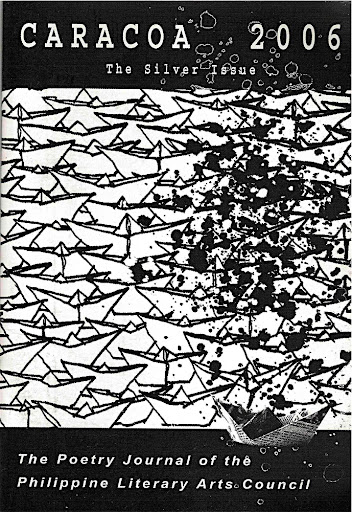
Voices New and Still New in Philippine Poetry in English
“The question may be posed,” wrote issue editors Joel Toledo and Lourd Ernest H. de Veyra in their introduction to Caracoa 2006: The Silver Issue, “as to whether or not Philippine poetry in English has undergone seismic shifts during the preceding interregnum that has been the past decade before this Caracoa revival.”(On what took place during that intervening period, at least for the Philippine Literary Arts Council, publishers of Caracoa, read the prefatory “Our Story Thus Far…” which is an unadorned update on the 25th year of PLAC.)
There are 25 poems and poets in the Silver Issue. There are some relatively new names, and others that are like visiting relatives from the Filipino Diaspora. But they are “new” only because poetry books are still hard to come by in the country’s bookstores and in the publishing industry itself (except in the university presses), and this is the first time I will be encountering their work, but also because some of them are quite young in chronological age, though evidently not in matters of craft. And, as the editors point out, “of the literary voices that appeared in [the] last two issues, about half have gone on to win awards and publish their own collections,” but with the oft-repeated and still valid caveat that “the rest [are] puzzlingly lost in the Bermuda Triangle of modern living, perhaps consumed by other concerns, such as corporate responsibilities, rather than and art and literary forms.” And so it goes.
Although it is patently difficult to generalize about an anthology of poems (the most individualistic and individuated of the arts, each poem a personal statement, as we all know), it is apparent that the poets in this anthology are among those who have found their way through and out of the Bermuda Triangle. And for no other reason, that also enables me to play favorites (the poems I will mention are in no particular order)—after all a reviewer is not unlike a judge in the Palanca contests, but one who not “blind,” though without co-panelists either to argue choices with, and whose sole criterion is personal taste.
In language, in giving one the feeling of almost pure texture (or pure feeling of place, no matter that the place is Nature itself), because that was what the poet probably intended, “Happiness in Other Planets,” despite its length, wins hands down. I agree with the editors that the author (whom I haven’t met and from whom I am reading something for the first time), Amado Bajarias, is “criminally underrated.” If he has a collection published, I must have missed it; a book perhaps will be the best argument against invisibility and neglect. The contributors’ notes say that Mr. Bajarias is “an avid birdwatcher…” and here he is the naturalist who lets nature’s lushness freely become his poems, in an endless, continuous, uncategorized list, where “…the quiet shoal / Of mid-sigh” can seamlessly become “…a high laugh / Haikuing / Into a sudden garden in June.”
While I gravitate now towards the minimal and the monastically bare line (perhaps because I have been a long-line writer myself, and still am alternately—no strict methods or preferences), the other poems I like, as above, tend toward expression and rendition that extend the poetic line almost to the right margin of the page. One is Arkaye Kierulf’s “Horses,” and the other is Alexander Agena Jr.’s notional ekphrasis, “Lady in an Imaginary Painting.” But I am fascinated with “Horses” not because of the long lines but because it is one of the few today that shows good use of anaphora and paradox (“I believe all windows look out to the same sky. / I believe in keeping secrets. / I believe there is sincerity in lies.”). It lets these tools of classical rhetoric, with their clashing images, run at a thundering gallop, almost crashing into the corrals of our sometimes timid consciousness, before reining them in just in time, their nostrils snorting, our hearts beating.
Reining in but letting out bit by tortuous bit, while pricking us with irony even if the poem starts with such a deceptively mundane and jaded task as listing yearend resolutions, is Naya Valdellon’s “New Year at the Wake.” Irony is all but don’t let Naya fool you with her alternately “disinterested” and tender language, as in some of her best poems probing the extremes of the apparent arbitrariness of life and dying, where darkness lingers behind the next corner and doom sounds like a term of endearment. This New Year countdown takes you “Between Christmas and the cemetery,” though with a warning that “Endings are my specialty. What keeps me going / is not faith, but curiosity.”
 Can happiness only be in other planets? Is everything a countdown to death? The paths these poets take lead us to the poetic mind, yes, the Filipino mind, reacting to, entering, the world around him in whatever language he uses, from whatever point of view. “Sooner or later you will go / To Araneta Avenue,” Israfel Fagela begins half-portentously in “Condolences.” He refers, of course, to that Quezon City thoroughfare lined with funeral chapels. He runs through in his mind the other funerals he has attended where “The bereavement is so intense / It is like watching them sift through / The ashes of the house they grew up in.” But the persona here, not particularly close to the dead, cannot utter his condolences to the bereaved, no matter how he might “Reach inside your wellspring / And offer water to his heart now shrunken / Like a sun-dried tomato…”
In Ken Ishikawa’s “The End of a Frontier,” the loss of one’s place of childhood and all the mythical memory that goes with it (“…suddenly memory becomes a betrayal”) is counterbalanced by a realization. Coming away from the past obliterated by lahar, he trips on an upturned root “and saw how the ash / scintillated its spread of diamonds in the dark / and wonder still exists, / hiding in the littlest of talismans.” Oscar Alvarez’s “Economy Class” possesses the talisman of keen observation as his world-wandering character lists down in plain language and wry metaphors his stopovers, from Amsterdam: “they’re volcanoes waiting / for the right visitor (that’s me) / behind the porn magazines at Schipool…” through Singapore, where “faces stand out like / nicotine stains in a sea of / generic white incisors” down to Manila, “like fake Vuitton bags that / turn into jewelry upon / touchdown.” Particularly saddening and emblematic is the persona speaking in Mikael de Lara Co’s “Tongues.” “I’ve stopped writing in a language / that doesn’t have a word for snow… In this country where there is no world for guilt … [he] borrows a word / to describe this: delikadesa. / That boy, he takes a cube of ice / and places it inside his mouth, / and speaks: snow. / The damp, bitter air / forms shapes with his breath. He sees places. / He is there." (Co is the Palanca first prize winner in poetry in English for 2007.)
Long-time residents of the Filipino Diaspora are also well represented here. Joel H. Vega, well-anthologized poet (here and abroad) from the Netherlands, in the poem “Interiors,” plies his delicate pen into the tensions of modern architecture: “…two vertical structural members / support a horizontal member called a lintel / creating a covered space / such close proximity…” to provide an objective correlative to domestic infidelity. From Napa Valley in California, Wilfredo O. Pascual Jr. unfurls the hilarious possibilities of “A Filipino in the Charlie Brown Musical.” The persona playing Schroeder, “brooding artist,” with fake accent, cannot get his lines straight and gets screamed at by the director; he gets his vengeance by imagining his father back home who, as Snoopy does his waltz, “hanged a dead dog / in a hook, / blowtorched it…” for caldereta. To this, Ateneo and Columbia University graduate Jose Edmundo Ocampo Reyes provides a Zen contrast with the shortest poem in the anthology, “Glimpses.” It is as momentary as it is cosmic: a view from the window of a lakeside cottage, “Two pine trees rooted in one space / are seen at once: one that remains / utterly still, and its shadow-twin, / branches shuddering in a wind made of light.” Jim Pascual Agustin, who has made Cape Town, South Africa his home since 1994, recalls the days after the fall of Apartheid in his “Those Who Still Have Black Blood Under Their Feet.”
Two “veteran” voices speak from America: Luisa Igloria, who is deep into mothering and a professorship in the MFA Creative Writing Program at Old Dominion University in Norfolk, Virginia, takes from her huge cache of poems stirred into being by almost everything. “Minim” takes off from a magazine article on the classic “suffering” artist Modigliani, which she reads while waiting for her daughter to emerge from piano lessons. It leads her to meditate on Modernity, “how cruel you’ve been / as Muse…” and “the painters from Manila [who] made their way to Rome and Barcelona” not sixty years before Modigliani, and Jose Garcia Villa “when he came to… write among the early Moderns: at best, a minor poet… the paradox of distance / infinitely halved, never sutured close.” From New York, Luis Cabalquinto is still the émigré who never left home, his hometown Magarao in Camarines Sur always lurking, peeking from behind the tense rhythms of his minimalist lines in “Details”: “the unnamed melody / playing inside the dark chamber / of your mind, rapt in rhythm / with the bright slow death of sun.” Cabalquinto’s poetry continues to be an effulgent ecstasy of memory.
A great deal of ambidexterity in the use of form, technique and rhetoric seems to be exhibited by the younger voices in Caracoa 2006. Franklin Cimatu (who is “young” only because we are still awaiting his first collection in a book) exercises his skills by exacerbating the already difficult sestina with a letter-jumbling wordplay on his subject and title, “The Manifest Destiny Routine, or My Fetid Sestina.” Transforming it into absurd variations (“Miss tenant deify” or “Aint my fetidness”) as the sestina winds around itself with its recurring end words, could have been hilarious if it were not about the sad history of our country. On top of this, the poem is only one in a series (about 30 now, according to the Notes) recreating the routines of the comic pair, Pugo & Tugo, popular in the 1940s-50s. I would like to be able to read the whole cycle that promises to be a valuable and artful artifact of this period of Philippine popular culture.
In the same vein, mark the peculiar rite of passage in Mark Anthony Cayanan’s “As Dina Bonnevie,” where a young boy discovers his father’s hidden Betamax tape of an archetypal Filipino “bold” movie, “Ang Babaeng Nawawala sa Sarili.” The luscious Dina Bonnevie (or her manifestation) “her calves limbered into eternity,” steps out of the TV into his living room. “…she lunged at me, her bronzed / skin, the pixels of her… I was what I could become…” This revelation and epiphany resonates in Raymond John de Borja’s “Tell Me, Where is the Soul,” an astute dissection of an actual dissection of a frog in the school laboratory. Asking this ultimate question, the poet perhaps becomes his own specimen: “…When we opened the heart, / we found more of the heart and nothing more… we were asked to scrape off / the skin and muscles, and name every bone— / here is where the heart was, / here the lungs, here the low croak.” Death, the void, is ever fascinating, whether you dissect it with scalpels or numbers, as in Rodrigo V. de la Peña Jr.’s prose poem, “Algebra,” where after a student leaps to her death from the top of the Humanities building, the other students become “painfully conscious of gravity, puzzled by integers in their disguises of x and y.”
All this contemplation of death and life’s ironies (their ultimate interchange-ability, despite how love tries to come in-between)—the doppelganger infidelity of “Weekend Couple” by Paolo Manalo, the in-your-face, internal rhyming stridency of Angelo R. Lacuesta’s “Modern Girls,” the deceptive equanimity of “Journey of the Flowers” by Glenn Atanacio—continues to be the proper subject of poetry. Caracoa 2006 does not lack in examples.
As chronicle and milepost for Philippine poetry in English, Caracoa is subject to the vagaries of funding and like-minded friends’ generosity, mainly through the initiatives and persuasive skills of its founders, especially Alfread A. Yuson and Gemino H. Abad. Caracoa must range the diversity of material available to it at the time it is able to come out. And yet, the number of contributions (eighty, trimmed down to 25 for the current issue) surprise even its editors, this time two of the country’s younger leading poets who perhaps had to sacrifice including their own works because of page limitations.
Poetry in English continues to be written in this part of the world. And written well, if we go by Caracoa 2006. Were there “seismic shifts”? In language and the physical world, the continents are always drifting. In both, they are always liable to collide.
ADDENDUM: Pancho Villanueva’s Art in Caracoa 2006
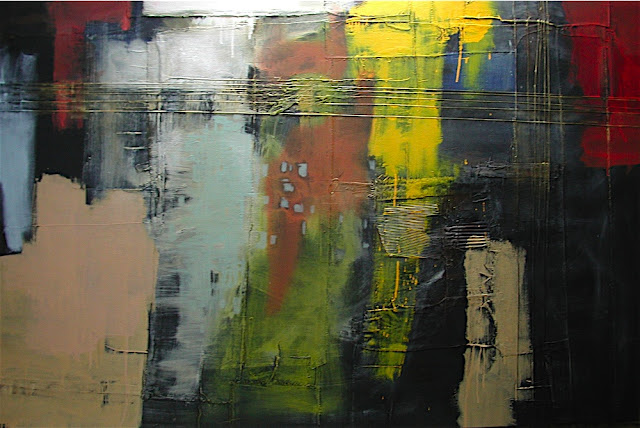
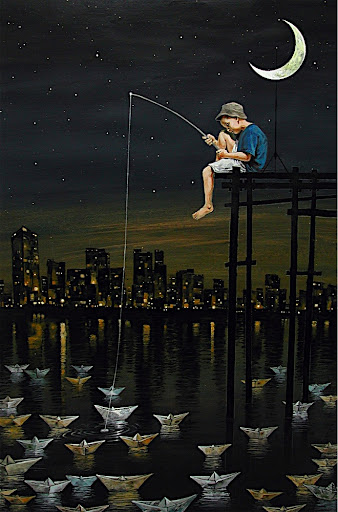
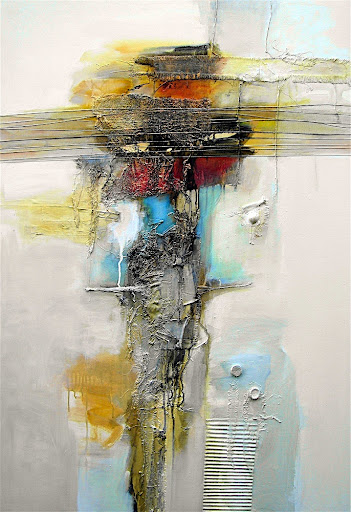
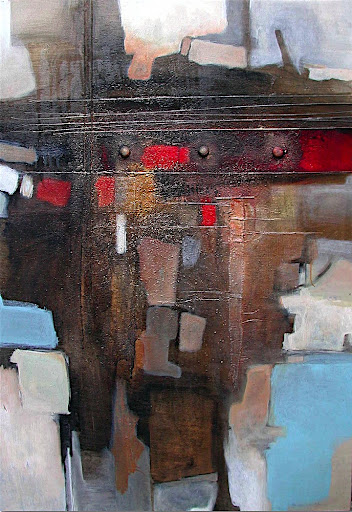
I must not neglect to mention the design and art of the issue. Caracoa has maintained its characteristic look through the years: a poet’s chapbook with off-white pages, sometimes with textured linen board cover, and always with lots of legitimate artist’s or artists’ illustrations, paintings, photography. Caracoa 2006 does not stray from the template. It was designed, with personal touches, by abstract artist Pancho Villanueva (whose works are increasingly being collected), who is himself seriously into poetry, being a recent “alumnus” of the Dumaguete workshop. Owing to their natural poverty, poetry collections are parsimonious about production values, and are thus printed in black and white. Publishing in the Internet, on the other hand, is quite inexpensive, especially via a virtually cost-free blog. Therefore some of Pancho’s paintings that adorned the book’s pages you will see here in their glorious living color. (REPROs: the Cover; "Dreamcatcher," frontispiece; Abstract 1, centerfold; Abtract 2 and Abstract 1, illustrative art)MARNE L. KILATES
October 8, 2007
The Philippine Literary Arts Council (PLAC),
publishers of Caracoa, celebrated its 25th anniversary last year. It was founded in September 1981 by prominent English-language poets Gemino H. Abad, Cirilo F. Bautista, Alfrredo Navarro Salanga, Ricardo M. de Ungria, and Alfred A. Yuson. Its Honory Fellows are Carlos A. Angeles, Franz Arcellana, Tita Lacambra Ayala, Erwin E. Castillo, Ricaredo Demetillo, Ophelia A. Dimalanta, NVM Gonzales, Edna Z. Manlapaz, Bienvenido N. Santos, Edith L. Tiempo, and Emmanuel Torres. Associate Fellows are: Cesar Ruiz Aquino, Juaniyo Arcellana, Fidelito Cortes, Jose Y. Dalisay Jr., Simeon Dumdum Jr., Marjorie Evasco, Felix Fojas, Eric Gamalinda, Cristina Pantoja Hidalgo, Luisa Igloria, Marne L. Kilates, Susan Lara, Clovis Nazareno, Charlson L. Ong, Danton Remoto, Ramon C. Sunico, Cesare A.X. Syjuco, Ma. Fatima V. Lim-Wilson and Ruel S. de Vera.The Caracoa
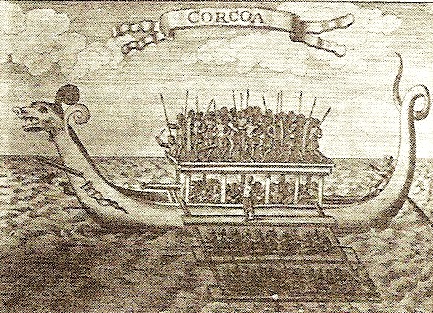 The caracoa was a war vessel plying the waters off Mindanao and the Moluccas in the 16th century. The rowers stayed close to the hull, while the warriors stood with their spears on a platform. The poet sat alone at the far end of the boat, manning the rudder. He was neither rower nor warrior, yet he decided where the prow should point. His own thoughts knifed through the immense sea of his solitude, though the waters kept him company.
In him was rower and warrior, he himself was a double-decked vessel of grace and irony. He was far back, yet provide direction. At times the caracoa lost its way. No matter. The sea would still be there, and the shoals would still be duly recorded.
Sunday, June 3, 2007

Our Own Voice, or OOV, the competent and nifty literary ezine that is home to the writings of many wandering Filipinos (roaming the world or in their imaginations, discovering frontiers and breaking down barriers), of which I wrote in a previous post, is back on the Net. And, as its tireless editor Reme-Antonia Grefalda wrote in an email in response to my rather panicky post wondering where the website had gone, it is back alive and full-bodied. It had just experienced one of these not-so-mysterious glitches about lost or purloined domain names, and now you can click its rightful link, http://www.ourownvoice.com and what will pop out is not some stranger traying to sell you stereo speakers. It has reason to be proud (like the pure white peacock on its Frontispiece, reproduced above, with quotes from featured poet, Filipino Canadian Patria Rivera): it's on its seventh year and 24th issue, its contributors Nadine Sarreal (former associate editor) and Corazon Amaya Cañete have been quoted by the New York Times, and the works of the winners of its Global Filipino Literary Awards will be catalogued and collected by the U.S. Library of Congress. For any Filipino sailing the tradewinds of the Net, OOV should be a safe harbor, a stopping point, a landmark. For any wandering other soul, it should be one of the first ports of call. Our Own Voice is back.
And it is back to its main subject, that of Being Filipino, wherever you are. For a taste, let me quote from Reme's "From the Editor's Laptop," and savor the theme of this new issue.
"A COUNTRY OF OUR OWN
"This issue is devoted to genealogists, archivists and family historians for their ongoing efforts on behalf of their family trees; proving that it is a work-in-progress, constantly added to and expanded; started by one and updated by others down the ancestral line. They are silent plodders intent on documenting their ancestors, digging deep for roots. Rarely compensated for their efforts, they are obsessed in pursuit of clues to connections binding families one to the other. "We each belong to a tribe, a clan, contributing our family stories of heroism and idiosyncrasies, and traditions that solidify into what in abstract is called “heritage”. No family member is tossed out of the tree. He could be a professional assassin, a rake, a black sheep. Members could be “anak sa labas”, a bastard, or adoptee. Still, each is connected, either vertically or horizontally, by a family branch or twig to the ancestral tree. Belonging is permanent. Always, family on a grand scale spells a sense of pride; in smaller units, a safe harbor for anyone lost or astray."
I guess that's enough to interest you and to celebrate OOV's return. So off now and click. It's the second name on my list of links, on the right column of this page.
(PHOTOS: 1. Our Own Voice frontispiece photo by Ding Yi Zhong; 2. The Gruta Family)
Monday, April 23, 2007
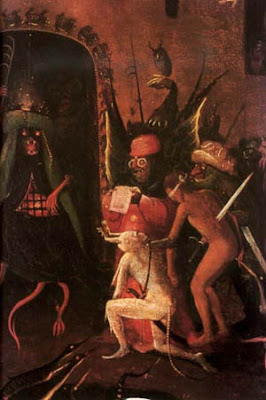 The Devil by Hieronymus Bosch (from Wiki)
Let us pause for a glimpse of the Devil in our present world (or at least in America). Our friend Luis (Luigi) Francia, Filipino poet at The Village Voice, and a member of our list-serve Plarider Papers, writes: “I got this from a friend circulating it to her friends. Feel free to circulate to your own circles as well.”
POETRY IS DANGEROUS
by Kazim Ali
On April 19, after a day of teaching classes at
Shippensburg University, I went out to my car and
grabbed a box of old poetry manuscripts from the front
seat of my little white beetle and carried it across
the street and put it next to the trashcan outside
Wright Hall. The poems were from poetry contests I had
been judging and the box was heavy. I had previously
left my recycling boxes there and they were always
picked up and taken away by the trash department.
A young man from ROTC was watching me as I got into my
car and drove away. I thought he was looking at my car
which has black flower decals and sometimes inspires
strange looks. I later discovered that I, in my dark
skin, am sometimes not even a person to the people who
look at me. Instead, in spite of my peacefulness, my
committed opposition to all aggression and war, I am a
threat by my very existence, a threat just living in
the world as a Muslim body.
Upon my departure, he called the local police
department and told them a man of Middle Eastern
descent driving a heavily decaled white beetle with
out of state plates and no campus parking sticker had
just placed a box next to the trash can. My car has
NY plates, but he got the rest of it wrong. I have two
stickers on my car. One is my highly visible faculty
parking sticker and the other, which I just don’t have
the heart to take off these days, says “Kerry/Edwards:
For a Stronger America.”
Because of my recycling the bomb squad came, the state
police came. Because of my recycling buildings were
evacuated, classes were canceled, campus was closed.
No. Not because of my recycling. Because of my dark
body. No. Not because of my dark body. Because of his
fear. Because of the way he saw me. Because of the
culture of fear, mistrust, hatred, and suspicion that
is carefully cultivated in the media, by the
government, by people who claim to want to keep us
‘safe.’
These are the days of orange alert, school lock-downs,
and endless war. We are preparing for it, training for
it, looking for it, and so of course, in the most
innocuous of places—a professor wanting to hurry home,
hefting his box of discarded poetry—we find it.
That man in the parking lot didn’t even see me. He saw
my darkness. He saw my Middle Eastern descent. Ironic
because though my grandfathers came from Egypt, I am
Indian, a South Asian, and could never be mistaken for
a Middle Eastern man by anyone who’d ever met one.
One of my colleagues was in the gathering crowd,
trying to figure out what had happened. She heard my
description—a Middle Eastern man driving a white
beetle with out of state plates—and knew immediately
they were talking about me and realized that the box
must have been manuscripts I was discarding. She
approached them and told them I was a professor on the
faculty there. Immediately the campus police officer
said, “What country is he from?”
“What country is he from?!” she yelled, indignant.
“Ma’am, you are associated with the suspect. You need
to step away and lower your voice,” he told her.
At some length several of my faculty colleagues were
able to get through to the police and get me on a cell
phone where I explained to the university president
and then to the state police that the box contained
old poetry manuscripts that needed to be recycled. The
police officer told me that in the current climate I
needed to be more careful about how I behaved. “When I
recycle?” I asked.
The university president appreciated my distress about
the situation but denied that the call had anything to
do with my race or ethnic background. The spokesperson
of the university called it an “honest mistake,” not
referring to the young man from ROTC giving in to his
worst instincts and calling the police but referring
to me who made the mistake of being dark-skinned and
putting my recycling next to the trashcan.
The university’s bizarrely minimal statement lets
everyone know that the “suspicious package” beside the
trashcan ended up being, indeed, trash. It goes on to
say, “We appreciate your cooperation during the
incident and remind everyone that safety is a joint
effort by all members of the campus community.”
What does that community mean to me, a person who has
to walk by the ROTC offices every day on my way to my
own office just down the hall—who was watched, noted,
and reported, all in a day’s work? Today we gave in
willingly and whole-heartedly to a culture of fear and
blaming and profiling. It is deemed perfectly
appropriate behavior to spy on one another and police
one another and report on one another. Such behaviors
exist most strongly in closed and undemocratic and
fascist societies.
The university report does not mention the root cause
of the alarm. That package became “suspicious” because
of who was holding it, who put it down, who drove
away. Me.
It was poetry, I kept insisting to the state policeman
who was questioning me on the phone. It was poetry I
was putting out to be recycled.
My body exists politically in a way I can not prevent.
For a moment today, without even knowing it, driving
away from campus in my little beetle, exhausted after
a day of teaching, listening to Justin Timberlake on
the radio, I ceased to be a person when a man I had
never met looked straight through me and saw the
violence in his own heart.
Tuesday, April 17, 2007
So, going back to that Wednesday, at the enchanted realm of Tilamsik ng Sining, after that sentimental and glorious ceremony of Vim&Elay’s renewal of vows, which was rather intimate with the presence of more than an hundred friends and family, here is the ultimate sago. 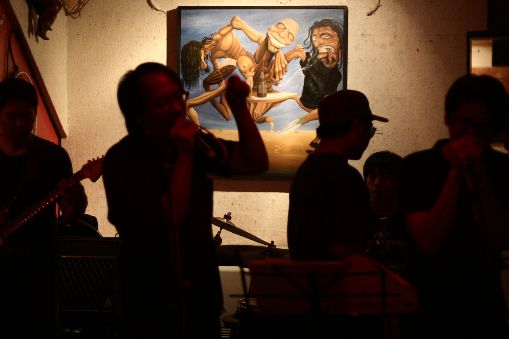
Lourd de Veyra, radioactive at Penguin Cafe, Friday the 13th of 2007
Mike Coroza, poet and poetry professor at the Ateneo, anachronistic authority on a lost, forgotten period of our popular culture, had just started his recount of kundiman and Tagalog popular music history, from the 40s to the mid 70s, at the peak and wane of the likes of Ruben Tagalog, Larry Miranda and Rick Manrique, to name a few of the landmark names. (Indeed he needs to write a book about it perhaps with an accompanying CD of the surviving recordings or his own vocal versions of the songs because he is a good singer himself. Tune in to his radio program on the subject on 104.3 FM, where he features the songs and surviving singers of the period/s.)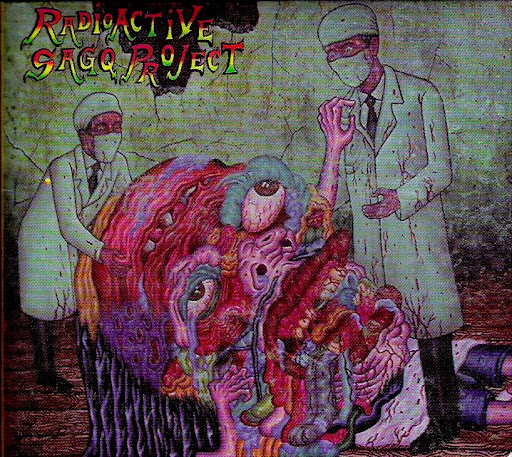
The new CD, "Tangina Mo, Maraming Nagugutom sa Mundo, Fashionista Ka pa Rin," handsome & elegantly titled, from Tierno Recordings
We were all listening open-mouthed to the exotic trivia of Mike’s impromptu lecture, when the Lord of Irreverence, goodfriend Lourd Ernest de Veyra, Lord Sago himself, beside his gracious, most charming significant other, Marj Lachica, hands me the latest CD of the Radioactive Sago Project. That’s after I asked him to visit my blog sometime, and was apparently surprised at the prospect. “Really, you’re blogging now?” he says, as if it was the strangest thing in the universe (or as if the universe had conspired to make it happen finally), as he reaches over to fish something out of his mailman’s bag, then slung over the shoulder of Marj, and hands me the CD. It has a longish title, cited in the caption above, so let's just call it The CD.
Now, I have always been a fan of this group with their trademark rambunctious performances (notoriously exemplified by the “Gusto Ko ng Baboy” number), but maybe for reasons different from other people’s. The common liking of course would spring from their brand of droll and irreverent humor, especially delivered in Lourd’s baritone monotone (a fake one because this guy cannot be other than musical), a voice so acutely bored with the world, dripping with Weltchmerz but barely suppressing a snicker. If only for that, apart from my bias for poets who are musicians besides, this group already ranks in my list. (How high? Secret.) 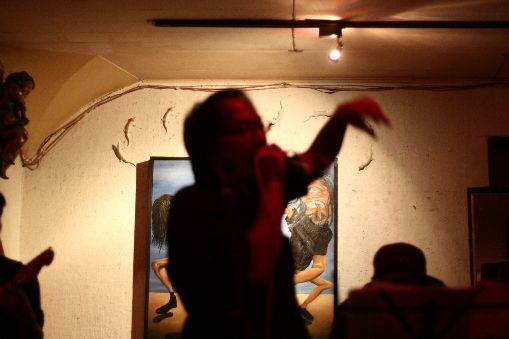
Lord Sago, ballistic
I refer to their stylistic breadth, their big elephant ears always wide open and scanning the musical noosphere for new tunes and new ways for making and playing them, and having fun in the process. Which makes Sago more mature (if that’s a value in the music industry) than most of their contemporaries, and which adds both sting and sentiment to their wry and playful music-making. This is un-obvious to many who turn off to or after hearing “Baboy.” It’s the 45-rpm Single Syndrome in this age of the 60-minute CD. You buy a whole album because of one song (happens to me sometimes), or you don’t because you don’t care about that one song in already nauseous radio play. But in my case, I buy the CD or album because that song stands out for its possibilities which can only be sampled through the other songs of the group, in the CD. In building up my collection for my CD shelf and playlists, more of one group is better until they wear themselves out in my appreciation (which seldom happens: when they’re good, they’re good, they’re worth coming back to).
So, 45rpm Syndrome or no (this is what I like about blog, it allows me to ramble), it’s worth listening to Radioactive Sago if only for their literate allusions and quotations from the sources of their musical wanderlust. Well, I won’t apologize for the prejudices of a hoary listener like me. My own enjoyment is taking the tour with them in their perambulations and peregrinations in strange landscapes, which is what I expect of musicians who I presume are as good a listener as myself (I like to think). It pleases me when I hear something that reminds me of my own ramblings as a listener, from a naïve pop fan born to bubblegum (“Love, love me do! You know I love you!”) to a curious listener looking for the sources of fusion, crossover and mainstream (how does the original Trois Gymnopedie sound after first hearing it from BS&T, or God Bless the Child from David Clayton Thomas—one had to go back to Billie Holiday and found a new world in old, mainstream jazz; who in the world was Varese to whom Chicago paid tribute in the fifth album before the dumbing down by Peter Cetera?).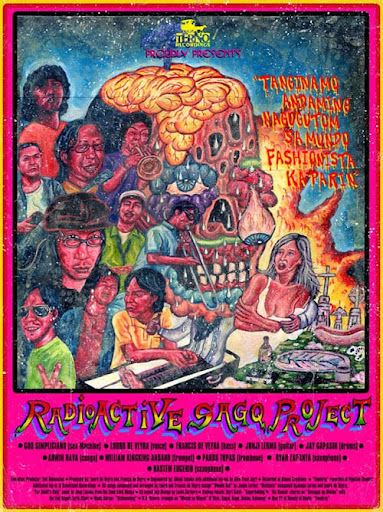
The glorious, even handsomer poster: an insert in the CD case
Certainly this is a most personal way of finding something worth listening to in any new music, but finding it—lineage trees of styles and genres—in Radioactive Sago will be a surprise to many (not to me, I watched—vicariously, anyway—and read Lord Sago himself ruminate in his essays about music in his childhood home in Kamias).
Premier novelist Charlson Ong (of Banyaga: A Song of War fame) rides with me and asks who was playing on the car stereo and I say that’s Radioactive Sago, and he says, Oh do they have that kind of music, and asks for the CD cover. Sago was playing ‘George Estregan Groove Explosion’. Before then, listening to it on my own, I had been excited by its urban jazz rock rhythms, with its ‘blowing’ or brass section a vital part of the arrangement, which I miss in contemporary radio. The title gave me a wicked send-back to the sins of my puberty, my secret sorties to the bomba movies. Indeed George Estregan (requiescat en pace) was an icon of those days, with Merle Fernandez (older?), etc. The same goes for the track ‘Raul Aragon-Ricky Torre,’ which has a rather poignant Miles Davis-ish ring to it but gives me a pinch on the inside of the thigh (grade school punishment for naughtiness), if I remember who Raul Aragon was, or Ricky Torre, who I can’t. Lourd, refresh or correct me on this.
And then I skipped to Mambo Rat, which starts Charlson snickering:
“May dagang magaling sumayaw…
"Parang Tito Eduque pag siya ay gumalaw
Nababaliw ang babae at napapasigaw…
"Todo adik sa keso
Super-swapang sa chicks
Sa Havana babanat
Iyan ang Mambo Rat!”
Mambo Rat is a very Filipino musical gag on the immigrant Cuban club band romance, which enables Sago to get away with the ludicrous obscenity of the title and the insidious ‘innocence’ of the lyrics. You’ve been long given up as incorrigible by your GMRC teachers, Lourd de Veyra. That’s Good Manners & Right Conduct for those born in the 70s and later.
Radioactive Sago goes really nuclear with “Superhatdog.” Significant other Marj Lachica provides the voice of the narrator in a futuristic post-Armageddon Filipinas where the only means of survival and salvation is the mystical theobroma called superhotdog:
“Taong 2069, tuluyan nang napinsala ng tao ang mundo.
Tuluyan na ring napinsala ng Pilipino ang sarili niyang bansa,
nang dahil sa kasakiman, katangahan at, peke na maling.”
Strewn with discarded cans of fake maling (popular MSG-laden ersatz luncheon meat previously smuggled from China), dark are the alleys Sago walks, telling of a burning city (“Nasusunog ang Maynila"): “Tahimik ang gabi, tulog na ang mga aso… Ito ang iyong siyudad, ito ang iyong sementeryo…” Ang Kiukok-esque in its menace, the conflagration scene limned by a pyromaniacal vocal solo and guitar arpeggios, punctuated by catastrophic brass and bass sections (with passages from Chicago’s ‘While the City Sleeps’), only to be followed by a delivery of the TV news which turns into the giggly ranting of an idiot accompanied by a coda of “When the Saints Go Marching In.”
By the time the car stereo reaches the last track, Charlson and I are thoroughly enjoying ourselves as Sago does a take on Indian raga, again quoting from George Harrison’s “Within You, Without You,” (from the Beatles’ Maharishi period), mixing the mystical with ball court cheers in that wacky refrain “Ay, ay, ay, sisboombay.” Real radioactive.
(Photos of Lourd courtesy of Lord Sago himself; the poster was filched from www.radioactivesago.com, the official Sago site. Of course the new CD is never the 'ultimate'—just a manner of speaking—there should be a lot more coming from this group, outstandingly insane and like no other in the new Filipino music.)
MARNE L. KILATES
Friday, March 16, 2007
Speaking in Tongues in the Purple Season (IV): Excerpts from Fidel Rillo’s Intro to Sonetos Postumos
0 comments Posted by Marne L. Kilates at 10:23 AM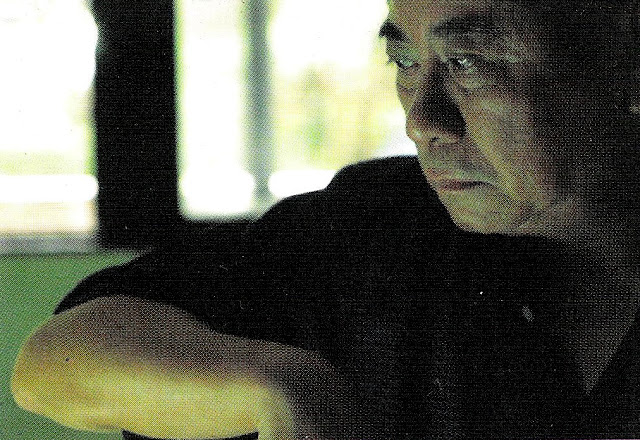 National Artist Rio Alma by Nap Jamir
There is a recurring line in Rio Alma’s poetry that has framed much of his themes in a career that spans nearly five decades of inspired creativity. That line, sa pagitan ng hininga’t kamatayan (literally between breath and death), encapsulates a universe that blasts and expands into infinite poetic possibilities once triggered by the poet’s imagination. It is, in a way, a simple tool that allows the poet to alter to whatever forms he wants the conventions and limits of the form itself to push his agenda of expressing what to him is a truly Filipino experience. 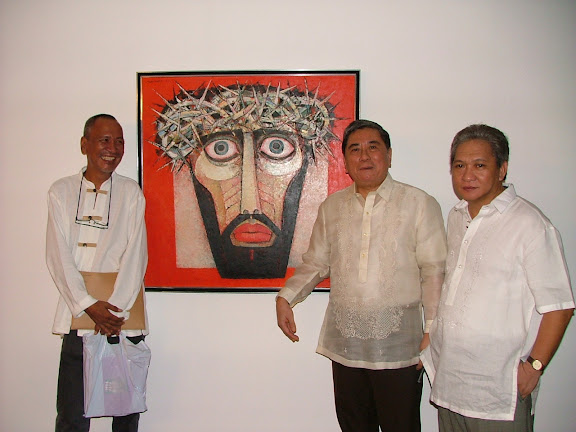 Fidel Rillo, Rio & me during the launch at CCP
The line itself is of course culturally conventional and the linear time implied is quite universal in bookending human experience. Birth and death anyway are the two ends of a pole upon which hangs man’s entire existence, though death is said to be a concept acquired quite late in the long history of the species. As commonly thought, man is the only living thing conscious of the concept of time and is thus the only being aware of its own mortality. This time-consciousness, considered an essential factor of rationality, has since formed man’s concept of himself and his environment, and his ventures into and explorations of the temporal wilderness of past, present and future have produced countless meditations on the inevitability of death and its finality.
This is not the case, however, in the time-consciousness of Rio Alma’s recurring line. His is socially engaged, using man’s concept of mortality to frame a gamut of experiences from the common to the sublime. This in itself is nothing new as far as Filipino poetics is concerned, which carries a load of works not lacking in value as far as social significance is concerned but is often weighed down by the pomposity of its aesthetics. Rio Alma bears no such baggage, and his poetry often steers clear of deadends, embarking instead on a journey through time and consciousness that intersect in aesthetics wide enough to accommodate his and his people’s experience. Sa pagitan ng hininga’t kamatayan is that frame of time and space, universal in scope and breadth but always grounded in the Filipno experience. 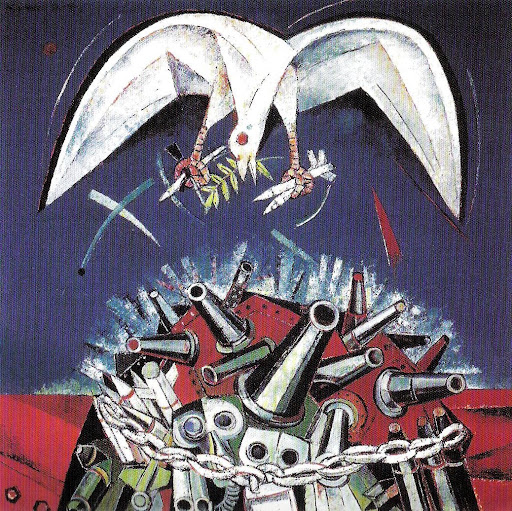 Junkscape with Dove by Ang Kiukok (from the book)
It is the same time-consciousnes that supplies the knowledge that nourishes the politics of his works, from the apocalyptic cogitation of Makinasyon (his first book), the journey through the heart of darkness of Peregrinasyon, the partisanship of Doktrinang Anakpawis to the self-assessingf Palipad-hangin (his most personal, and his best) and Mga Retrato at Rekwerdo (which includes “Sa Iba’t Ibang Panahon,” to my mind the best poem in Filipino ever written, bar none).
More elaborately, through his literary criticism (bylined Virgilio S. Almario, his real name)—which proposes—Rio Alma has outlined a dynamic program that draws inspiration from the works of writers of the past while conducting investigation among the works of young writers to ensure a continuum that will elevate Filipino poetry to the level he envisions, and to which his own poetic output—which disposes—contributes a lot.Truly, Rio Alma is deserving of the National Artist recognition bestowed upon him by a grateful nation.
• • •
Sonetos Postumos… is not a journey into the unknown and, despite its somewhat otherwordly title, is certainly not beyond the linearity of the hininga’t kamatayan of the poet’s earlier works. “Posthumous” or postumo, a word used to signify something that continues or arises after death, could also refer to someone born after the death of the father. If so, could that someone be the present with its technology-driven concepts of life, sins, salvation, resurrection and mortality, themes which inhabit this collection? And could the father be the past with its slew of saviors, messiahs, prophets, magi, poets, artists and philosophers who had extolled virtues and damned the consequences of sins? Notice that these are the very same concepts that share commonalities among the major religions of the world, the foundation of which stemmed from human needs and fears. Whose death then does the postumo signify? Could it be that point in history when the human mind ceased to wonder about the terrifying aspects of unexplained phenomena hitherto ascribed to gods? The time perhaps when someone like Epicurus (referenced somewhere) exposed the pernicious nature of religion? Or the time when Nietzche declared the death of God? And what is it that continues after death?
• • •
By relocating the drama of these themes to the significant places in the land from which sprang three major religions, Rio Alma has provided the transcendent thread to which can be stringed, like rosary beads, his interpretations of the significance of human life and destiny without falling into the traditional traps set upon those whose incremental approach to the truth often ends up in archaic subjectivism. Likewise, he conceptualizes time and memory, using that which is familiar, to anticipate, interpret, structure, and control his present environment.
Thus, the use of Biblical sites as titles to the poems does not fundamentally universalize the experience in a doctrinal way but renders a temporal line that engages both the past and the present while providing a space that provides as much ironies since most of these are the sites of present-day conflicts. And also, since landscapes are always multitemporal, these ancient holy grounds provide for the present not only specific memories associated with particular objects of material culture but also cultural traces and remains from different ages.
I presume Rio Alma is a Christian, as most of his readers are, and the convenience of historical and theistic grounding adds accessibility to the meanings of the poems since this is the central axis around which the poet makes loops in time that effortlessly enlarge and expand to suggest movement in time though viewed from different perspectives. As tangible metaphors, the landscapes are useful in thinking abstractly of concepts such as time itself. By moving the actions many generations back, the age-old concepts in the poems are once again experienced, thus making more sense to the present and becoming real to set the mind on future things. But since relationships to the past are metaphorical, the real is not represented but created.
In a way, Rio Alma’s “version of history” can be considered as what some Western literary critics call an “invented tradition,” defined as “a set of practices, normally governed by overtly or tacitly accepted rules and of a ritual or symbolic nature, which seek to inculcate certain values and norms of behavior by repetition, which automatically implies continuity with the past.” One of the functions of this is to socialize people into particular social contexts. Rio Alma’s method was the same one used by the early Christians, including the writers of the gospels, who tried to fortify their collective memories of events in the life of Jesus by connecting them with locations that were already meaningful in the Jewish religious tradition of the Old Testament.
The same is true of historicity which, by the way, is never claimed in any of the poems. Rio Alma is not concerned about giving testimony of past events that took place somewhere else, as accurately and truthfully as possible, but is, instead, making meaningful statements about the past within the cultural context of the present, his present. Connections of experience are made through sheer etymology or the physical characteristics of the sites as in, for example, Aenon (literally a place having a great quantity of water) in the poem voiced by John The Baptist.
Clearly, the poet aims to make his “version of history” meaningful to the collective subjectivities and self-identities of the particular group he addresses. There is not even a coherent methodology in the poet’s presentation, but rather a consensus of assumptions and prejudices he shares with his audience. Thus, various references from different doctrinal and cultural sources are often cleverly intertwined to create a unifying bond of philosophies. Such referential knowledge come in forms like chants, mantras, quotations and allusions derived from such diverse sources like the Egyptian Book of the Dead, the Tibetan Book of the Dead, the Bhagavad Gita, The Bible, Divina Commedia, the Pasyon, Florante at Laura, Ibong Adarna, Sufi poetry, ancient proverbs, popular songs and historical figures like Plato, Nietzche, Alejandro G. Abadilla, etc.
The technique used by the poet to achieve this aim was probably what the critic Walter Benjamin had in mind when he described his method of work as literary montage and collage, the former as the cutting and reassembling of fragments of meanings, images, things, quotations, borrowing, to create new juxtapositions; the latter as direct quotation, literal repetition or citation of something taken out of its context and placed in another, a simple questioning of the notion of representation as finding some correspondence with an exterior reality. The aim is to construct something new out of old, to connect what may appear dissimilar in order to achieve new insights and understanding. The result is transcendence, which enables the poet to relocate even texts paraphrased or translated from sources such as Psalm 23 and Shakespeare’s Sonnet XVIII and make them integral to particular locations.
Like the Internet’s hyperlinks, these separate entities or diverse aspects of knowledge from different cultures become doubly meaningful and make better sense once connections are made. Much of what the poet is trying to forward or argue is self-contained in the individual poems but can only be fully comprehended and appreciated by considering all the poems in the cycles and in the context of the entire collection.
Sunday, February 25, 2007
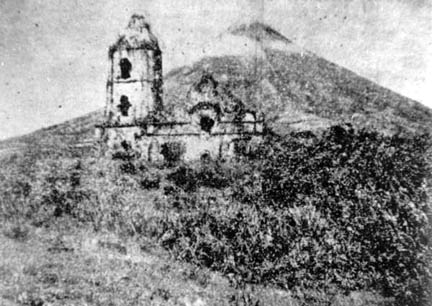
Old Kagsawa, with nave still intact
A POEM & FIVE TIGSÍK
By Rafael Banzuela
Translation
by Marne L. Kilates
AN LALAKI SA POON KAN BULKAN
Anas na lapak an saiyang mga palad
Dai na mati an gabat kan mga unsag
Sa buhay kan asadol asin minasbad.
Turog sa tanglay, pukaw sa daplos
An lalaki sa poon Bulkan Mayon
Dusay sa daga, daing tunong an igos.
Igos tios, ogak tigbak iyo man giraray
Sa sumada kikaabotan daing pagka-iba
And pagkakan aro-aldaw maluto, gulay.
Kung magtangad, langit; dumuko, dugi
Mangalagkalag man mahiling awot,
Pananaw abot sana sa hahaleon na ati.
Niyog, paroy, batag, doma, mga gulayon
Dolot sa banwa tanganing dai magutom,
Kan lalaki sa poon kan Bulkan Mayon.
Mga palad na pano ki lapak dai na bati
Dagos an angos sundo sa sunod na uson,
Sa unsag kan buhay ngorol na an mati,.
MAN ON VOLCANO SLOPE
All rough callus is the palm of his hand,
Numb to the weight and fall of the strokes
Of a life spent toiling with bolo and hoe.
Asleep, dog tired, he is wakened by sweat
The man on Mayon Volcano’s slope;
Intimate with earth, he never shuns toil.
Toil and suffer, idle and die, is all
It adds up to: each day no different
As he feasts on green vegetables and rice.
Look up, there’s the sky; look down, mud,
Gaze around and all there is weeds,
Horizon is a pile of dirt he must clear.
Coconut, paddy, banana, root crop, green leaves:
Gifts to the town to keep hunger at bay,
From the man on Mayon Volcano’s slope.
All the callus on his palms he no longer minds,
He lives between each surge of sulfur and mud,
Each stroke of a life dulled at the edge.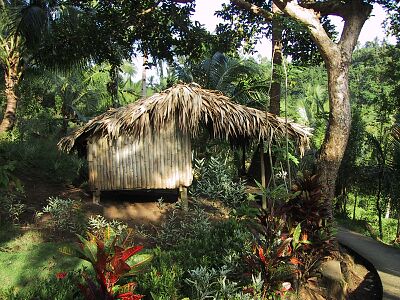 Hut in Tiwi (by Jun Balde)
LIMANG TIGSIK
1.
Tinigsik ko ining maputing bote
An habo magligok dai magrani
Kaming aranion gabos nawiwili
Sa lawas na garing mga butete.
2.
Tinigsik ko an saimong ablada
Na may piday kang manlima-lima
Sitsik sana ngani kan saimong ina
Buklos ka tolos, nagkakadarapa pa.
3.
Tinigsik ko ining upo
Iyan an istorya mo
Bayai daw Rodolfo
Matua ka sana sa ulo-ulo.
4.
Tinigsik ko siyang konsehal
An katuyuhan niya sabi banal
And pinta kan saiyang kudal
Kakolor kan edipisyo munisipal.
5.
Tinigsik ko sindang mga miron
Nagmamati sa tigsik kong magayon
Sige an tarango-tango, gabos aboyon
Daing pagkaaram daing siwo an bûyon.
FIVE TIGSIK
(Tigsík is a traditional Bikolano drinking verse, so called from the sound of the glasses of wine being clinked in a toast. ‘Mag-tirigsikan’ in Legazpeño; ‘magsarantikan’ in Nagueño, but the poetic form is Tigsík for both. It consists usually, not strictly, of eight- or twelve-syllable lines—the traditional verse measure common to Philippine languages—in a four-line monorhyming stanza. By nature, it always starts with a toast: “I drink to…” and goes on with its dose of humor, usually ribald. In the modern manner it is also used to comment on life and society.)
1.
I drink to this fine crystal glass
He who won’t quaff, don’t come near
We gathered here are enjoying ourselves
As well as our pot bellies.
2.
I drink to your tall stories
Sure, you got five girlfriends
But just at your mother’s psst,
Off you go stumbling home, in a jiffy.
3.
I drink to this gourd, upo
That’s the story you tell me
Oh, spare me, Rodolfo
You’re just older than the ulo-ulo.
4.
I drink to the councilor of the city
His purpose, his says, is noble
See his newly painted fence, how pretty
Its color’s the same as the City Hall’s.
5.
I drink to all you, onlookers,
Listening to my beautiful tigsík,
You nod your heads but forget
In a spoiled egg there’s no chick.
[Raffi has a natural and sometimes traditional Bikolano cadence and accent to his prosody that gives it a clear and evident public voice, due perhaps to his practice as broadcaster and commentator. Watch: “Dagos an angos sundo sa sunod na uson.” This wordplay and sound-play cannot be readily reproduced in translation; it can only be enjoyed in the original. Translation, ever humble and respectful of both the original and the translating language, must invent its own devices, fork its tongue, so to speak, to ‘trans-relate’ the poem’s utterance in the voice of strangers—convey it in another set of habits of the tongue, to another set of ears.]
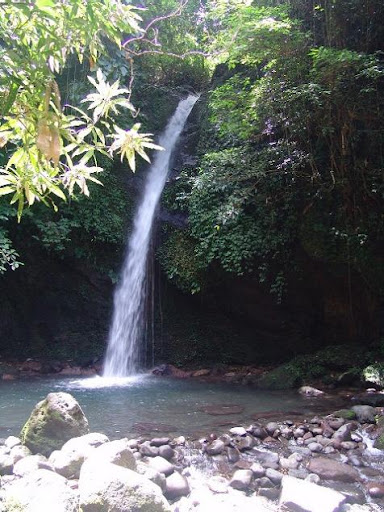
(photos courtesy of Jun Balde)
TWO BIKOL POEMS
By Juan Rafael Belgica
Translation
by Marne L. Kilates
BUSAY
Tunog na atang kan panganoron
Pinunpon kan mga sanga buda dahon
Idinugdog sa sulay na gamut
Natipon, pinadaba kan mga lumot:
Burabod na sa tabo kan panahon
Masupay, mapa-anon, hahanapon
An sapa, an salog, an danaw, an dagat
Babayaan an inulnan ta pighahalat
Kan saldang para baduan kan kinang
Na hinabol kan mga bitoon na dai mabilang.
Mahale, mabulos, mapaaram
Sa lomlom na pungaw dai makataram
An naka-ulang na gapo, sangang balagbag
Tunay na maantabay sa paglagalag
Sarig na pagtobod, kusog ki daghan
Minakalot ki bagong dalan
Ano ang makakapugol, makakapaluway
Sa pagsusog kan agihan na dai pa iway
An sapa minaabot sa dagat, inanay.
An sa hampas, an langit minagibong tulay.
WATERFALL
Dew the gift of cloud
Gathered by branch and leaf
Sprinkled on spread of roots
Kept, nurtured by lichen and moss:
Spring that in time’s dipper
Runneth over, drifting, seeking
The rivulet, the river, the lake, the sea
Leaving its afterbirth as the sun
Waits to garb it in the sparkle
Woven by countless stars.
Then it goes, flows, takes leave
In the darkness of longing, stones
Are speechless, branches cannot bar it
Instead they are bridges to its drifting
Abiding faith, stoutness of belief
It carves a new path
Who can stop or slow it down?
In seeking out the absent pass,
The stream plods to the sea.
But from a cliff, the sky is its bridge.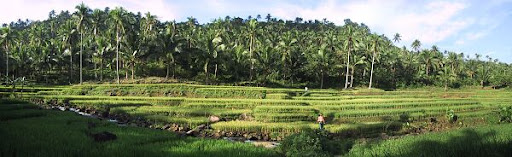
MANITO: ENOT NA BUKLIT
Kun igwa ako ki posporo
Pwede kong ilaog an mga tinampo:
Hale digdi, sa payo kan palito
An simbahan, sa gilid an munisipyo.
Hale sa tahaw, pababa, an teritoryo
Kan madudunong, kan mga para-turo.
Sakay sa bisekletang saro ang rweda
Burabod kan dai mabilang na pagbida-bida.
Sa may wala, mga nagkapirang dupa
Nagpapahiringalo na an pigmimidbid pa
Kaipuhan an tinambak na isog buda orag
Kun malabay ka pagdulag kan liwanag.
Kun igwa ako ki posporo
Ang sakong inulnan dai makaka-husto:
Sa likod, an lukban na palasayo
Kan mga pansugat kan dalo-dalo,
Sa atubangan, minadaralagan
Ang mga kabayong huba pagmina-uran
Sa too, dai magbano, magtino
Diyan minaligid an santelmo.
Pagtugdon kan banggi, an mundo
Pwedeng ilaog sa kahon kan posporo.
MANITO: FIRST PAGE
If I had a matchbox
I could fit the streets into it:
From here at the match-head,
There’s the church, beside it, the town hall.
From midway, outwards and down-slope,
The countless days of fun and fear begin,
Astride a monocycle,
A source of endless stories.
To the left, after a few pairs of arm-lengths,
Those whose faces I can’t make out are taking a break
You’d need lots of nerve and grit
If you must pass them at dark.
If you had a matchbox
My afterbirth won’t fit in it:
At back, the palace of thorns
Of the pomelo tree,
In front, there gallop
The horses naked in the rain,
On the right, never pause or make a remark
For there lurks the fireball of St. Elmo.
At the roosting of night, the world
Can fit in a matchbox.
[I must remark the quality and virtues of the original text: its ingenious weaving of images, its use of emotionally laden words close to the heart of every Bikolano, such as padaba and inulnan. In “Manito” (the poet’s birthplace), the poem fits the streets into a matchbox, but his inulnan, because of its magnitude, is the only thing that cannot fit into it, even the world itself can, ‘at the roosting of night’. “Waterfall” starts from the dewdrop that is the ‘gift of cloud’. It is an intricate poem that traces the dew’s intricate path from the cloud to the leaves and roots of forest, where even the stones and branches are ‘speechless’ and cannot bar its path to the sea. In end, when the waterfall has to leap from a cliff, the sky must create a bridge for it. Nowhere in Bikol poetry before it have I seen such sparkling new images.]
Orolayan, Orosipon (II): Two Poets Out of the Shadows
1 comments Posted by Marne L. Kilates at 2:52 PM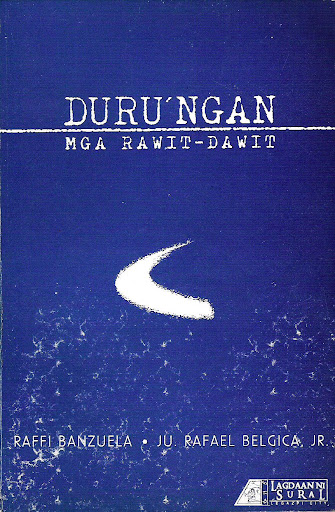 At the beginning, or at the other end, of our highways, lies buried our afterbirth, the inulnan or placenta, a word so important in Bikol. This makes our hometowns more intimate than the motherland itself. ‘Ulnan’ or ‘ulunan’ is pillow in Bikol, ‘inulnan’ is that which served as pillow, a cushion for the head (and foetal body) against bump or injury, within the mother’s womb. Apart, of course from providing the store and conduit for foetal nourishment. ‘Ulunan’, which has a cognate in Tagalog (there are more similarities in our languages than differences, I always like to say) refers as well to that place, inside or outside of ourselves, where our head belongs, where it returns for shelter and comfort—memory itself. ‘Inulnan’ figures much as a symbol in one of the two Bikolano poets’ works whose poems I will feature here.
[Apologies for the endless quotation marks on the Bikol words, I can’t italicize in Safari—this search engine of Mac—when blogging or emailing. Blogspot says to better to use Mozilla Firefox or Explorer. I have to shift to either. When italics appear and fonts are better looking (the bold should be bold, italics italics, smaller fonts where they should be, as in captions) then that means I’ve shifted to a better search engine. Bear with me in the meantime, dear readers and visitors, and suffer the typographical illiteracy of this blog.]
So back to Orolayan. It just so happens that these two poets I am about to present are personal friends of mine. But that doesn’t deprive me of the right to endorse their poetry, in Bikol, and what they did for their, this, our, native language, the language of our birth and afterbirth, and maybe rebirth. Ladies and gentlemen, the two Rafaels of Bikol poetry: Juan Rafael (Jun) Belgica, Jr. and Rafael (Raffi) Banzuela.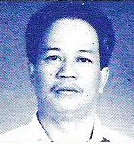 JUAN RAFAEL BELGICA, Jr. is the son of Juan (Johnny) Belgica pere, the last of the Bikolano poets who were adepts at the craft of rawitdawit either orally or written, beloved school official, and friend of my father Eugenio (who together with his brother, Tomas, published Bikolandia, the first Bikol magazine, after the war). Jun, fils, equipped with genes and heritage, himself a man of many interests, from history to political science to economics, has not just picked up where his father left off. I daresay his first poem in Bikol, “Sa Lukunlukunan kan Pantalan,” has upped Bikol poetry another level. I consider it, for reasons stated below, the first modern, contemporary Bikol poem. (It will need some work in translation so I will only be able to feature it here in the future.)
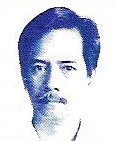 RAFAEL BANZUELA, constant loner and earnest individualist (as I recall from our college days, like his friend Alberto Realubit), sharer of bottles of brandy and beer, is an accomplished and award-winning broadcaster, former radio station manager, and lately head of the Mass Communications Program at Aquinas University. I have worked with Raffi in the college publication. After college he wento into professional broadcasting and local journalism, writing his pieces in the Bikol language, at which perhaps he resolved to go back to his literary roots. But for me Raffi, apart from being a premier Bikol poet, will always be the introspective denizen and intense memory-collector of his beloved Albay Viejo (the title of his book of essays which I hope to review sometime in this online journal, and to which I hope he adds another volume).
Together they persisted, since the 70s—when nobody was looking, when Bikol literature was dead—in writing their Bikol poetry. Like two conspirators (because I was not in on their plot), they were honing their skills, steeling their guts and perfecting their stances and routines like Kung Fu masters, laying out their stratagems sub rosa, in hiding, in the shadows. Perhaps before midnight they would lurk and sniff around like whiskered, cold-nosed mammals at the Peñaranda Park, into the wet markets of Camalig, Daraga and Albay: in the morning they would watch from among the canopy eaves when the fish crates and bañeras were being unloaded, and they would loiter in the din of the haggling and calling among vendor, barker and suki, when the stalls were all boarded up at night, or when Albay Gulf was chuckling and licking the joints of the spindly limbs of the Legazpi pier. This last mentioned sounds better in Bikol—“Sa Lukunlukunan kan Pantalan” (mentioned earlier)—Jun’s seminal Bikol poem written in college where we—he—proved that the Bikol language was capable of carrying modern sentiment and sensibility, with all its angst and Weltschmerz, but also (together with Raffi) setting it on a trajectory of triumph and hope.
So that when they came out of the shadows, before any other Bikol poet or coterie of poets could come out of their own, I was in awe. But they were unsung—in the invisible world of local publishing, and all the more so because they were writing in a language (a major Filipino language) that was just in the process of reviving itself, in no small way through both poets’ efforts. So, in the only way I know (in brief but earnest appreciation and in sample translations), I am now trying to make up for what could have been lost.
Raffi and Jun had engendered their, as it were, illegitimate offspring (English and Filipino were the only valid languages for poetry, it seemed): a healthy, frisky, resolutely wailing firstborn, a two-author book called ‘Duru’ngan’. The meaning of the word eludes me but it sounds like ‘durungan’—in Bikol, things happening or people acting at the same time, in unison, in rhythm. With its apostrophe, however, which looks like a substitute glyph for the glottal stop, it also sounds like ‘the place where you look out or down from, as in a window, ‘durungawan’. (Bikol still must develop its own standard orthography complete with diacritical marks; in another poem I first translated ‘tunog’ as sound, which was actually ‘tûnog’, with the glottal stop, meaning dew or dewdrop.) Unfortunately the book doesn’t provide a clue or intro. So I’m guessing (as with some of the other words I have forgotten or am no longer familiar with, with my writer’s Bikol definitely rusty). Still I share their passion and confidence, their enterprise, their audacious love, their great leap in language, when they declare, in the introductory poem (a collaboration) of the book:
Tuminangad kami sa sirangan, nahiling su daliwawa.
Masalingayahon. Kami man.
Mas pang pina-ogma kan mga oni kan mga bayong.
Magayonon. Su mga bayong. Kami
Gauod nagging pusiw—nakiutaan sa mga tunog—
Mga sadit na aking nakakupo sa daghan
Kan mga nagbabarayleng dahon,
Mga brilyantito sa nagmumuklat na aldaw.
Sa kasalingayahan, sa kagayonan
Kan nagbubungkaras na daliwawa kami namungnan,
Nagimadmad: an tunog
Saro-saro, luway-luway nagbuburutas
Sa pagkakupo sa daghan kan mga dahon
Na pagal na sa pagbayle sa tabyon kan sonatang dolot
Kan mga bayong na pasaro-saro ngani man—
Garing sarong orkestra—inabot an ultimong nota.
Su mga tunog napara, sa hinalean, nagbuelta.
Dayaday, nag-apwak an alangaang, kami napagios
Napabungkaras, sarong pangatorogan palan…
[Translation for non-Bikolanos:]
We looked to the east and saw the dawn.
It was radiant. And so were we.
We rejoiced even more at the singing of the birds.
Beautiful. The birds. We,
Perhaps, became a pusiw—and made small talk with the dewdrops—
Tiny children clinging to the breasts
Of the quivering, dancing leaves,
Tiny diamonds in the blinking eyes of the waking day.
In the radiance, in the splendor
Of the rising dawn we were stunned,
And stirred from our daze: the dewdrops
Were each, slowly, letting go
Of their hold on the breast of the leaves
Which in turn were weary from their swaying dance
In the birds’ sonata, and the birds themselves reaching
One by one—like an orchestra—their last note.
The dew was gone. It had returned to where it began.
Gradually, all around, the swelter swelled, we stirred
And rose. It was all a dream…
What a magnificent, magnetic fantasy about a sort of dawn-world of language, apparently characteristic of cultural revivals, the assertion of lost identity by subjugated peoples. But the ‘we’ of the poem have no illusions about this. In fact they wake up from the dream. In their persistence they go on to say that something had to be done. The two Rafaels had each savored the possibilities of the language, and it cannot be all a dream. If it was, then all the more they had to make it real, in unison, in stride and beat, Duru’ngan:
Ay, kaipuhan nang mag-ipos-ipos, magdurudanginot.
Magmaliogot!
Danga: nag-ipos, nanggutos, tiniripon an gabos.
Naging ining saindong pigkakaptan, pigmamaanan:
Duru’ngan.
[Translation:]
Ay, we must up and go now, make a start.
Persist!
Then: gather, pick, pluck, bundle, clutch.
Which became what you’re holding, under scrutiny, now:
Duru’ngan.
(The English translation, like all translations, can only approximate the original, but in the process transposes it into another mode of speech.)
Who can refresh our memory, excavate our speech from the debris, detritus and dross of oblivion that has buried it even when it was near death? Perhaps, or most certainly, only the poets, who unearth such words as daliwawa, pusiw and supay. Perhaps only Jun and Raffi, when everybody else has forgotten such words. We must not only speak but write our language. When we only speak it, it can die in time, out of atrophy and disuse, when our children are educated in a different language, when we migrate to other cultures and sire offspring that will nurse and wean in the language of strangers. We must write, write, write, create and recreate experience and meaning in language, in language that can imagine and create itself, in the language of the heart and the five senses, in the language of the street and in the special language of the professions and technology. We must be able to imagine ourselves, talk to ourselves, in the language of our birth and in the language of our growth, if it is not to die. Even if we had become good in other languages. Bikol, Bisaya, Iluko, Tagalog, Filipino. English. Spanish. All are part of ourselves, including those that were used against us, which we can neutralize by making them our own. We cannot and must not deny or ignore each, if we are to know and become ourselves. Let a thousand flowers bloom, let a thousand tongues speak. We cannot help but listen.
Monday, February 19, 2007
Orolayan, Orosipon: Bikol Writing is Alive & Well and Living in Naga, Iriga, Oas, Daraga, Legazpi, Manila…
3 comments Posted by Marne L. Kilates at 10:56 PMIt is a singular regret that I am unable to go home as much as I’d like to. And now I am even afraid to, because again Bikol, Albay specially, was in the path of nature’s wrath whose swath of destruction and death is almost unspeakable, and now I don’t even want to look (that’s the title of a guilty poem I haven't finished, that starts in the middle and doesn’t as yet have a beginning and an end). Of that, later in this journal. So if I can’t even look, well, I’d like talk about a happier thing—writing—in Bikol (both the language and the place). Of course writing, being what it is, coming from life itself, cannot refuse to look, cannot be spared or willingly spare itself from life. But the happy thing is that writing is happening in Bikol, in the language. 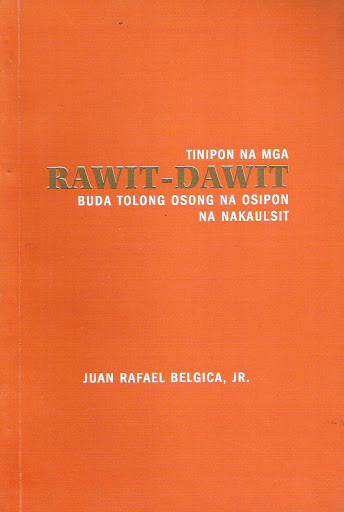 Juan Rafael Belgica's second collection of Bikol poems
I used to be chided by friends for making a daring and apparently baseless statement some years ago that Bikol literature is dead. I still insist that the statement was true when I said it. The last thing that I had read then was the research and translation done by the late Merito Espinas, beloved professor that went the rounds of the three better schools in Albay, Aquinas University, Bicol University, and my alma mater Divine Word College, and among these three academies spread the word on Ibalong, Handiong, Aslong, and culled from the musty chests of Mariano Goyena… And even then, the epic fragment was under a cloud of doubt, with the only text existing written by a 17th century friar and Espinas himself could only translate it into English. Only by the irony or ironies of translating it back into Bikol (as if from a palimpsest, by the poet Zacarias Lorino) would we have a Bikol version of our supposed epic. Ateneo de Naga had a fine Bikol studies program under Fr. Lynch. And sometime in my college life I became involved (as a lighting crew) in the production of the only zarzuela in Bikol, “Mga Burak sa Haron nin Pagkamoot,” (with Mike Molina and Charito Esquela, Noel and Lando’s sister, in the lead roles), written and composed by the great architect-writer-musician Everardo (Ever) Napay (Jojo and Toy’s dad, these latter two my companions in Amy Manila’s “New Tomorrow” Sing Out Philippines, Legazpi City chapter). Krisitan Cordero's upcoming collection, his fourth (courtesy of his blogsite, with link here below)
But nothing, simply nothing, was being written in Bikol at that time. There were Bikol columns in fortnightly English newspapers which couldn’t come out if no legal notices paid for their printing. Ever Napay dreamed of (and attempted) an English-Bikol broadsheet. But it was journalism and it never saw the light of day.
I was talking about (and pining for literature)—writing that creates and seeks to know itself—and not newspaper columns in barely surviving tabloids. Where was a book of stories, or a novel, or of poems in Bikol?
I can point to a specific instance when I saw poetry and stories began being written again in Bikol. This was when they reserved a slot at the UP Writers’ Workshop for one or two writers writing in the Bikol language (apart from Cebuano, Iloko, Quinaray-a). The deal was that there had to be enough works to be workshopped, the works had to be translated into Filipino, and a writer proficient in the language should be sitting in the panel. Thus there was a crop of poems and stories, although some of them were later found out to be translations by the authors themselves of their original Filipino works into Bikol (for them to qualify). It was tolerated. But one of the good results was that the authors had actually started writing in Bikol, or those who merely translated their works into Bikol subsequently shifted, as the Bikol writers found that their works could stand scrutiny and survive as Bikol.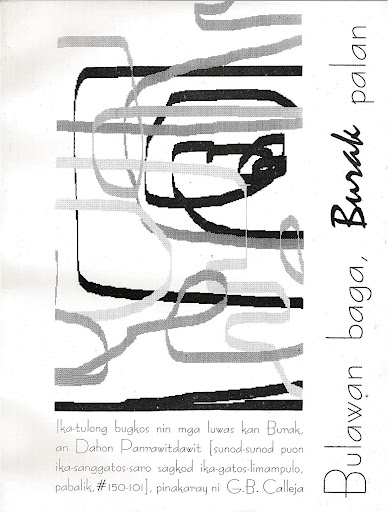 The third annual collection of Burak (a fourth one has come out): poems from Bikol and the Bikolano diaspora, published from Canada by Gode Calleja
I was one of the first panelists (and later the award-winning fictionist Abdon ‘Jun’ Balde, Jr., who was writing in Filipino anyway, and only later in Oasnon) who saw the first Bikol poems of Frank Peñones, Esting Jacob, and later Kristian Cordero (the latter recently has had his run of Palanca Awards, new author award, mainly for his Bikol poetry). And then came the NCCA regional/provincial forums (sometimes led by the NCCA executive director himself at that time, Rio Alma), including the one Jaz Llana and Raffi Banzuela organized for Aquinas U for one of the first Arts Month celebrations, where I made the statement. The immediate result of the forum was a new organization of Bikol writers, a hybrid magazine-broadsheet of Bikol prose and poems… and now, a veritable flood of works (I hope not be overcome by any Reming inundation or mudslide), actually, new titles of books of poetry and essays coming out of the printer’s. (I‘ve even written some poems in Bikol myself.) Now I must also mention the almost solitary effort of Gode Calleja, based in Canada, for putting out, and persisting in publishing, the snail-mail-distributed, one-page journal called Burak, which he collects, with his insightful introductory essays on the Bikol language, into an annual compilation showcasing poetry from Bikolanos and the Bikolano diaspora. These Bikol writers’ works I will sample here in this journal from time to time, in translation (for the non-Bikolano), but with their originals accompanying them.
Sunday, February 11, 2007

Parts of the week I spend on a part-time job that pays modestly but affords me generous moments of communion with nature. I step out for a smoke from the office, after a bout with the computer tapping out somebody else’s speech or a slogan or a press release. Before me is a pond straight out of Basho. Around it are the park’s lush vegetation and clumps and clumps of bamboo. The pond stretches out to the near horizon where beyond the treetops the tips of city can be seen: the skeleton of an unfinished building, the latticework of a radio tower, the spindly, lopsided arm of a construction crane. The pond may be crystal clear or murky or shimmering depending on the weather or time of day. I smoke silently or share the silence with a colleague, or he breaks it with shoptalk reminding me that for him, this precious scene is part of every day. I linger before going back to slogans because there is a poem here somewhere. And I take some notes on a little notebook.
Not a Haiku
Bamboo are creaking.
Leaf ripples the sun
On lagoon.Words are an excess
In this haiku afternoon.
That was this afternoon. Tonight under the incandescent brightness of a lamp, on a dining table I have appropriated as my writing desk, I am adding and snipping and restoring and again snipping away lines. And counting syllables. Five. Seven. Five. English, or perhaps any other language, is a bother, when the form is Japanese. I think of a solitary monk walking from a monastery hidden among the slopes of paint-brush mountains…Ah, to have one thought, one image, one particle of memory in the few strokes of a brush…
Almost a Haiku
Bamboo sway dripping.
Sun on lake breaks the grey
Sky of the monsoon.
Thunder rumbles somewhere. It is now pouring. Outside my closed window I can imagine the rain slanting across the funnel light of a lamppost. The light creates a circle on the sidewalk. But lamppost lights, with the advent of mercury or xenon, are no longer like that. It is a memory borrowed from a book or a movie. Which image, borrowed or no, of course I can’t see because my window is closed. The whirr of the electric fan on the floor drowns in the hissing and rattling of the rain. I know it is whirring because it did before the sound was drowned by the rain. I wonder what the pond looks like in this weather. But it is night and there is no poet there. And it is storming. No moon to shimmer or shatter on the water. Are the bamboo there? Or, before the storm, was a frog jumping? In my memory it is daylight. I can see it. I am there. And I snip and restore and snip away my lines and syllables again.
Perhaps a Haiku
Bamboo leaf spinning,
Ripples the sun on lagoon.
Words are an excess.
I rest my pen. But it is not a pen. It is a keyboard. And a mouse. I click, I save. I light a cigarette.
September 7, 2006


