Sunday, February 3, 2008
A Heady Night and “After the Rain”
in Galleria Duemila
0
comments
Posted by
Marne L. Kilates
at
5:24 PM
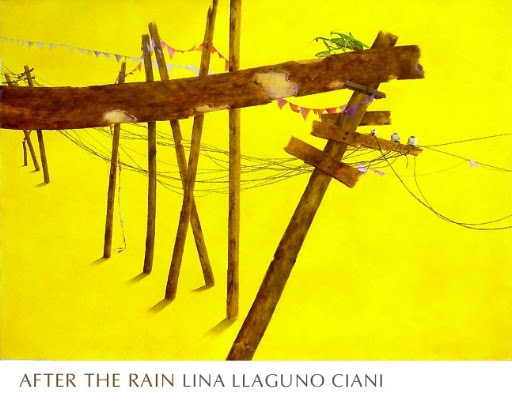 A Day After, the painting featured on the invitation to the one-woman show
& my thanks to noted painter Lina Llaguno Ciani
for letting me read my poetry at the opening
and share the appreciation of her audience.
And, of course, to Galleria Duemila owners Silvana and Ramon Diaz, for their warm and generous welcome, glorious pasta, cheese, olive oil, fruits, superb espresso, and wine during the first meeting and the lone dress rehearsal (of the Keynote presentation of the paintings and my poetry). And to gallery staff Mimi and Sandy for their indispensable help and technical assistance. And to Cynthia Villanueva Cochon, my high school speech teacher and friend who has always lent her appreciation and support for my work, and who referred Lina to me almost out of the blue—or out of the gray skies of our province and Bikol after the terrible rains of Typhoon Reming in 2006, the aftermath of which is the subject of Lina’s new paintings. For poets long used to precious few readers composed of friends and relatives and a handful of friends from the old hometown, “After the Rain” (the exhibit runs from February 2 to 29 of this year), is a munificent instance and venue for reaching an audience and readership beyond the blog or the bookshelf. 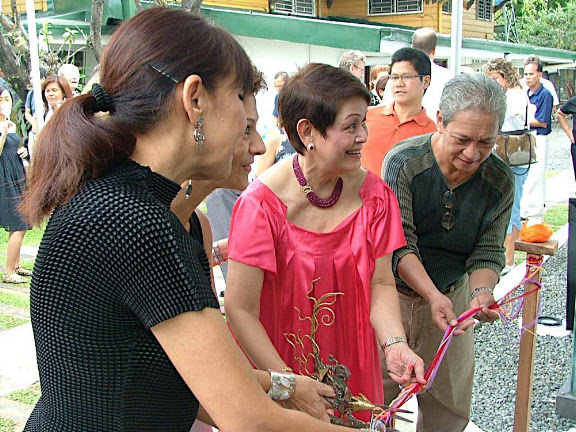
Lina & yours truly assist the two guests of honor cut the strings: Ms. Cosetta Fedele (partly hidden), wife the of the Italian ambassador, Rubens Fedele; and Ms. Carina C. Lebron
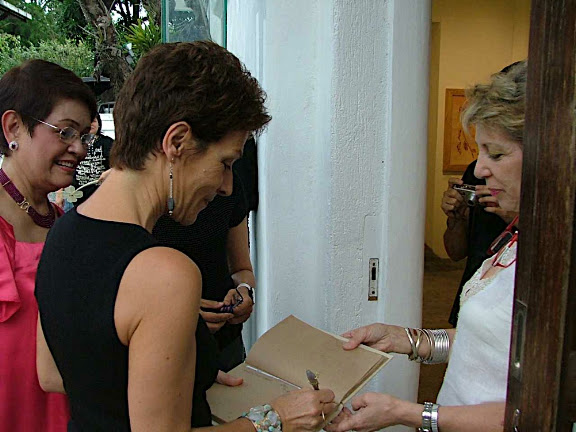
Galleria Duemila owner Silvana Diaz offers gallery guest book for signing
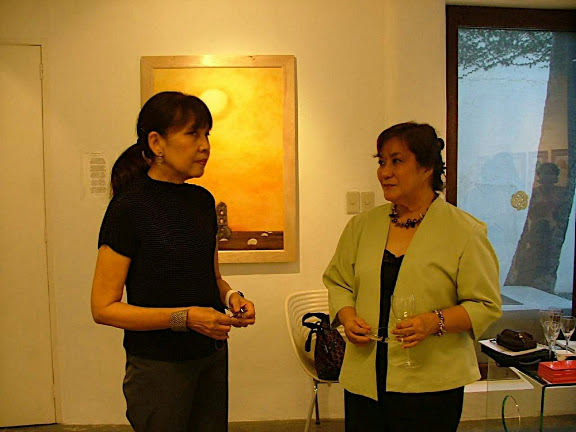
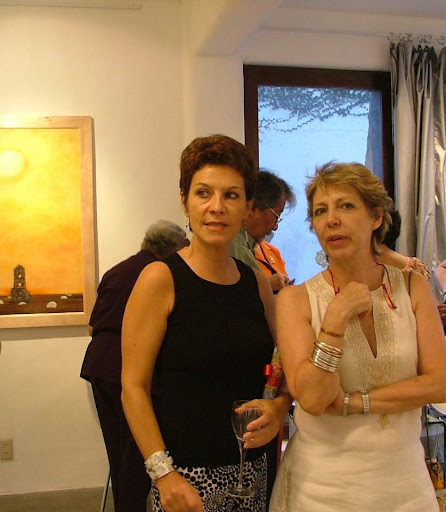
Lina Llaguno Ciani & Cynthia Villanueva-Cochon, with the painting Noon Moon behind them
Ms. Coscetta Fedele & Silvana Diaz
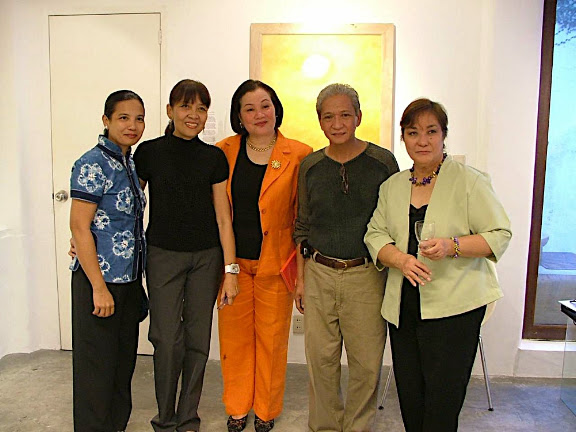
The friends from Daraga & guests: Pam, the Artist, a friend, Cynthia
Lina’s most distinguished company graced the occasion, led by two guests of honor: Coscetta Fedele, wife of the Italian ambassador to the Philippines, Mr. Rubens Fedele, and Carina C. Lebron, who speaks perfect Italian. Ms. Fedele is a long-time friend of Lina’s. The Filipina artist was attending a June 12 Vin de Honeur at the Philippine Embassy in Italy when she was introduced to the couple and discovered that they lived in Tevignano Romana, one of the oldest comuni north of Rome, where Lina lives. The municipality is on the famous Lake Bracciano, an important tourist attraction, and apparently the scene one would find from the painter’s window. The gracious Ms. Fedele and Lina had been friends ever since. Ms. Lebron is the owner and founder of Casa Montessori International in South Forbes Park, and when she lived in Italy to train in the Montessori method, the two Filipinas became close friends. The ebullient Silvana Ancellotti-Diaz, the Italian moving spirit behind Galleria Duemila and Lina’s friend, introduced me for the poetry reading. Duemila might be considered Lina’s home gallery, having staged her one-woman shows there almost yearly when she comes home from Italy. Of the 34 shows in her career, 12 were at Galleria Duemila.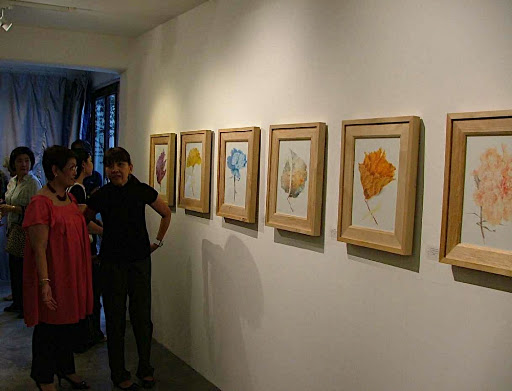
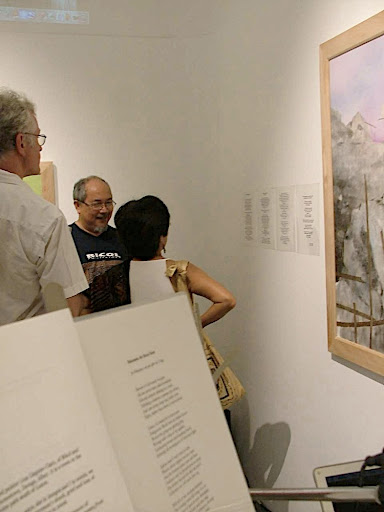
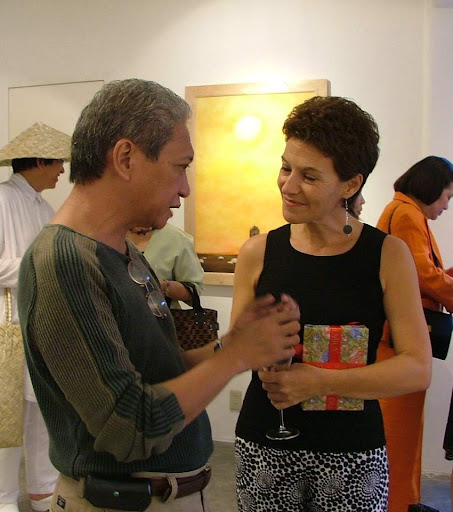
Lina & Ms. Lebron view the Foglia series
The Cruzes of Legazpi City
Jun Balde & Hope Abella (back turned) from the reader's corner
A candid interview with guest of honor Ms. Coscetta Fedele
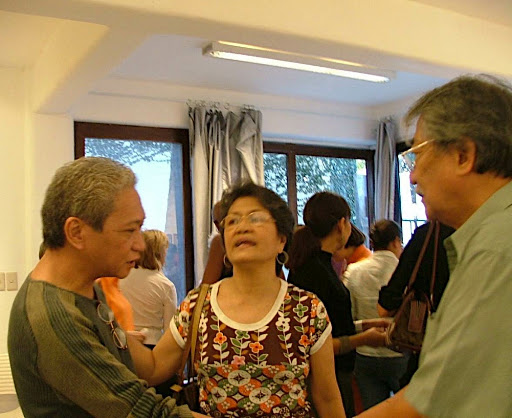
Members of the old gentry of Legazpi City and Daraga, Lina’s hometown (and mine), came to attend and there was a reunion of sorts for the distinguished daughter of the town and city. Among them whom I can recall with apologies for my “memory almost full” (another apology to Paul McCartney), were the Locsin family, including a former schoolmate at Daraga Elementary School, Roberto Locsin, and his gracious wife from the Bayona family; and Dr. and Mrs. Cruz. I made acquaintance too with Lina’s niece, the lovely Marie, whom I delightfully found was the daughter of my poet friend Remigio “Toy” Llaguno Jr. In those golden days, Toy recruited me to man a two-person editorial staff (he was editor, I was associate) for our college publication (Divine Word College of Legazpi), which he christened Outspeak. We published a few issues before he graduated and left me to form a staff of my own. And of course on hand was Lina’s close friend Cynthia Villanueva-Cochon and her daughter. My former speech teacher in high school was apparently up and about even if she was fresh from a pacemaker operation. Also present was Fr. Ely Mata, SVD, brother to my high school classmate Gil, and Mona, who sang with me in Amy Manila’s New Tomorrow Sing Out in Legazpi, when the world was almost carefree.
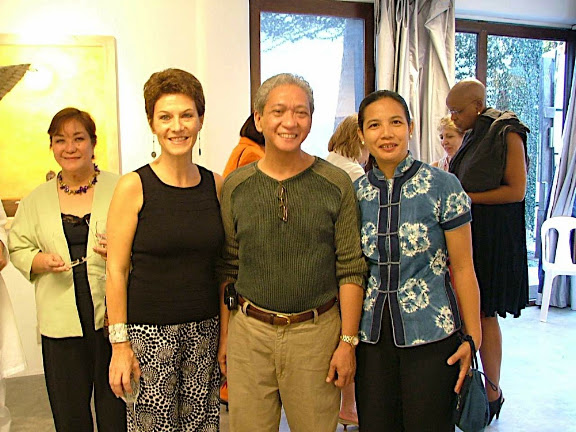
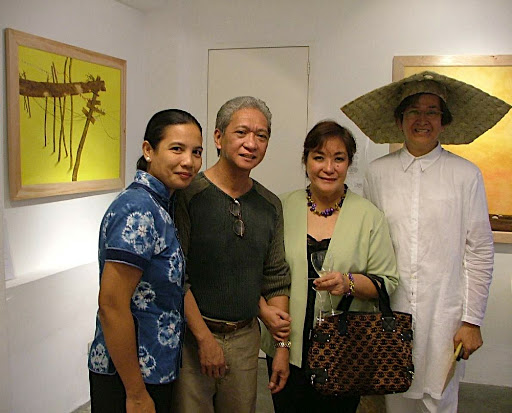
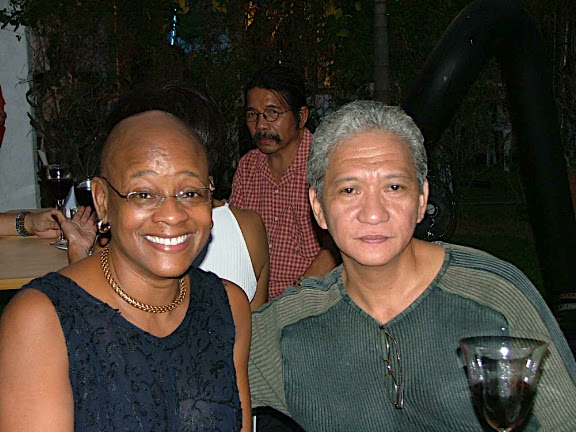
Cynthia Villanueva-Cochon, Ms. Fedele, Marne and Pamela Grace Bañez
With Cynthia's friend in his magnificent costume
Michelle Washington of MMQ Theater Group and UP, with Marne & Dan at the back
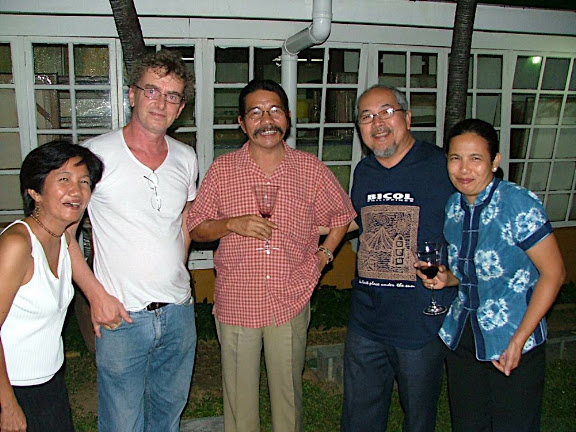
Some members of the liveliest group of the night who finished all the wine and almost all the beer: Hope Abella of Lingap Foundation; Peter Pinder, poet from New Zealand and Baguio; Senate publications editor Dan Pinto; novelist Jun Balde; and my signifant other, Pam
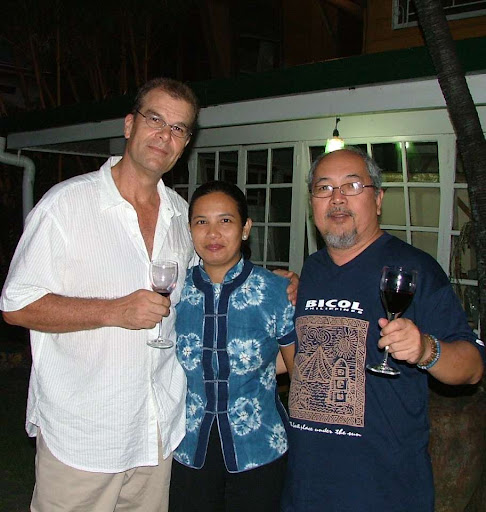
One more toast for the night with Lester A. Harvey of Le Soufflé, New Zealand and Pasay City, Pam & Jun
(Photos by Pamela Grace and Marne)
Joining me and Pam at the garden cocktails were Hope Abella of Lingap Foundation, and two fast friends, the novelist Abdon “Jun” Balde Jr, and editor of the Senate publications Dan Pinto. The day before, the three of us, together with Jun’s lovely wife, Fe, had just arrived from Legazpi City. We went there to attend part of the 60th year celebrations of Jun’s alma mater, Aquinas University, where he received honors in ceremonies called Omaw sa Oragon (Tribute for Distinction and Excellence) for literature. Jun is a retired engineer of 30 years who went back to his old love, writing (and painting), and has since then published seven books and won awards for all of them.
The new friends we made were, among others, Michelle Washington of MMQ Theater Group and who teaches theater in UP, and two gentlemen from New Zealand, poet Peter Pinder who has made Baguio and the Philippines his home for some thirty-five years, and Lester A. Harvey of Le Soufflé, who has also been in our country for more than 30 years. They joined and enlivened our table, together with Silvana’s artist daughter, Romina, who teaches photography to children from the informal settlers’ area near the gallery.
The conversation, Peter and Jun quoting of lines of poetry, Hope and Romina sharing insights from their earnest social work, and frequent laughter from Jun’s adventures as a project engineer in Katmandu, and Lester’s irrepressible humor (we were later joined by Silvana), made our table the liveliest in the garden party, and the longest-staying group that finished the wine and consumed the beer well into the night. A heady night of art, poetry and wine (thanks to Lina and Silvana) it was, I hope we didn’t awake the ghosts in the storied house of the Diazes in old, genteel, Pasay. 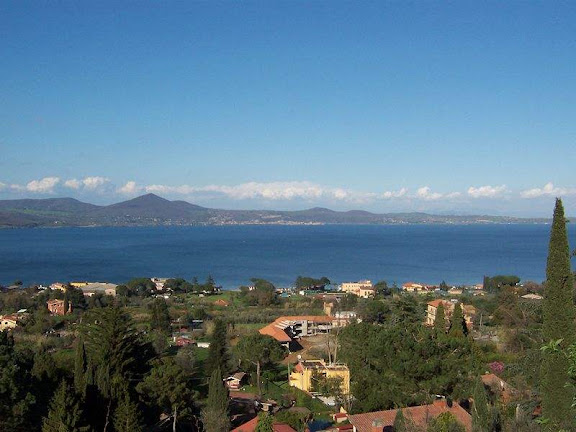
And for those who've never been there (including myself), here's a picture of Lina's other hometown, Trevignano Romano, on the famous Lake Bracciano north of Rome. Perhaps the glorious sight one would find looking out of the artist's window. (courtesy of Wikipedia)
(For my review of the one-woman show, without reference to my poems on the paintings, please refer to or click the entry (last of January 2008) at the Archive on the right column of this page. My poems on the paintings will posted next, as promised, bringing this series of postings to three.)
Wednesday, January 2, 2008
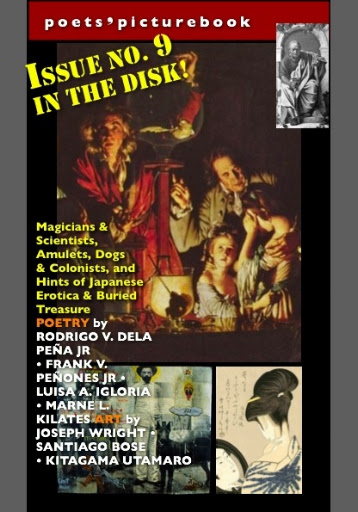
Happy Greeters for the New Year & poets’picturebook is up & jumping with great contributions & contributors
0 comments Posted by Marne L. Kilates at 3:07 PM
Now for the parting and welcoming words for the changing of the years. While the fireworks drove away negative feng shui and kept children wide awake, text messages flew across the airwaves bringing tidings of good cheer and keeping you and me and Smart, Globe, Sun and BayanTel happy. Like other New Years I was able to evolve a response to all the glowing wishes I received and here, more or less, was what I sent to the texters:
May you and your family’s New Year be filled with more poetry, art, inspiration, beauty and wealth in all its forms.
It was well appreciated. I just had to have variations for those who didn’t care about poetry, but the part about wealth in all its forms was kept in all the text messages I sent. I received all sorts of graphics and the standard double entendre and the racy jokes beer buddies are fond of, but too risqué to reproduce in the Net. The loveliest ones were in three iCards I received and here let me share them with you:


iCards are cool.
Friend from the States Melissa Nolledo-Christoffels with her lovely children
Did you receive these bohemian....
and Newtonian greetings?
This dire image from Photoshopper Dan Pinto is not actually asking for Armaggedon (himself also in the title role)
Marj Evasco's finicky feline, Gold, guards the entranceway to her apartment through her lovely Zen garden in front
The funniest came from Kristian, who after the standard seasons’ greetings, wished us luck for the Year of the Rat…
...ano mang hayop tayo ipinanganak!
As usual, Marj Evasco never misses to share something not just quotable but poetic, which I usually save in my computer after receiving the message on my phone. After a pre-Christmas dinner for a few of her close friends who later enjoyed some wine, coffee and music in her small but lovely Zen garden in front of her unit at Hagdang Bato, she texted me these words from our common favorite Bengali poet, Rabindranath Tagore:
The butterfly counts
not months but moments,
and has time enough…
Which sent me searching through my shelves the next morning for the one book I have of the great Indian poet, introduced by W.B. Yeats, who wrote:
These lyrics—which are in the original, my Indians tell me, full of subtlety of rhythm, of untranslatable delicacies of color, of metrical invention—display in their thought a world I have dreamed of all my life long. The work of a supreme culture…
I used to be able to recite to myself the following fragment from the sage Rabindranath, because it touched something in me which I felt for my country, but it got buried under other thoughts and cares and I can now barely get to the second line. I was not able to send it to Marj (it would have taken about four text messages and I didn’t want to add to the happiness of Globe, Smart, Sun & BayanTel), so I reproduce it here on free blog (although I still pay for Internet time to PLDT):
Where the mind is without fear and the head is held high;
Where knowledge is free;
Where the world has not been broken up into fragments by narrow domestic walls;
Where the words come out from the depths of truth;
Where tireless striving stretches its arms towards perfection;
Where the clear stream of reason has not lost its way into the dreary deserts sand of dead habit;
Where the mind is led forward by thee into ever-widening thought and action—
Into that heaven of freedom, my Father, let my country awake.
And so, greeters and greetings of all sorts. Full of fun, sweetness and good thoughts. A world we dream of all year long, all our lives. And the sweetest was from Krip Yuson:
This season we may never forget
The love we have for Jesus
Let Him be the one to guide as
Another New Year starts
And may the spirit of Christmas
Be always in our hearts
—Jose Mari Chan
Happy New Year!
❦
My poems featured at
Click the link on the right column under "Check These Places Out"
Maurice Oliver's Concelebratory Shoehorn Review
poets'picturebook Update: The Next Issues
We're really jumping and globe-trotting: we have poets and artists from Bikol to Australia to America to Italy to Korea! And such quality poetry, art and photography from names we know and perhaps know for the first time! Join them!
Wednesday, December 26, 2007
Perhaps an unlikely trio but everything’s possible on the Net. Or in the creative imagination. In the Pictura Poisesis reading of a month ago at Mag:Net, it was more than possible. Here then are the rest of the poems from Pictura Poiesis, and the paintings from great artists that inspired them. Enjoy both.
Sid Gomez Hildawa
On Juan Luna’s Tampuhan (1895)
It is a yellow afternoon that slides open
the capiz-shell windows,
that makes the mahogany floor
like a pond shimmer with silhouettes
of the ventanilla’s squinting fingers.
“My dear, you’re missing the procession
below.” He leans out, as if wanting
to join the shuffle of dusty feet.
She looks in, anchored to wooden things.
the yellow light passes without a sound
between them.

Sick Leave
(On Luna’s Parisian Life)Like a patch of skin spared
from sunburn by a shield
of cloth or sun block lotion,
there’s a rectangle on the wall
lighter than the wall itself,
where a painting used to hang.
Now that the artwork is gone,
visitors ask, “What used to be there?,”
and “What was it about?,”
as if they hadn’t seen the piece before,
or maybe not carefully enough.
‘Wasn’t there a woman seated
in a café?, Didn’t she have a glass
of wine, or some company?,”
The damp ground, eavesdropping,
almost shifts, holding up the house
whose wall holds up a rusty nail
in its perpetual upturned pose,
holding up no answer.
On my fourth day in hospital
with dextrose feeding me twenty
drips a minute, I picture in my mind
a space I may have left behind,
not entirely empty, but of air
made thinner by my absence,
or of lighter tissue,
so that people pause, inquire,
and imagine what used to be there.
“So where’s the painting now?
 Sid with National Artist Rio Alma at Mag:Net.
Sid Gomez Hildawa is poet, visual artist and professional architect. As artist, he was among the recipients of the CCP Thirteen Artists Award and the British Council Fellowship for art and architecture in 1990. As writer, his poems have appeared in national publications and anthologies. He was a poetry fellow to the UP National Writers Workshop in 1995 and the Iligan National Writers Workshop in 1997. He won twice in the Philippines Free Press Literary Awards for poetry. His collection, “Building a House and Other Poems” won in the 2006 Palanca Memorial Awards for Literature. Sid is currently pursuing a Ph.D. Literature degree from De La Salle University, after obtaining his Master of Fine Arts in Creative Writing there in 2004. He is a member of the Art Association of the Philippines, the United Architects of the Philippines, and the ALON literary collective, while working full time as director for the Cultural Center of the Philippines’ Visual, Literary and Media Arts Department.

Marjorie Evasco
La Condition Humaine
There is a room where a man lies next
To a woman whose shoulders are lit
By morning. He wakes her to drift
Of clouds, wash of skies, drizzle
Of leaves in the air. “Magritte,”
He says into her ear, tracing
With a long slender finger,
A frame beyond the windowpane.
Another room in another time
Suddenly opens inside her.
She is standing by a window
Before the painting’s expanse of grass,
The cut of dirt road, and on the horizon
A stand of mountains measuring the reach
Of a single aspen. “La Condition Humaine,”
She turns to the man beside her,
As if to say she understood how inside
And outside the rooms of love
The landscape was not always seamless;
How, every time she turned her heart
Into words to invent the true form
Of being, dustmotes were already trapped
In the light of images, like this morning
Vanished fast into another day.
In no time they shall each be elsewhere.

Joel Toledo
Crows
Even the streak and blaze of color cannot undo
the onset of evening, sudden dip of the sunset
tainting the impressions. At least, spilling hues always
awaken to dewdrops, birdsong, and strokes of morning,
when gradually the eye again trains itself to vision,
curves and festivities. So then the endless parade
goes on in increments, smudges of blue and definitions.
The painter sought to extend his hearing, as if
sound is an impediment, as if the charge of seeing
is the pursuit of pure silence. This way, the stakes
may be higher, the senses sharper. The sonorous swirls,
the remembered spires—they are nothing more
than the pushing of night onto empty canvas. A good
right ear should suffice, found browns, long walks
down the valleys, shadows blending and dissolving
and gone again. See now the watermills revolving,
digging into the water. See now the frenzied cycles
and the calm, calm women under the bridge,
bathing and washing, colorful and well-dressed,
waiting for noon and cleaner clothes, the call
of cathedral bells. They are pious this way
and attentive. The man is moving in and out
of the landscape, damaged and all, still willing
to stand still and wide-eyed, awaiting the flutter
of wings, flapping of clothes, capture. If only
the crows had remained feeding and hidden,
their flight none too startling, none too dark,
madly bursting into sunflowers and wheat fields
and it is evening once again, gases and cypress
and celestial ornaments covering the sleepy town,
that half-heard cawing and black debris of wings
spinning and spiraling, gathering up there
and over here: tower of night, curls of wild light.
After Van Gogh, After Kurosawa
My thoughts… Absences & Treacheries
The Lunas by Sid. It is coincidental that Sid Hildawa chose for his ekphrastic exercise the same two Luna paintings I have poems on, Tampuhan and Parisian Life. Well, these two would probably make the other most popular works of one of our greatest painters, after the magnificent Spoliarium. In fact, the subject of Sid’s second poem gained some notoriety recently as some sectors protested over its purchase by GSIS from—was it Sotheby’s or Christie’s?—using “people’s money.” Meaning, that while retirees or beneficiaries of the government worker’s insurance fund still go through the bureaucratic wringer to claim their benefits, here was GSIS spending millions on a crummy painting. And to that the agency responded that they were just recovering a “national treasure”…
Whichever side of the debate you are or were on (GSIS eventually had its way) is perhaps not germane to Pictura Poiesis. Or is it? Would a retiree who has not collected his GSIS benefits but who loves art, and who is perhaps a poet (a literature professor from UP?), not consider writing an ekphrasis on this crummy national treasure? Why not? He could in fact give poetic voice to his resentment of GSIS. That’s the whole point of ekphrasis.
But Sid is not an unrecompensed retiree and it is a different set of circumstances he uses to express his thoughts on the painting (or he uses the painting to muse on a different set of circumstances). Absence is a complicated thing. He draws parallels between such a prosaic thing as getting sick and being absent from work and the absence of something vague, unnoticed, or maybe something as mysteriously unimportant as a painting. The “patch of skin spared/ from sunburn,” is actually a correlative (under the circumstances) of the “rectangle on the wall / lighter than the wall itself, / where a painting used to hang.”
“Sick Leave” ultimately becomes a comment on the persona’s intimations of mortality, who perhaps owned Parisian Life or its reproduction and lost it or sold or gave it away (the poem doesn’t say) as he hears his visitors ask, “‘Wasn’t there a woman seated in a café?...” And that the (vacant) space it left behind was like own his prospective absence, “not entirely empty, but of air /made thinner…” Was the thing/painting lost or gone, important? Why was it not noticed except in its absence? Does this say something too about the author’s regard of the controversial painting itself, and does he not ask us in turn what we think of it? The poem's last line, a rhetorical question, bespeaks with disguised half-concern our ultimate horror vacui.
The Tampuhan (lovers’ quarrel) poem is a real vignette in the literary and artistic senses, being a brief evocation and an illustration or picture with faded or no borders. Allow me to interpose my own Tampuhan poem here (perhaps written earlier than Sid’s), not to compare merits but just to contrast treatment and possibilities. (The poem is reproduced below, after these notes). Sid’s vignette of a “yellow afternoon” is as fleeting as the “yellow light” that passes without a sound between the two lovers, a moment in time as brief as the poem itself. My version of the yellow afternoon is a “varnished” one, evocative of my own memories of old provincial house, the bahay na bato. Both poems mention the ventanilla as a fixing detail, but mine mentions more of them, unable to avoid their local and Spanish names. It is a longer rumination that aspires to recreate not just the moment but the historical time of the painting, resorting to inventions and elaborate speculation on the subject/s.
Marj’s Magritte. It is always fascinating to dwell on the enigmatic and witty images of René Magritte and how they have actually inhabited the modern popular imagination. (Paul Simon has “René and Georgette Magritte with Dog After the War,” Paul McCartney is a collector of Magritte.) Floating men in black overcoats and the ubiquitous (and intriguing) bowler hat, the apple in front of the head, the deceptive horizons and the painting superimposed on nature while imitating it, the overall transgression and treachery of our visual reality. Everything is not as it is, a pipe is not a pipe, a portrait is not a portrait: the representation is not, can never be, the thing. But we see ourselves in those paintings (despite their distinctly European character): the drab anonymity of cities, the faceless everyman duplicated and multiplied. They are us, we murmur in recognition. We are witnesses, participants, residents of the Human Condition.
Even love is not spared from La Condition Humaine. It is perhaps only a comforting illusion despite its grand nobilities, its self-denial and futile defiance of death. So the lovers could as well be living inside the painting in Marj’s poem. And they are aware of it, they recognize Magritte and the human condition—all too painfully but also esthetically. He wakes her to behold the morning with its “drift of clouds / wash of skies,” and traces “A frame beyond the windowpane.” Inside her “Another room in another time / Suddenly opens…” The lovers, in their anonymity and self-awareness, represent, or enact, Magritte’s version or reality (in Magritte there can only be versions of the thing in iself—as in all art and literature):
She turns to the man beside her,
As if to say she understood how inside
And outside the rooms of love
The landscape was not always seamless…
And the lovers are apparently just another version of themselves:
How, every time she turned her heart
Into words to invent the true form
Of being, dustmotes were already trapped
In the light of images…
Like the floating men in bowler hats, the face covered with an apple, the pipe that is not a pipe (and themselves living inside a painting), perhaps they are not even man and wife:
In no time they shall each be elsewhere.
They apart not only from each other but from their "true" selves, whatever those are: but that "truth," wherever it resides (does it float above or around us, is it inside or outside us?), is ultimately unknowable.
Joel’s Van Gogh. (Aha, this is my opportunity to direct you to my new blog-ezine, poets’picturebook. My comment on Joel’s “Crows” is posted there as part of the third Test Issue. His and Marj's pictures and biographical notes, if you don't know them yet, are also there. In the post previous I sent out my invitations for contributions to the ezine. Come on, take a peek. Or a tour.)
My Luna
Tampuhan
by Marne L. KilatesWas it a time of grace, of smooth
And even things? How long ago
Was it, how far away that seldom
We make a visit, even in our dreams?
Sun on floor of a varnished afternoon
Before Christmas, lace on the pasamano,
Curve of elbow under gossamer sleeve,
Hand as delicate, missing its abanico,
Vines around the branches of talisay
Beyond the wooden balustrade
Of the ventanilla, brocade saya
On the polished planks of narra,
Velvet on slipper carved with flowers
Under the step of tender maiden heel
Hid behind the folds of skirt, now perhaps
Cold in the tropic heat like a heart.
Curled back of batibot chair, burnt
Rattan cane more like eyebrows
Than mustache, unable to comprehend
The afternoon’s sudden gloom,
Window of capiz-shell at the shoulder
Of camisa de chino, and two faces averted
After the posuelos of hot chocolate,
Rice cake and suman have been taken away.
How long ago was it? How long before
Or after the Parisienne, when men
In coats and stove-pipe hats sat whispering
In a café, on the eve of another Dream?
April 25, 2007
Last Notes on Pictura Poiesis & how it led to poets’picturebook…
One thing I like about poetry in blogging is that the blogger (whom I assume to be a poet when he insists on putting poems in a blog) is compelled to search for images or pictures to accompany his poems. Compelled because that is the nature of the medium or venue (which one is it?)—it is a visual one. Even a poem in a blog must be treated visually. The web log or online journal is not a simple diary (written and hidden in a drawer), it is a letter to oneself that other people read instantaneously. The computer and/or Internet are/is firstly visual, thus meant to be seen. It is the illegitimate son of television but who is so talented that he is taking over the family business. Most of us Net users are even still a bit confused about what it is. Is it a medium or a venue? Is it a framed canvas, a cathode ray tube, a plasma LCD panel… or is it the keyboard and all those “peripherals” too, that we use to manipulate it? It is a TV screen and yet we can control what we want to see or put in it. It is a writing pad as well as a typewriter and yet it “publishes” and distributes what we write immediately. It is both a “thing” and a “place.” One creates a blog and another visits it. Author is also publisher, but also printing press and bookstore. Movie studio is movie house also. And so we are forever creating and entering the worlds we create—poems, novels, movies. The Imagined Reader has become, is also, the Imaginative Writer. The medium is no longer just McLuhan’s message, it is also the venue. Visit my book. Read my house. They’re all in my site. Sight. Kitakits!
That’s why Pictura Poiesis is a good thing for this blog. It gave me a lot of visuals, and materials for it. I had most of the texts and the digital files of the paintings from Marj’s student-poets in her literature graduate class (excepting Joel, who teaches in Miriam, and me who’s mainly puttering around the Net). But, as George Harrison said, all things must pass. Meaning, this is my last posting on Pictura Poiesis. I”ve run out of materials. From time to time, when I find pictures or shoot my own that can accompany the poems here, that should provide interesting blogs. But more interesting would be your poems & pictures. No, not of your face (but send that too for the bionote), but of an interesting photographic, or even Photoshopped, image that can go with your poem. Now that is an interesting idea…
The idea has become poets’picturebook, my new blog and ezine which I introduced in the previous post, and which as I said, does not replace All Our Nameable Days. But I actually suspended my writing for the Pictura series, clicked the Create Blog button, and spent the better part of the pre-Christmas week testing posts. Part of these notes has become my introduction to the first Test Post of the ezine. So we have two blogs: take your pick as reader for one or as contributor to the other. Take both. The better for our art.

Tuesday, November 27, 2007
Pictura Poiesis: An Ekphrastic Edition of Mag:Net's Happy Mondays, a Sparkling Night of Pictures, Poems & Friends
0 comments Posted by Marne L. Kilates at 10:33 AM
A LL OUR FRIENDS CAME, and gallery owner Rock Drilon commented, as I fiddled at the mixing console back of Mag:Net Bar above the first floor art gallery, that it looked like a real production. The longish hall was full. All silhouettes faced the screen onstage (where the band played or people read their poems). Among these shadows were National Artist Rio Alma and wife Lyn, Kaibigan Dr. Jimmy Abad (without our friend, Krip Yuson, who had to be at Ka Pete Lacaba’s second Salinawit concert at Capisce over at Metrowalk in Ortigas), Anvil Publisher Karina Bolasco, two beautiful Susans—angel-voiced Susan Fernandez and fictionist Susan Lara, poet and book designer Donat Alvarez, and a host of Marj Evasco’s artist and academic friends and students whose names I missed. And, the bigger-than-usual literary crowd from the UP-Ateneo-Miriam academic triangle. By coincidence, award-winning film director Mark Meilly was there behind me as I tested the projector. He was a working acquaintance from my advertising days when he directed one of my forgettable TV commercials. He had come in late and missed the showing of his indie film before our “show,” and stayed to watch ours perhaps a mite curiously. Picture Poiesis was an attempt at something different and mildly thematic—a slightly structured and sequenced reading, of poems accompanied by pictures projected onscreen. This was a necessity, for they were the source art of the readers’ the ekphrastic poems, poems taken from, reacting to, or inspired by art and that night it was paintings. One could also be ekphrastic from other forms of art, mainly the non-verbal ones, like sculpture, music, dance, or even scenes from a play or movie.
 And ekphrastic was quite ecstatic, as the readers commanded the audience’s attention, captive now by the images onscreen. (And thanks, too, to some of the smooth transition effects and themes of the Keynote presentation—the electronic presentation program to be preferred over the other brand’s popular one.) Marj Evasco of La Salle, the inspiration of the show (and who gave it its intriguing title), had, the week before, handed over to me CDs prepared by the poets from her graduate class, with the text and digital files of the paintings. They were the main readers of the show. I had no choice. My co-organizer Joel Toledo, initiator of Happy Mondays, is a techie who doesn’t do presentations. Now I had been “forced” to do it myself. In retrospect, while I was still in advertising, doing digital presentations was a job we “creatives” usually left to the AEs (account executives). Out of the comfort zone, when I left my ad agency job, I had to do presentations myself to chase after projects, and I had gotten adept at the Mac Keynote. It was a chance to show off how something as mundane and prosaic as Keynote might become a tool for poets, on my old Powerbook, or simply, as a fine, and rather refined, alternative to the PowerPoint which everybody does.
As it turns out, by audience reaction and text messages after the show, Keynote might yet come in handy for the literary mind unaffected by technophobia. But what you will see here are the paintings and the poems (for surely we cannot blog a presentation). They are, in themselves, the actual objects of beauty that provided the reason for the show, and made the Mag:Netic night sparkling. There were twelve paintings, two photographs, and eight poets, some of them having written poems on one painting. My poems based on the photographs may be accessed in a recent posting ("Continuing My Adventures...", link under Previous Posts in the right column of this blog), so I will not include them in this series of postings. One poet read, as opener of the show, and perhaps more as a recent example or tribute to ekphrastic poetry—Lawrence Ferlinghetti’s “Short Story on a Painting of Gustav Klimt.” I will feature in this series only the original poems read in Pictura Poeisis.
Here, first, is Marj Evasco’s poem on a Picasso. Marj, of course, is Dr. Evasco of La Salle’s Literature Department, right now among the leading in her generation of Filipino poets in English (without referring to gender), who chose to stay and build her work here. Neither Picasso’s colors nor Evasco’s lines need elaboration.
Solsequiem
(after Pablo Picasso’s Maternidad, 1905)by Marjorie Evasco
She had known ever since she felt
the miracle of his heart quickening in her;
it would end the way it began, her arms
gathering his hurt body again and again
into her indigo mantle, the shield of her love
bringing the world to complete silence.
Today, when the boy limped into the room
of her mending, she laid the ball of thread,
needle and pair of scissors on the footstool
near her ebony chair, and held him close,
right hand tilting his face for her blessing,
her left covering his, cupping a ball,
red and small as his heart upon
his lightsome shoulder. As she bent
to soothe him, death quietly slipped out
and into the world’s double horizon
of sienna and cyan, cyan and cerulean,
primary hues of earth meeting sea,
and sea meeting sky. Anchoring his vision
on the woman at the center of a room
mending a child’s heart, Picasso tends
to the world before it completely shatters,
has hands shaping a small blue universe
illuminating the script, enfleshing the Word.
❦
Post-Posting: The Anchor of “Solsequiem”
I will take back my words. The colors and lines of two masters need no elaboration, but they can stand appreciation. I had to say something about this poem, how you and I might not just “like” it but find reason to, among and between its lines. I hadn’t the time to look up solsequiem (which I misspelled and corrected above), to be able to say something competent about the poem—the title, of course, is the first clue—so I went to the primary source. And across the microwave traffic of Globe and Smart, I asked Marj—
TEXT MESSAGES (italics provided):
Me: Maayong buntag, Marj… So, what’s ‘solsequiem’?
Marj: Maayong buntag, Marne. From the “Blue” chapter of “The Primary Colors” by Alexander Theroux: Solsequiem is the blue tinta used by the medieval monks in illuminated manuscripsts. Lovely, no?
Me: Lovely, lovely! I will do my own research.
Marj: “A blue called turnsole (sometimes called solsequiem) was commonly used by monks for putting gorgeous pen flourishes around letters (usually red) in illumination books.” (A. Theroux, 1994:9)
I looked it up. “Turnsole,” according to the Oxford Dictionary bundled in my Mac, is “a Mediterranean plant of the spurge family, whose flowers are said to turn with the sun. Chrozophora tinctoria (family Euphorbiaceae), from which a blue or purple dye was formerly obtained. ORIGIN late Middle English: from Old French tournesole, based on Latin tornare (see turn) + sol ‘sun.’" I love this. I can see the sol in the Spanish (or Latin?) name, but I don’t have a Latin dictionary and my Spanish-English one is a tiny Pocketbook edition. So let’s leave it at that for the meantime.
The texting continues.
Me [half of the research done]: I can imagine Eco’s monk [Adso, I remember now] in ‘Rose’. I could have been an illuminator in another life.
Marj: Ah, The Name of the Rose! Me, too, I KNOW I was a monk, but in Tibet.
A word can transport us not just through the cell sites of Metro Manila but through time and space, to the medieval Italy of Benedictine monks illuminating manuscripts (thanks in part to Umberto Eco), and the ancient Himalayas, among the ancestors of Swami Vivekananda in their Lotus positions. Marj’s soul prefers to be Oriental.
Now, let me just attempt go to the heart (or anchor) of “Solsequiem.” I know Marj won’t mind my partially formalist reading (one of many, of course), but notice how the poem creates a narrative—illuminating Picasso’s visual and manifest subject—around Motherhood. The mother in the first stanza is the mother we all know (or forget?), who finds the fulfillment of her womanhood when “She had known ever since she felt / the miracle of his heart quickening in her…” The part about motherhood that we are familiar with comes from the child’s inherently selfish appreciation: “…her arms / gathering his hurt body again and again.”
But the narrative is already extracted as text from the painter’s visual subject. Do we or I know, whether we have researched the circumstances of Picasso’s painting and subject or not, that the child’s was a “hurt body”? Here starts, I think, the extractive process of ekphrasis. The poem now is reading the painting. The “shield of her love” (our “typical” mother’s infinite virtue) is not just any comfortable embrace but an “indigo mantle”—a Picasso mantle painted in his early “blue” period.
The second stanza, up to the first two lines of the third, ending in “his lightsome shoulder” extends the narrative based solely on the images and details of the painting, despite the fact that the poem has introduced a new element about the boy that we don’t know or cannot immediately see in the painting. So we are told that he “limps,” his body was “hurt” perhaps not just in play but permanently. Between the painting and the words of the poem all we see are the white body of the delicate child, his face “tilted” for her blessing (such diction!), almost enclosed in the indigo mantle of her love. If he limps or was permanently hurt, is she too the permanently Grieving Mother, perhaps a post-Christian Mater Dolorosa anticipating the global disturbances after 1905 (the date of the painting)—the War of 1914-18, the Spanish Civil War (that killed another poet, Federico Garcia Lorca), and even Picasso’s Guernica—the source and signified of the archetypal blue of suffering?
We are, of course, reading all these into (or around) the painting and the poem. Or are we? We must ask Marj (the only advantage of having a living author; when the author is no longer there—some people don't want her or him to be there at all—the poem becomes a true artifact, and there will be as many readings as there are readers), or you can send your comments. Our excursions into its external contexts make a complete revolution as the poem takes us back to the painting itself, which I think is the whole point of ekphrasis:
…As she bent
to soothe him, death quietly slipped out
and into the world’s double horizon…
and we find that the “double horizon” is composed of Picasso’s pigments: “…sienna and cyan, cyan and cerulean,” (lovely colors, lovely names!) the primary colors of our perceiving the shimmering borders and non-borders of our physical world, “earth meeting sea, // and sea meeting sky.” And “anchoring” all these (Picasso’s and our vision) is the Mother, the “woman at the center of a room / mending a child’s heart.” But the poem insists it is the vision, or the process of seeing through art or from the eyes of the artist, that enables us or Picasso to “tend… to the world before it completely shatters…” Such optimism.
Perhaps art or the perception (the search and the finding) of beauty is our only salvation?—as Picasso “[shapes] a small blue universe / illuminating the script, enfleshing the Word”? Can we “un-shatter” the world? Can we “tend” to it before it annihilates itself, through art? Or is this “simply” the creation (and reading) of art, the voice in the wilderness of the world’s prosaic pain, representing (again) the idea that if the world had listened to the (illuminated) Word—in red and gold and solsequiem—Picasso might not have had to paint Guernica?
We all know what war, pain, and death look like (or a child's limp). They have been with us since the beginning. Artists have painted them, poets have told about them, made us experience them, in words. We forget. Ekphrasis is an amazing reminder.
Marne L. Kilates
November 28, 2007
❦
PHOTOS: From top, the backdrop and first slide, in Keynote "Leather Book" theme, with detail from Klimt; the Mag:Net sign from the smoking deck, where one might see the Poet's Alcove, that week with a Maningning Miclat poem on display; gallery owner and painter Rock Drilon; and Picasso's Maternidad.
A Pictura Poiesis Second Edition is in the works, featuring known poets writing on other art forms—sculpture & music, from classical to jazz.
Tuesday, November 13, 2007
Two Swashbuckling Scorpios Conspire to Have a Grand Night at Conspiracy & Half the World Converges on Visayas Avenue
0 comments Posted by Marne L. Kilates at 9:23 PM(Siyempre, the World of Friends, Relatives, Banyuhay Fanatics, Composers, Musicians, Magicians, & Men of Letters, of the Brush & the Bottle)
It’s the week after the birthdays of two prominent (ahem) Scorpios in Visayas Avenue, Quezon City. At least that’s what one of them thinks of himself and some close friends and family agree. And that’s me and the really famed Heber Bartolome.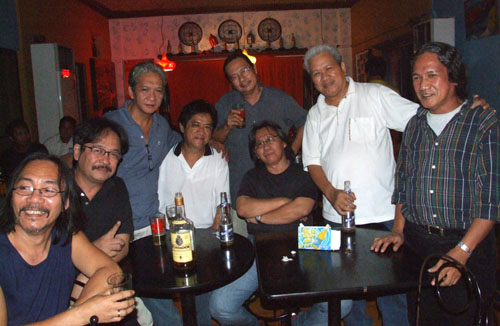
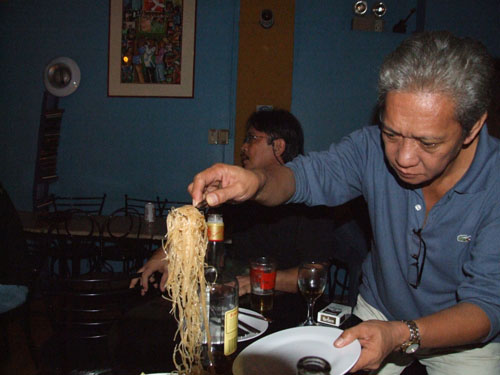
Me, I’m taking a break from proposals (just completed one for a moolah-making project), presentations, editing (endgame for three translation books, writing intro and proofreading original Filipino and translation text), doing a corporate identity guideline with logo description, rationale and specs (tip: I don’t know graphic or publishing programs like Corel, Photoshop or In-Design, so I do all my graphics in Mac’s Keynote presentation—where I am bit of an expert—then export them to JPEG, and there you are, neat…), and shuttling between translating a Filipino novel into English and, again, Keynote presentations for a planning conference. So, as promised my Banggaan mates, here are the pictures from Heber’s Tuesday Conspiracy gig, supposedly his and my birthday celebs—it was one day after mine, November 5, and three days before his, the 9th, a Friday. But, my, what a celebration it was. Banggaan have seen these pictures but the whole Internet hasn’t, so here they are again, with Heber’s letter and some of my captioning, as long as I can recall that inebriated night. Pansit figured very well, no matter how impromptu, which Heber insisted on having, in the Filipino and Chinese tradition of always having noodles during a birthday celebration, for long life.
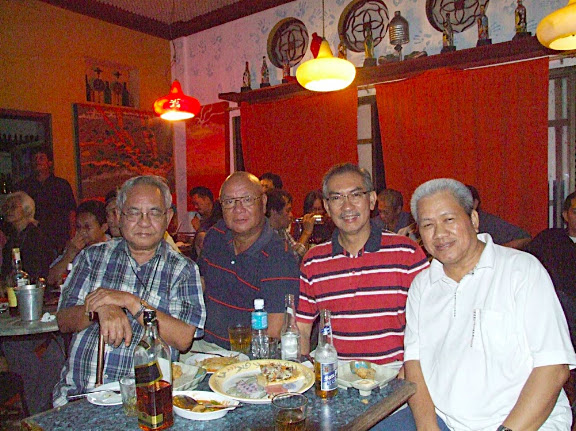
HEBER (the afternoon before, on the cellphone): Pare ikaw ang may birthday ngayon [he’s confused as well], huwag kang mawawala. Gusto ko may pansit, pre. Darating yung mga Banggaan, si Benjo Laygo, si Joel from Australia, si Zen from California. Tapos sina Randy David, (former UP president) Dodong Nemenzo at baka si (National Artist) Bien Lumbera.
ME: I’ll take care of the pansit. Puwde tayong bumili sa katabing restaurant, yung Nena’s [I can’t remember the name], masarap ang pansit dun.
HEBER: Great! Puwede rin tayong magpaluto sa Conspi mismo.
ME (about an hour before, cellphone text): Hebs, running late fr anothr mtng. D n mkabili pansit.
HEBER (cellphone text): Oks lang. Ako n lng.
BEFORE THE SHOW. Few tables filled. Heber and some friends in one, a Fundador and pulutan before them. Beside them are gracious old ladies, Heber’s guests from a songwriting workshop he conducts. I came in with poet and playwright Reuel Aguila, we took a table in the garden where we could smoke before the Banyuhay show.
HEBER: Marne, may pansit na tayo. Nagpaluto na ako rito. Binigyan ko ng one thousand (pesos) pero mga five hundred lang daw magagastos.
ME: Yung sukli for more beer na lang!
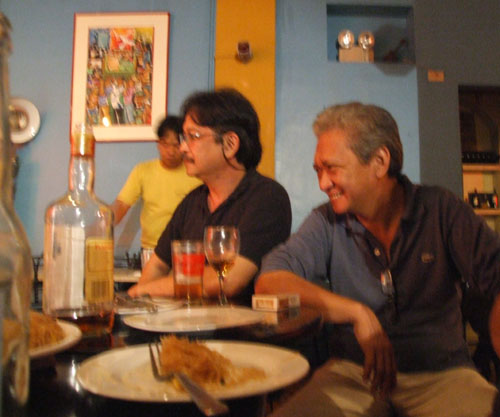
& HERE’S HEBER’S LETTER TO BANGGAAN:
Banggers,Sobrang abala ako. Hindi ko alam kung nakapagkwento na ako sa nakaraang Bday gig ko sa Conspiracy. Bukas na kasi ang totoong birthday ko. Nagpa-golf tourney ako sa dalawang dahilan: Una, para merong activity sa aking kaarawan, pangalawa, para maka-raise ng konting pondo na gagamitin sa recording ng aking workshop participants. Biglaan lang ito. Kahit konti lang ang sumali. Ayos lang.
Sa Linggo naman, 11th, darating sa bahay mga composers, pansit na naman. So medyo naging tatlong events ang birthday ko.
Yung sa Conspiracy ay talagang napakasaya. Yun ang text sa akin the next day ni Randy David, ni Dulce, ni Marne na siyang birthday celebrant.
Di nga dumating pareho sina Zen at Joel. Si Zen ay tumawag martes ng hapon dahil pati yung flight nya pabalik sa Glendale ay kailangan i-re-sked. Dahil kailangan daw niyang sumama sa kanyang ina sa gawing norte.
Si Joel naman ay nag-text sa akin ng ganito wednesday ng umaga: Para akong babaeng binalisawsaw. Nanakit ang puson, balakang at hita. Stress. Dehydration. So sorry to miss ur concert. So ashamed of my kamalasan.
Maraming ikukwento siguro si Joel sa atin pagbalik niya sa Melbourne. Di ko alam kung ano ang sitwasyon ng exhibit niya sa Baguio.
PHOTOS. Narito ang ilang pix sa Conspi [inayos ko nang konti ang captioning-MLK]:
THE REAL PROMINENTS (Second pic above): Former UP President Dodong Nemenzo, Nonoy Buncio, Randy David at ako.
THE ALSO PROMINENTS (First pic above): Sina Boy Dominguez, Benjo Laygo, Marne, Ed Manalo, Reuel Molina Aguila, pareng Nap Jamir, Levi.
THE PANSIT MARNE DIDN'T BUY, (Third above) so he just took care of the beer, mainly for the Also Prominents.
BENJO & MARNE, (Fourth above) Really swell and cool guy Benjo, whom Marne met for the first time.
Si Ben (Razon) ang kumuha kaya wala sya sa mga ipinadala ko. Nasa kanya ang memory card ko. Pero abala din sya. sobrang busy rin.
Yung mga detalye ng pangyayari ay next week ko pa maikukwento. Kumanta si Dulce, Bayang Barrios at ilang workshopers. Nagperform ang ilang rap recording artists, mga magicians, atbp. Maganda talaga ang nangyari. Masaya. Nabuhay si Nanay Perla. Nag-acapella. Hangga dito muna.
Heber
MY EMAIL TO BANGGAAN (after the flurry of greetings on the Web)
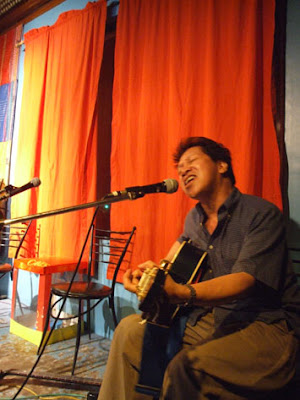 Thanks Jimi, Claro, Tanto, Clem & All the Bangganis.
Ang saya ng birthday namin ni Heber. Ako, mainly "kibitzing" celebrator, dapat daw kasi sabi ni Heber huwag akong mawala dun sa Martes gig niya kahit it was not the exact day of both our birthdays (Nov. 9 siya, Nov. 5 naman ako), pero ang saya, kami ang nagsara ng Conspi. I will blog the Conspi event later. Di ko pala nasagot ang pansit kasi na-late ako ng kaunti, so beer na lang ang sinagot ko. Kaya nalasing kami sa Black Label, Fundador, at San Mig. Shalamat! At saka, ang galing pa rin ng Banyuhay, Heber is always the great strummer, apart from the songwriter that he is, Levi and Jesse are still the best guitarists (classical, folk, pop, etc.) hereabouts, and Jesse is perhaps the only local expert on 60s-70s music, from the Gordon Lightfoots to the Paul Simons, etc., etc. Mag-request lang kayo sa kanya.
Marne
Next Mag:Netic Nights: Pictura Poeisis
 A-brewing now as this comes out is the "much awaited" ekphrastic show to be mounted by several poets at our favorite watering hole on Katipunan, just opposite one of the gates of Miriam College and the northernmost entrance of Ateneo. Mag:Net Café and Gallery comes to life with words and pictures (mostly paintings inspiring poems, done in PowerPoint or in my case, Keynote) on November 19, seven o’clock to 9 in the evening. The nth installment of the continuing saga of the Happy Mondays Poetry Nights organized by Prof. Joel Toledo, award-winning poet, of Miriam, this Monday Manila poetas from La Salle (from the graduate class of Prof. Marj Evasco), UP, Miriam, Ateneo, and even perhaps Mapua during the open mic, converge on this artful joint owned by painter Rock Drilon. The idea sprung out of a conversation after my lecture in Marj’s class on ekphrastic poetry. The title comes form Marj. Why not read the poems and show the artwork that inspired them? Mag:Net really comes in handy with its big screen (used by the likes of Khavn de la Cruz to show their world-recognized short or indie films). So third Monday it is then, and tomorrow, Wednesday, we gather the CDs with pictures of the poetry-producing paintings. It will be a really colorful Monday then, like this sign.
THE SIGN from History
And let me let you in on a lesser known but facinating trivia about Mag:Net and its "Café" logotype. ‘Twas the first time I heard it from Rock Drilon, over our last beer before we went up to his third floor digs and store of paintings from various artists which I had never seen either. Take a look at the “Café” part of the sign (sorry for the small photo), with its unique typography, he says. Because it is not typography. It’s a “font” you won’t find in any font book or type catalogue (or pirated CD), or with or in any colophon. Because it’s not a font either. Rock goes on, he doesn’t mention any credits or I just missed his attributions, but the collection of four letters comes from history and the history of text, from old documents about or from our own national narrative: the c is taken (scanned? cut-before-pasting? I missed this too) from a Rizal manuscript, it’s in his handwriting; the a from a signature of Juan Luna in one of his paintings; the f is probably not an f but a t, or simply a slash, and its cross is not a stroke but the way blood flows from a cut: because it is a cut, the way the Katipunan cut their themselves on the arm for their secret blood compact, and it’s probably Bonifacio’s, when he signed the pact with his blood; the e is what I missed or can’t recall from Rock’s narrative. I will have to ask him again. That makes the Café in Mag:Net Café a real sign, a collection of glyphs or sigils or runes that are not just representations but contain (more or less) what they signify, that could lead you to discoveries and labyrinths. Like the I Ching or the Sefirot, which could lead you either to the universe or just coffee.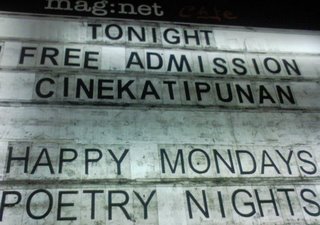
Saturday, September 29, 2007
“Man Dying”: One More Picture Poem from Alfredo Roces’ Art
3 comments Posted by Marne L. Kilates at 5:59 PM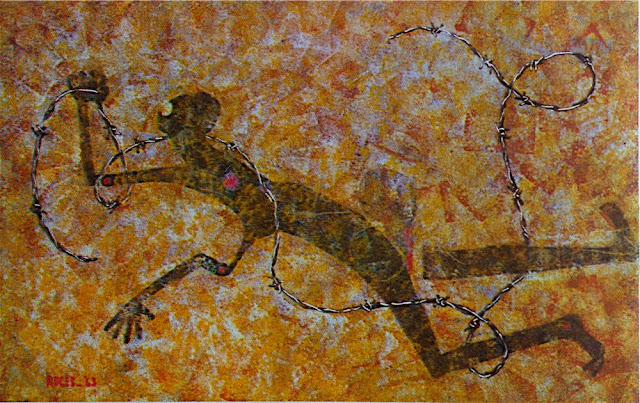 Man Dying. casein mixed media. 1961.
Man Dying
In this period I was interested in prehistoric cave paintings and was experimenting with some casein and rubber paints…. It was after I had read about this guy in East Berlin who was shot while making a break for the West Berlin border, collapsing somewhere in no man’s land separating the East from the West. The guards in the West could not, or would not, help him because he was not quite in West terrain, so he just lay there dying as guards and officials from both sides stared silently away.
—Alfredo Roces, From My Cyberjournal
At Lascaux, it was men crossing
The threshold of humanity,
Perhaps from a certain kind of death,
Into beauty.
Such shapes, indeed,
Of life, in muscle or shadow,
Shimmering in newfangled light
That was neither the sun’s nor the moon’s,
But struck from stones
And lit the eye that lead the hand
To line and color that kept the ancient
Memory of these walls.
In Berlin, what threshold
Was almost crossed?
Only that of later men observing lines
And walls. And what light
Lit the eye behind the cross-hairs
And moved the finger on the trigger,
And shut the eyes that stared
Silently away? Only
That newfangled light that erases
Beauty with indifferent precision.
And yet this threshold was not
Precise (because no thresholds are).
It was the crossing between
Caves where men lived
Only by their own newfangled lights
And thus drew precise lines
That shaped their own memories
And walls. It was a crossing
Into the darkness
Before men lived in caves.
Marne L. Kilates
September 28, 2007
NOTE: Couldn’t let go, I was on a writing binge (two poems in a row during almost a month of blockage, although I was doing “non-poetic” work). The Net by its nature has spoiled me into expecting almost instantaneous feedback—but this was no solitary thing, I was writing from someone else’s work and that entitled me somehow to know what my absent partner had to say about what I did to or from his work. The transaction is both spiritual and electronic. Sight unseen. A nod would feel like a contract had been signed, although with no real obligations but just opening up the possibilities (which I hope I did) of a work of art to exist in another mode, for instance, from visual to textual, from image to words. And I had kind words from Mr. Ding Roces (“Absolutely divine, Marne…”). He had his comment posted on my blog itself, and sent an email. I am not embarrassed (maybe just a little, wink, wink) to tell this. Then, I went through this usual reaction to the reaction, which is to go back to the source, the subject of all the excitement (usually just mine)—which was my own posting, and then to the source posting on Ding Roces’ blog. I had missed one painting. I reviewed Ding’s own vignettes and annotations to the pieces, especially the first two paintings that caught my eye. Ruben Darío and my own personal memories of green bottles and as a sacristan (at the church on the hill in Daraga, Albay, in ancient times) easily started my heart pumping. But I had completely overlooked that other piece. Of course I appreciated the other more abstract ones but otherwise old-fashioned me gravitated to the more figurative. “Man Dying” had an extraordinary vignette, rising from the mists of the Cold War. But it spoke of more than political divisions, and the painting brought back pictures that had intrigued archaeologists and poets from the first time a cave decorated with Paleolithic paintings was discovered in Dordogne, France. Cirilo F. Bautista’s “Lascaux” is a favorite of mine. Even as I downloaded the piece and answered email from Mr. Roces, the Banggaan group, and new poet-friends from the Net, Laura Stamps and Maurice Oliver, I was noting down lines, my mind was racing over these images. And it was the violence of Ding’s painting itself—man reduced to a flimsy primate, primitive, shape, entangled in barbed wire but almost diaphanous in its beauty as it just about blended into the texture of the medium itself (I looked up “casein” in the dictionary but it was of little help)—that reminded me of pictures of cave paintings (I have never been to Lascaux, not to mention France, like Cirilo has). And so, this poem.
(A note on the form: Once again I am unable to reproduce the indentions I had devised for this poem—there are enjambments and peculiar line breaks—because blog has a definite template which I don’t know how to override with the little html I know. The proper indentions will be seen in the printed copy of the poem, if the book materializes, but Mr. Roces will have his own properly indented and line-broken copy.)
REPRO from the Alfredo Roces blog
Two Picture Poems from Alfredo ‘Ding’ Roces’ Paintings
2 comments Posted by Marne L. Kilates at 5:19 AM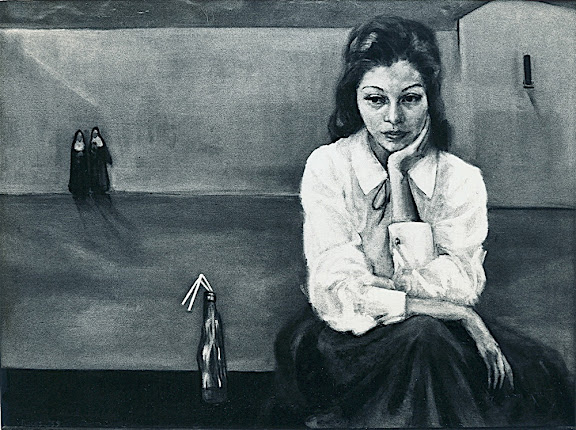 Sonatina. Oil. 1957
Sonatina
(from Ruben Darío and Alfredo Roces)La princesa está triste... ¿Qué tendrá la princesa?
Los suspiros se escapan de su boca de fresa,
que ha perdido la risa, que ha perdido el color.
La princesa está pálida en su silla de oro,
... y en un vaso, olvidada, se desmaya una flor.
—Ruben Darío
The flower has become
A pair of broken straws, the vase
A soda bottle,
What gurgle of emptiness echoed,
When you sipped
The last drop of sweetened water?
Behind you, the gray
College, monastic in its bareness:
The nuns, so far
From your grief—what decades
Can they count
In the Sorrowful Mysteries?
Listen, the world is no longer
So simple. It is no respecter
Of tenderness. Ripening,
It crumples like a fruit.
Prepare yourself. Sorrows past
Are sorrows still to come.
Marne L. Kilates
September 24, 2007
(NOTE: Alfredo Roces’ “loose non-poetic translation”: The princess is sad...What ails her?/Sighs escape from her strawberry mouth/which has lost its laughter, which has lost its color/The princess sits pale in her golden chair/...and in a vase, neglected, a flower swoons)
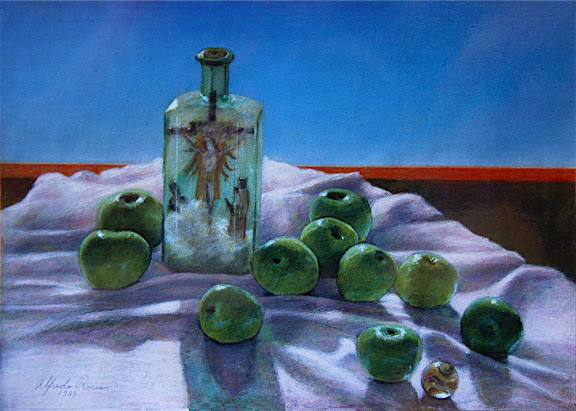 Recollections of Paradise. Pastel. 1992
Recollections of Paradise
In my memory, green bottles
Meant oil or medicine kept by grandmothers
For that slight fever or bout
Of indigestion, perhaps from eating
Too many guavas filched from the neighbor’s tree
At the other side of the fence;
Or for that sprain after a rough game,
Or for herself, her swollen knees
And elbows: it meant a soothing liniment.
Or this bottle. Inside, a miniature
Tableau of the suffering Christ
And the grieving Mother (and John,
And the Magdalene?): Did he remember Paradise
Before he thought for a moment
He had been abandoned by the Father?
Or was it the Paradise he promised
The repentant thief whose copy
Is nowhere to be seen in this bottle?
We had similar bottles at the other altar
Grandmother kept in another part of the house,
Not at the main shrine of the Sacred Heart
That watched over our household.
They contained sacred oils blessed
By the Spanish priest at the Paschal hour,
(Beside the blackened statue of San Roque
With his faithful dog beside him,
A piece of bread in his mouth),
Old sacramentals like the faded novenas
Replaced by prayer books and scapulars
With words in English. We did not have
This icon bottle. I thought of guavas,
I see apples (and one glass marble),
In this Filipino Catholic still life. What
Have we replaced in our old faith?
What have we given up? A Paradise
Remembered in still another tongue,
Like our faith of Sundays,
Our innocence of catechumens,
The scent of apples, a game of marbles,
The liniment of holy oil that our grandmothers
Rubbed us with to hasten our convalescence?
What ails us? What is the name
Of our disease? Because we cannot utter it,
It is something we cannot conjure or cure.
It is the memory before this Paradise
That is the darkness of our soul.
Marne L. Kilates
September 25, 2007
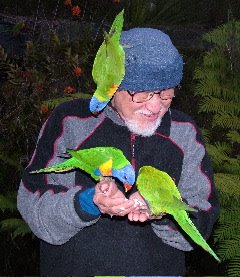
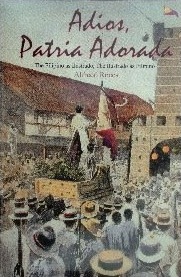
Alfredo “Ding” Roces, the respected Filipino artist-writer based in Sydney Australia, recently launched his online journal,http://dingrocespo.blogspot.com/ (listed under the links, “Check these Places Out,” on the right column of this blog). Much awaited by his friends, especially at Banggaan e-group, the blog is a veritable ore lode of interesting stories, reminiscences, and insights on various Philippine subjects, especially art, history and literature. The two paintings here come from that site (and for those interested, more vignettes about the paintings can be read there). An indubitable Renaissance Man, Ding (of the famous Roces family of writers, educators, publishers and one National Artist for Literature), the painter who studied under the quondam Dadaist, George Grosz, is also a consummate editor and publisher, notably of the encyclopedic multi-volume Filipino Heritage series, which is sadly out of circulation now. His latest honor (one of several from the same award-giving body) is the 2006 Manila Critics Circle National Book Award for Social Science, for his book, Adios, Patria Adorada: The Filipino as Ilustrado, the Ilustrado as Filipino (De La Salle University Press). The citation partly reads, “for his audacious treatment of history…” and his “learned and nostalgic look at... the ‘enlightened’ men who formulated the ideas of Asia's first republic….” Ding is a member of Banggaan (of which this writer is also a member), an exuberant, chatty, gossipy e-group of professional and amateur artists, photographers, writers, and all sorts of good souls from the Philippines and the Filipino diaspora.
These poems are part of a growing collection of ekphrastic studies which I am contemplating to gather in a future book, and are also a form of tribute to Ding’s much-admired art.
PHOTOS & REPRODUCTIONS from the Alfredo Roces blog


