Saturday, September 29, 2007
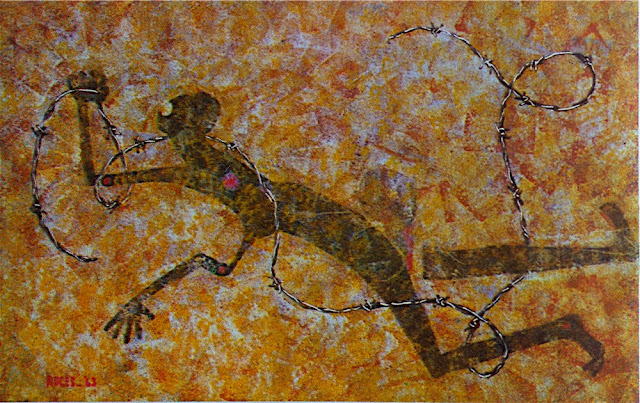 Man Dying. casein mixed media. 1961.
Man Dying
In this period I was interested in prehistoric cave paintings and was experimenting with some casein and rubber paints…. It was after I had read about this guy in East Berlin who was shot while making a break for the West Berlin border, collapsing somewhere in no man’s land separating the East from the West. The guards in the West could not, or would not, help him because he was not quite in West terrain, so he just lay there dying as guards and officials from both sides stared silently away.
—Alfredo Roces, From My Cyberjournal
At Lascaux, it was men crossing
The threshold of humanity,
Perhaps from a certain kind of death,
Into beauty.
Such shapes, indeed,
Of life, in muscle or shadow,
Shimmering in newfangled light
That was neither the sun’s nor the moon’s,
But struck from stones
And lit the eye that lead the hand
To line and color that kept the ancient
Memory of these walls.
In Berlin, what threshold
Was almost crossed?
Only that of later men observing lines
And walls. And what light
Lit the eye behind the cross-hairs
And moved the finger on the trigger,
And shut the eyes that stared
Silently away? Only
That newfangled light that erases
Beauty with indifferent precision.
And yet this threshold was not
Precise (because no thresholds are).
It was the crossing between
Caves where men lived
Only by their own newfangled lights
And thus drew precise lines
That shaped their own memories
And walls. It was a crossing
Into the darkness
Before men lived in caves.
Marne L. Kilates
September 28, 2007
NOTE: Couldn’t let go, I was on a writing binge (two poems in a row during almost a month of blockage, although I was doing “non-poetic” work). The Net by its nature has spoiled me into expecting almost instantaneous feedback—but this was no solitary thing, I was writing from someone else’s work and that entitled me somehow to know what my absent partner had to say about what I did to or from his work. The transaction is both spiritual and electronic. Sight unseen. A nod would feel like a contract had been signed, although with no real obligations but just opening up the possibilities (which I hope I did) of a work of art to exist in another mode, for instance, from visual to textual, from image to words. And I had kind words from Mr. Ding Roces (“Absolutely divine, Marne…”). He had his comment posted on my blog itself, and sent an email. I am not embarrassed (maybe just a little, wink, wink) to tell this. Then, I went through this usual reaction to the reaction, which is to go back to the source, the subject of all the excitement (usually just mine)—which was my own posting, and then to the source posting on Ding Roces’ blog. I had missed one painting. I reviewed Ding’s own vignettes and annotations to the pieces, especially the first two paintings that caught my eye. Ruben Darío and my own personal memories of green bottles and as a sacristan (at the church on the hill in Daraga, Albay, in ancient times) easily started my heart pumping. But I had completely overlooked that other piece. Of course I appreciated the other more abstract ones but otherwise old-fashioned me gravitated to the more figurative. “Man Dying” had an extraordinary vignette, rising from the mists of the Cold War. But it spoke of more than political divisions, and the painting brought back pictures that had intrigued archaeologists and poets from the first time a cave decorated with Paleolithic paintings was discovered in Dordogne, France. Cirilo F. Bautista’s “Lascaux” is a favorite of mine. Even as I downloaded the piece and answered email from Mr. Roces, the Banggaan group, and new poet-friends from the Net, Laura Stamps and Maurice Oliver, I was noting down lines, my mind was racing over these images. And it was the violence of Ding’s painting itself—man reduced to a flimsy primate, primitive, shape, entangled in barbed wire but almost diaphanous in its beauty as it just about blended into the texture of the medium itself (I looked up “casein” in the dictionary but it was of little help)—that reminded me of pictures of cave paintings (I have never been to Lascaux, not to mention France, like Cirilo has). And so, this poem.
(A note on the form: Once again I am unable to reproduce the indentions I had devised for this poem—there are enjambments and peculiar line breaks—because blog has a definite template which I don’t know how to override with the little html I know. The proper indentions will be seen in the printed copy of the poem, if the book materializes, but Mr. Roces will have his own properly indented and line-broken copy.)
REPRO from the Alfredo Roces blog
Subscribe to:
Post Comments (Atom)


3 Comments:
Marne,
Although I am a writer myelf, I am no poet and I find it extremely difficult to write about my paintings precisely because these paintings are my outlet for vague, multi-layered ideas and emotions. I like to have the viewer contribute his/her imagination to my paintings.
You have successfully turned the key and unlocked this one. Yes, it is a frozen moment in time and yet timeless because it keeps happening.
Cheers
Ding
I was nine years old in 1961, but the Cold War kept poking its ugly head into our Current Events sub-subject in elementary school. Perhaps I came later upon this news item (when I could understand it better), but the Cuban missile crisis, the Kennedy assassination, affected me in a vague but unforgettable manner much like 911 affected us now.
Thank you for the chance to reflect on these happenings, and make my own record of them in the only manner I know best.
Warm regards,
Marne
manoy marne, maoorag ining mga obrang bago. parating igwang pagmati iningd inadara sakuya. sa hiling ko mas orog kaining pinapahiwas an mga panan'awan na hinonang kalubuson sa anuman na moda kan kanya-kanya arte. kun pwede ko na pong mahiling si pinapakisuyo ko saimo bago matapos ining bulan. mabalos na dakulaon.
Post a Comment