Saturday, September 29, 2007
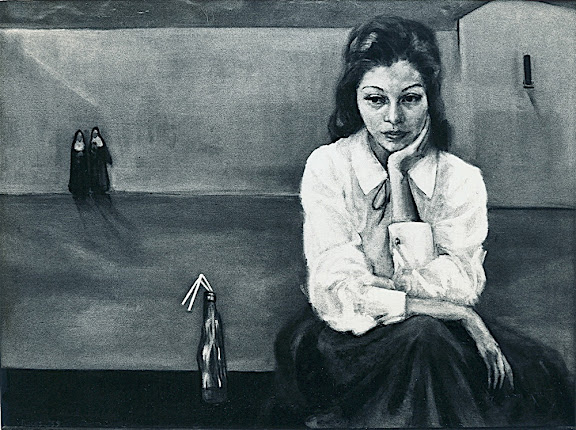 Sonatina. Oil. 1957
Sonatina
(from Ruben Darío and Alfredo Roces)La princesa está triste... ¿Qué tendrá la princesa?
Los suspiros se escapan de su boca de fresa,
que ha perdido la risa, que ha perdido el color.
La princesa está pálida en su silla de oro,
... y en un vaso, olvidada, se desmaya una flor.
—Ruben Darío
The flower has become
A pair of broken straws, the vase
A soda bottle,
What gurgle of emptiness echoed,
When you sipped
The last drop of sweetened water?
Behind you, the gray
College, monastic in its bareness:
The nuns, so far
From your grief—what decades
Can they count
In the Sorrowful Mysteries?
Listen, the world is no longer
So simple. It is no respecter
Of tenderness. Ripening,
It crumples like a fruit.
Prepare yourself. Sorrows past
Are sorrows still to come.
Marne L. Kilates
September 24, 2007
(NOTE: Alfredo Roces’ “loose non-poetic translation”: The princess is sad...What ails her?/Sighs escape from her strawberry mouth/which has lost its laughter, which has lost its color/The princess sits pale in her golden chair/...and in a vase, neglected, a flower swoons)
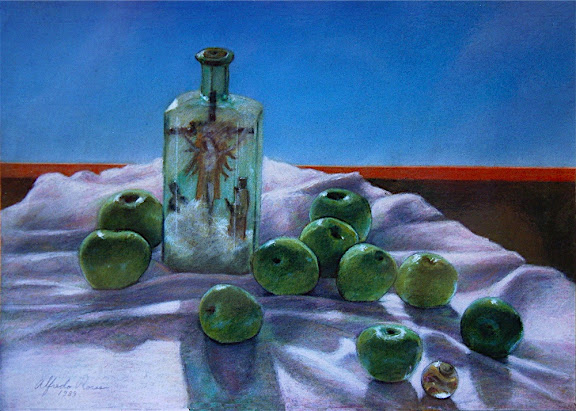 Recollections of Paradise. Pastel. 1992
Recollections of Paradise
In my memory, green bottles
Meant oil or medicine kept by grandmothers
For that slight fever or bout
Of indigestion, perhaps from eating
Too many guavas filched from the neighbor’s tree
At the other side of the fence;
Or for that sprain after a rough game,
Or for herself, her swollen knees
And elbows: it meant a soothing liniment.
Or this bottle. Inside, a miniature
Tableau of the suffering Christ
And the grieving Mother (and John,
And the Magdalene?): Did he remember Paradise
Before he thought for a moment
He had been abandoned by the Father?
Or was it the Paradise he promised
The repentant thief whose copy
Is nowhere to be seen in this bottle?
We had similar bottles at the other altar
Grandmother kept in another part of the house,
Not at the main shrine of the Sacred Heart
That watched over our household.
They contained sacred oils blessed
By the Spanish priest at the Paschal hour,
(Beside the blackened statue of San Roque
With his faithful dog beside him,
A piece of bread in his mouth),
Old sacramentals like the faded novenas
Replaced by prayer books and scapulars
With words in English. We did not have
This icon bottle. I thought of guavas,
I see apples (and one glass marble),
In this Filipino Catholic still life. What
Have we replaced in our old faith?
What have we given up? A Paradise
Remembered in still another tongue,
Like our faith of Sundays,
Our innocence of catechumens,
The scent of apples, a game of marbles,
The liniment of holy oil that our grandmothers
Rubbed us with to hasten our convalescence?
What ails us? What is the name
Of our disease? Because we cannot utter it,
It is something we cannot conjure or cure.
It is the memory before this Paradise
That is the darkness of our soul.
Marne L. Kilates
September 25, 2007
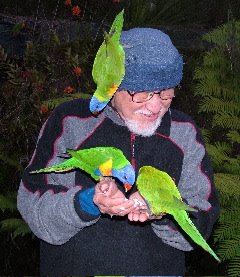
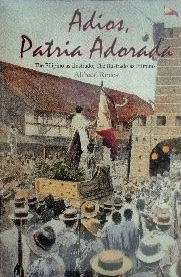
Alfredo “Ding” Roces, the respected Filipino artist-writer based in Sydney Australia, recently launched his online journal,http://dingrocespo.blogspot.com/ (listed under the links, “Check these Places Out,” on the right column of this blog). Much awaited by his friends, especially at Banggaan e-group, the blog is a veritable ore lode of interesting stories, reminiscences, and insights on various Philippine subjects, especially art, history and literature. The two paintings here come from that site (and for those interested, more vignettes about the paintings can be read there). An indubitable Renaissance Man, Ding (of the famous Roces family of writers, educators, publishers and one National Artist for Literature), the painter who studied under the quondam Dadaist, George Grosz, is also a consummate editor and publisher, notably of the encyclopedic multi-volume Filipino Heritage series, which is sadly out of circulation now. His latest honor (one of several from the same award-giving body) is the 2006 Manila Critics Circle National Book Award for Social Science, for his book, Adios, Patria Adorada: The Filipino as Ilustrado, the Ilustrado as Filipino (De La Salle University Press). The citation partly reads, “for his audacious treatment of history…” and his “learned and nostalgic look at... the ‘enlightened’ men who formulated the ideas of Asia's first republic….” Ding is a member of Banggaan (of which this writer is also a member), an exuberant, chatty, gossipy e-group of professional and amateur artists, photographers, writers, and all sorts of good souls from the Philippines and the Filipino diaspora.
These poems are part of a growing collection of ekphrastic studies which I am contemplating to gather in a future book, and are also a form of tribute to Ding’s much-admired art.
PHOTOS & REPRODUCTIONS from the Alfredo Roces blog
Subscribe to:
Post Comments (Atom)


2 Comments:
Absolutely divine Marne! My paintings have gained angelic wings. Thank you also for kind words. More power at mabuhay ka.
Ding
Thank you, too, Ding. My pleasure.
Marne
Post a Comment