Monday, February 19, 2007
Orolayan, Orosipon: Bikol Writing is Alive & Well and Living in Naga, Iriga, Oas, Daraga, Legazpi, Manila…
Posted by Marne L. Kilates at 10:56 PMIt is a singular regret that I am unable to go home as much as I’d like to. And now I am even afraid to, because again Bikol, Albay specially, was in the path of nature’s wrath whose swath of destruction and death is almost unspeakable, and now I don’t even want to look (that’s the title of a guilty poem I haven't finished, that starts in the middle and doesn’t as yet have a beginning and an end). Of that, later in this journal. So if I can’t even look, well, I’d like talk about a happier thing—writing—in Bikol (both the language and the place). Of course writing, being what it is, coming from life itself, cannot refuse to look, cannot be spared or willingly spare itself from life. But the happy thing is that writing is happening in Bikol, in the language. 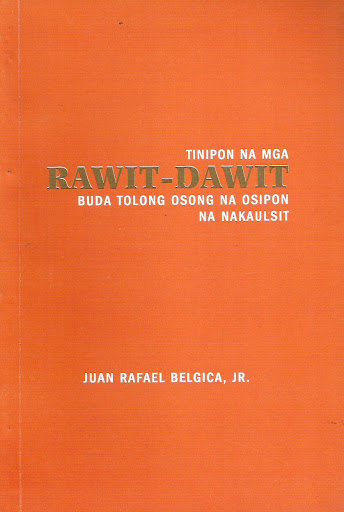 Juan Rafael Belgica's second collection of Bikol poems
I used to be chided by friends for making a daring and apparently baseless statement some years ago that Bikol literature is dead. I still insist that the statement was true when I said it. The last thing that I had read then was the research and translation done by the late Merito Espinas, beloved professor that went the rounds of the three better schools in Albay, Aquinas University, Bicol University, and my alma mater Divine Word College, and among these three academies spread the word on Ibalong, Handiong, Aslong, and culled from the musty chests of Mariano Goyena… And even then, the epic fragment was under a cloud of doubt, with the only text existing written by a 17th century friar and Espinas himself could only translate it into English. Only by the irony or ironies of translating it back into Bikol (as if from a palimpsest, by the poet Zacarias Lorino) would we have a Bikol version of our supposed epic. Ateneo de Naga had a fine Bikol studies program under Fr. Lynch. And sometime in my college life I became involved (as a lighting crew) in the production of the only zarzuela in Bikol, “Mga Burak sa Haron nin Pagkamoot,” (with Mike Molina and Charito Esquela, Noel and Lando’s sister, in the lead roles), written and composed by the great architect-writer-musician Everardo (Ever) Napay (Jojo and Toy’s dad, these latter two my companions in Amy Manila’s “New Tomorrow” Sing Out Philippines, Legazpi City chapter). Krisitan Cordero's upcoming collection, his fourth (courtesy of his blogsite, with link here below)
But nothing, simply nothing, was being written in Bikol at that time. There were Bikol columns in fortnightly English newspapers which couldn’t come out if no legal notices paid for their printing. Ever Napay dreamed of (and attempted) an English-Bikol broadsheet. But it was journalism and it never saw the light of day.
I was talking about (and pining for literature)—writing that creates and seeks to know itself—and not newspaper columns in barely surviving tabloids. Where was a book of stories, or a novel, or of poems in Bikol?
I can point to a specific instance when I saw poetry and stories began being written again in Bikol. This was when they reserved a slot at the UP Writers’ Workshop for one or two writers writing in the Bikol language (apart from Cebuano, Iloko, Quinaray-a). The deal was that there had to be enough works to be workshopped, the works had to be translated into Filipino, and a writer proficient in the language should be sitting in the panel. Thus there was a crop of poems and stories, although some of them were later found out to be translations by the authors themselves of their original Filipino works into Bikol (for them to qualify). It was tolerated. But one of the good results was that the authors had actually started writing in Bikol, or those who merely translated their works into Bikol subsequently shifted, as the Bikol writers found that their works could stand scrutiny and survive as Bikol.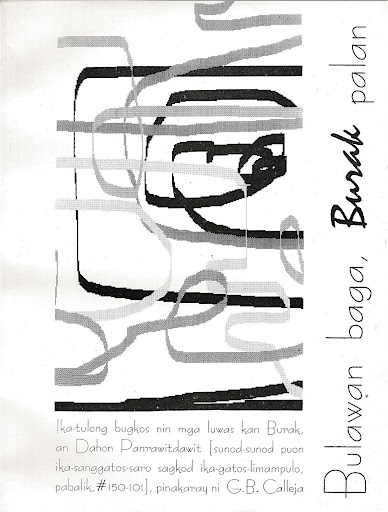 The third annual collection of Burak (a fourth one has come out): poems from Bikol and the Bikolano diaspora, published from Canada by Gode Calleja
I was one of the first panelists (and later the award-winning fictionist Abdon ‘Jun’ Balde, Jr., who was writing in Filipino anyway, and only later in Oasnon) who saw the first Bikol poems of Frank Peñones, Esting Jacob, and later Kristian Cordero (the latter recently has had his run of Palanca Awards, new author award, mainly for his Bikol poetry). And then came the NCCA regional/provincial forums (sometimes led by the NCCA executive director himself at that time, Rio Alma), including the one Jaz Llana and Raffi Banzuela organized for Aquinas U for one of the first Arts Month celebrations, where I made the statement. The immediate result of the forum was a new organization of Bikol writers, a hybrid magazine-broadsheet of Bikol prose and poems… and now, a veritable flood of works (I hope not be overcome by any Reming inundation or mudslide), actually, new titles of books of poetry and essays coming out of the printer’s. (I‘ve even written some poems in Bikol myself.) Now I must also mention the almost solitary effort of Gode Calleja, based in Canada, for putting out, and persisting in publishing, the snail-mail-distributed, one-page journal called Burak, which he collects, with his insightful introductory essays on the Bikol language, into an annual compilation showcasing poetry from Bikolanos and the Bikolano diaspora. These Bikol writers’ works I will sample here in this journal from time to time, in translation (for the non-Bikolano), but with their originals accompanying them.


3 Comments:
manoy, iyo dakul akong nadangog sa sinabi mo kaidto manungod sa literaturang bikol asin sa hiling ko bako man na istatiko an saimong mga argumento, kan panahon na idto iyo tama asin pagamia'aw ngani, santelmo itong nakaparibaraw sa kadaklan, alagad ngonyan, pinupuna ta na an pagbalukat. marhay-rahay na magtarabangan kitang mga oragon asin magayon sa orog na ikakauswag kan nagsasaringsiing tang tataramon.
Right you are, Kristian. The thing was, many of those who responded with some annoyance (or hurt) were not at that time writing anything literary in Bikol. And that included myself. I was lamenting the fact that Bikol literature was dead (!) because no one, including myself, was writing a story, novel or poem, and publishing them, in Bikol. Literature, the contemporary living one, must be written and published. Now it is different. There are websites, blogs and books in Bikol. And I suppose, and hope, there are readers, too.
Marne
pasensya ka na if halo-halo ang comments ko to this particular post of yours. we have never met but i was lured to reading the whole writeup of yours dahil sa mga suanoy na bikol words i remember hearing my grandparents talking with their friends - eavesdropper that i am ever since. anyway, can not help but also walk my mind thru my childhood days up to the present - i even read names which apparently are commmon friends of ours. i am from tabaco,albay, by the way, now tabaco city. our common friends are childhood friends and neighbors, too. am really glad i chanced upon this blog of yours. i wish i could see/meet you in person, but at the moment i am out of the country. will see when i go home sa bicol, will try my best to fight my other timid self- na pirming nanggagana - to know your whereabouts. pls , ipadagos mo ang pagsurat sa bikol. kaipuhan kang generation Y ngonyan ang saindang guinikanan.
pareho lang siguro edad ta, so dai ako masabing manoy, siguro, amigo, sa masunod na orolay na lang.
myr
Post a Comment