Sunday, February 25, 2007
 At the beginning, or at the other end, of our highways, lies buried our afterbirth, the inulnan or placenta, a word so important in Bikol. This makes our hometowns more intimate than the motherland itself. ‘Ulnan’ or ‘ulunan’ is pillow in Bikol, ‘inulnan’ is that which served as pillow, a cushion for the head (and foetal body) against bump or injury, within the mother’s womb. Apart, of course from providing the store and conduit for foetal nourishment. ‘Ulunan’, which has a cognate in Tagalog (there are more similarities in our languages than differences, I always like to say) refers as well to that place, inside or outside of ourselves, where our head belongs, where it returns for shelter and comfort—memory itself. ‘Inulnan’ figures much as a symbol in one of the two Bikolano poets’ works whose poems I will feature here.
[Apologies for the endless quotation marks on the Bikol words, I can’t italicize in Safari—this search engine of Mac—when blogging or emailing. Blogspot says to better to use Mozilla Firefox or Explorer. I have to shift to either. When italics appear and fonts are better looking (the bold should be bold, italics italics, smaller fonts where they should be, as in captions) then that means I’ve shifted to a better search engine. Bear with me in the meantime, dear readers and visitors, and suffer the typographical illiteracy of this blog.]
So back to Orolayan. It just so happens that these two poets I am about to present are personal friends of mine. But that doesn’t deprive me of the right to endorse their poetry, in Bikol, and what they did for their, this, our, native language, the language of our birth and afterbirth, and maybe rebirth. Ladies and gentlemen, the two Rafaels of Bikol poetry: Juan Rafael (Jun) Belgica, Jr. and Rafael (Raffi) Banzuela.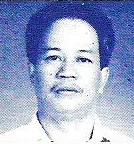 JUAN RAFAEL BELGICA, Jr. is the son of Juan (Johnny) Belgica pere, the last of the Bikolano poets who were adepts at the craft of rawitdawit either orally or written, beloved school official, and friend of my father Eugenio (who together with his brother, Tomas, published Bikolandia, the first Bikol magazine, after the war). Jun, fils, equipped with genes and heritage, himself a man of many interests, from history to political science to economics, has not just picked up where his father left off. I daresay his first poem in Bikol, “Sa Lukunlukunan kan Pantalan,” has upped Bikol poetry another level. I consider it, for reasons stated below, the first modern, contemporary Bikol poem. (It will need some work in translation so I will only be able to feature it here in the future.)
 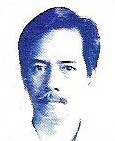 RAFAEL BANZUELA, constant loner and earnest individualist (as I recall from our college days, like his friend Alberto Realubit), sharer of bottles of brandy and beer, is an accomplished and award-winning broadcaster, former radio station manager, and lately head of the Mass Communications Program at Aquinas University. I have worked with Raffi in the college publication. After college he wento into professional broadcasting and local journalism, writing his pieces in the Bikol language, at which perhaps he resolved to go back to his literary roots. But for me Raffi, apart from being a premier Bikol poet, will always be the introspective denizen and intense memory-collector of his beloved Albay Viejo (the title of his book of essays which I hope to review sometime in this online journal, and to which I hope he adds another volume).
Together they persisted, since the 70s—when nobody was looking, when Bikol literature was dead—in writing their Bikol poetry. Like two conspirators (because I was not in on their plot), they were honing their skills, steeling their guts and perfecting their stances and routines like Kung Fu masters, laying out their stratagems sub rosa, in hiding, in the shadows. Perhaps before midnight they would lurk and sniff around like whiskered, cold-nosed mammals at the Peñaranda Park, into the wet markets of Camalig, Daraga and Albay: in the morning they would watch from among the canopy eaves when the fish crates and bañeras were being unloaded, and they would loiter in the din of the haggling and calling among vendor, barker and suki, when the stalls were all boarded up at night, or when Albay Gulf was chuckling and licking the joints of the spindly limbs of the Legazpi pier. This last mentioned sounds better in Bikol—“Sa Lukunlukunan kan Pantalan” (mentioned earlier)—Jun’s seminal Bikol poem written in college where we—he—proved that the Bikol language was capable of carrying modern sentiment and sensibility, with all its angst and Weltschmerz, but also (together with Raffi) setting it on a trajectory of triumph and hope.
So that when they came out of the shadows, before any other Bikol poet or coterie of poets could come out of their own, I was in awe. But they were unsung—in the invisible world of local publishing, and all the more so because they were writing in a language (a major Filipino language) that was just in the process of reviving itself, in no small way through both poets’ efforts. So, in the only way I know (in brief but earnest appreciation and in sample translations), I am now trying to make up for what could have been lost.
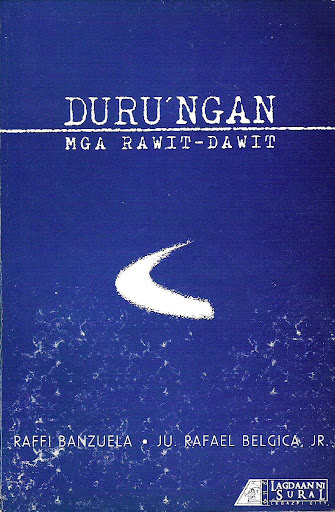
Raffi and Jun had engendered their, as it were, illegitimate offspring (English and Filipino were the only valid languages for poetry, it seemed): a healthy, frisky, resolutely wailing firstborn, a two-author book called ‘Duru’ngan’. The meaning of the word eludes me but it sounds like ‘durungan’—in Bikol, things happening or people acting at the same time, in unison, in rhythm. With its apostrophe, however, which looks like a substitute glyph for the glottal stop, it also sounds like ‘the place where you look out or down from, as in a window, ‘durungawan’. (Bikol still must develop its own standard orthography complete with diacritical marks; in another poem I first translated ‘tunog’ as sound, which was actually ‘tûnog’, with the glottal stop, meaning dew or dewdrop.) Unfortunately the book doesn’t provide a clue or intro. So I’m guessing (as with some of the other words I have forgotten or am no longer familiar with, with my writer’s Bikol definitely rusty). Still I share their passion and confidence, their enterprise, their audacious love, their great leap in language, when they declare, in the introductory poem (a collaboration) of the book:
Tuminangad kami sa sirangan, nahiling su daliwawa.
Masalingayahon. Kami man.
Mas pang pina-ogma kan mga oni kan mga bayong.
Magayonon. Su mga bayong. Kami
Gauod nagging pusiw—nakiutaan sa mga tunog—
Mga sadit na aking nakakupo sa daghan
Kan mga nagbabarayleng dahon,
Mga brilyantito sa nagmumuklat na aldaw.
Sa kasalingayahan, sa kagayonan
Kan nagbubungkaras na daliwawa kami namungnan,
Nagimadmad: an tunog
Saro-saro, luway-luway nagbuburutas
Sa pagkakupo sa daghan kan mga dahon
Na pagal na sa pagbayle sa tabyon kan sonatang dolot
Kan mga bayong na pasaro-saro ngani man—
Garing sarong orkestra—inabot an ultimong nota.
Su mga tunog napara, sa hinalean, nagbuelta.
Dayaday, nag-apwak an alangaang, kami napagios
Napabungkaras, sarong pangatorogan palan…
[Translation for non-Bikolanos:]
We looked to the east and saw the dawn.
It was radiant. And so were we.
We rejoiced even more at the singing of the birds.
Beautiful. The birds. We,
Perhaps, became a pusiw—and made small talk with the dewdrops—
Tiny children clinging to the breasts
Of the quivering, dancing leaves,
Tiny diamonds in the blinking eyes of the waking day.
In the radiance, in the splendor
Of the rising dawn we were stunned,
And stirred from our daze: the dewdrops
Were each, slowly, letting go
Of their hold on the breast of the leaves
Which in turn were weary from their swaying dance
In the birds’ sonata, and the birds themselves reaching
One by one—like an orchestra—their last note.
The dew was gone. It had returned to where it began.
Gradually, all around, the swelter swelled, we stirred
And rose. It was all a dream…
What a magnificent, magnetic fantasy about a sort of dawn-world of language, apparently characteristic of cultural revivals, the assertion of lost identity by subjugated peoples. But the ‘we’ of the poem have no illusions about this. In fact they wake up from the dream. In their persistence they go on to say that something had to be done. The two Rafaels had each savored the possibilities of the language, and it cannot be all a dream. If it was, then all the more they had to make it real, in unison, in stride and beat, Duru’ngan:
Ay, kaipuhan nang mag-ipos-ipos, magdurudanginot.
Magmaliogot!
Danga: nag-ipos, nanggutos, tiniripon an gabos.
Naging ining saindong pigkakaptan, pigmamaanan:
Duru’ngan.
[Translation:]
Ay, we must up and go now, make a start.
Persist!
Then: gather, pick, pluck, bundle, clutch.
Which became what you’re holding, under scrutiny, now:
Duru’ngan.
(The English translation, like all translations, can only approximate the original, but in the process transposes it into another mode of speech.)
Who can refresh our memory, excavate our speech from the debris, detritus and dross of oblivion that has buried it even when it was near death? Perhaps, or most certainly, only the poets, who unearth such words as daliwawa, pusiw and supay. Perhaps only Jun and Raffi, when everybody else has forgotten such words. We must not only speak but write our language. When we only speak it, it can die in time, out of atrophy and disuse, when our children are educated in a different language, when we migrate to other cultures and sire offspring that will nurse and wean in the language of strangers. We must write, write, write, create and recreate experience and meaning in language, in language that can imagine and create itself, in the language of the heart and the five senses, in the language of the street and in the special language of the professions and technology. We must be able to imagine ourselves, talk to ourselves, in the language of our birth and in the language of our growth, if it is not to die. Even if we had become good in other languages. Bikol, Bisaya, Iluko, Tagalog, Filipino. English. Spanish. All are part of ourselves, including those that were used against us, which we can neutralize by making them our own. We cannot and must not deny or ignore each, if we are to know and become ourselves. Let a thousand flowers bloom, let a thousand tongues speak. We cannot help but listen.


1 Comment:
Marne, I have a copy of Durungan, but where can I get a copy of Albay Viejo please? Thanks. Great blog!
Post a Comment