Sunday, February 25, 2007
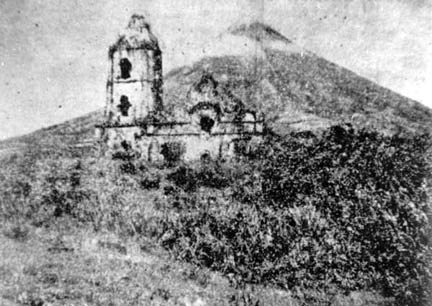
Old Kagsawa, with nave still intact
A POEM & FIVE TIGSÍK
By Rafael Banzuela
Translation
by Marne L. Kilates
AN LALAKI SA POON KAN BULKAN
Anas na lapak an saiyang mga palad
Dai na mati an gabat kan mga unsag
Sa buhay kan asadol asin minasbad.
Turog sa tanglay, pukaw sa daplos
An lalaki sa poon Bulkan Mayon
Dusay sa daga, daing tunong an igos.
Igos tios, ogak tigbak iyo man giraray
Sa sumada kikaabotan daing pagka-iba
And pagkakan aro-aldaw maluto, gulay.
Kung magtangad, langit; dumuko, dugi
Mangalagkalag man mahiling awot,
Pananaw abot sana sa hahaleon na ati.
Niyog, paroy, batag, doma, mga gulayon
Dolot sa banwa tanganing dai magutom,
Kan lalaki sa poon kan Bulkan Mayon.
Mga palad na pano ki lapak dai na bati
Dagos an angos sundo sa sunod na uson,
Sa unsag kan buhay ngorol na an mati,.
MAN ON VOLCANO SLOPE
All rough callus is the palm of his hand,
Numb to the weight and fall of the strokes
Of a life spent toiling with bolo and hoe.
Asleep, dog tired, he is wakened by sweat
The man on Mayon Volcano’s slope;
Intimate with earth, he never shuns toil.
Toil and suffer, idle and die, is all
It adds up to: each day no different
As he feasts on green vegetables and rice.
Look up, there’s the sky; look down, mud,
Gaze around and all there is weeds,
Horizon is a pile of dirt he must clear.
Coconut, paddy, banana, root crop, green leaves:
Gifts to the town to keep hunger at bay,
From the man on Mayon Volcano’s slope.
All the callus on his palms he no longer minds,
He lives between each surge of sulfur and mud,
Each stroke of a life dulled at the edge.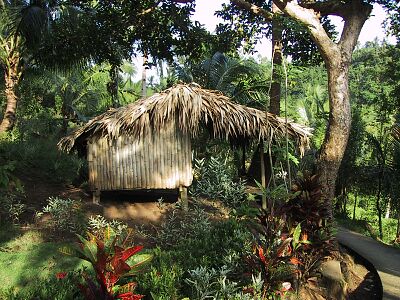 Hut in Tiwi (by Jun Balde)
LIMANG TIGSIK
1.
Tinigsik ko ining maputing bote
An habo magligok dai magrani
Kaming aranion gabos nawiwili
Sa lawas na garing mga butete.
2.
Tinigsik ko an saimong ablada
Na may piday kang manlima-lima
Sitsik sana ngani kan saimong ina
Buklos ka tolos, nagkakadarapa pa.
3.
Tinigsik ko ining upo
Iyan an istorya mo
Bayai daw Rodolfo
Matua ka sana sa ulo-ulo.
4.
Tinigsik ko siyang konsehal
An katuyuhan niya sabi banal
And pinta kan saiyang kudal
Kakolor kan edipisyo munisipal.
5.
Tinigsik ko sindang mga miron
Nagmamati sa tigsik kong magayon
Sige an tarango-tango, gabos aboyon
Daing pagkaaram daing siwo an bûyon.
FIVE TIGSIK
(Tigsík is a traditional Bikolano drinking verse, so called from the sound of the glasses of wine being clinked in a toast. ‘Mag-tirigsikan’ in Legazpeño; ‘magsarantikan’ in Nagueño, but the poetic form is Tigsík for both. It consists usually, not strictly, of eight- or twelve-syllable lines—the traditional verse measure common to Philippine languages—in a four-line monorhyming stanza. By nature, it always starts with a toast: “I drink to…” and goes on with its dose of humor, usually ribald. In the modern manner it is also used to comment on life and society.)
1.
I drink to this fine crystal glass
He who won’t quaff, don’t come near
We gathered here are enjoying ourselves
As well as our pot bellies.
2.
I drink to your tall stories
Sure, you got five girlfriends
But just at your mother’s psst,
Off you go stumbling home, in a jiffy.
3.
I drink to this gourd, upo
That’s the story you tell me
Oh, spare me, Rodolfo
You’re just older than the ulo-ulo.
4.
I drink to the councilor of the city
His purpose, his says, is noble
See his newly painted fence, how pretty
Its color’s the same as the City Hall’s.
5.
I drink to all you, onlookers,
Listening to my beautiful tigsík,
You nod your heads but forget
In a spoiled egg there’s no chick.
[Raffi has a natural and sometimes traditional Bikolano cadence and accent to his prosody that gives it a clear and evident public voice, due perhaps to his practice as broadcaster and commentator. Watch: “Dagos an angos sundo sa sunod na uson.” This wordplay and sound-play cannot be readily reproduced in translation; it can only be enjoyed in the original. Translation, ever humble and respectful of both the original and the translating language, must invent its own devices, fork its tongue, so to speak, to ‘trans-relate’ the poem’s utterance in the voice of strangers—convey it in another set of habits of the tongue, to another set of ears.]


0 Comments:
Post a Comment