Friday, May 25, 2007
Back with a vengeance! (I never used so many exclamation points in my life!) My camera is as excited as my eyes, but it can hardly keep in pace and in scope, because eyes are always wide-angle, and at the same time as macro as the universe. My heart is racing. My mind swings between limitless and instantaneous vision and the hard demand of poetry to stop and re-gather sense, sensation, experience. 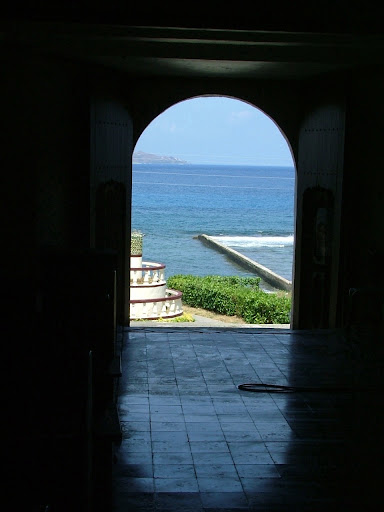 Pictures, while they may be the imprint of light left on the emulsion on film (before the digital age), or the series of zeroes and ones shaping data on disk, picture card or memory stick (still left by light caught by code and circuit), are just the visual equivalents of poetry. Or isn’t that obvious. Well, one composes images within a frame, to create an impression. The frame and the images become the impression—as perceived by viewer (though not necessarily the exact impression of the photographer). That’s why photography is also a process of selection. Even wide-angle shots, shots of speed and pause (pose)—all are the result of instantaneous choice and focus. For focus is for sense as well as lens. And I might as well be talking about poetry here. Substitute words, language, or speech for frame. Composition is also the creation of meaning. Meaning is gathered and re-composed in the frame of language, after the mind’s eye has scanned, chosen, focused on the images of life and the world (and beyond), that it needs to create, generate, engender meaning. So my words will again give way to images. (But captions are necessary, not to describe the images, but to guide you into the picture.) Batanes!
 Sabtang Lighthouse, one of the last sights of the Island before you sail back to Batan
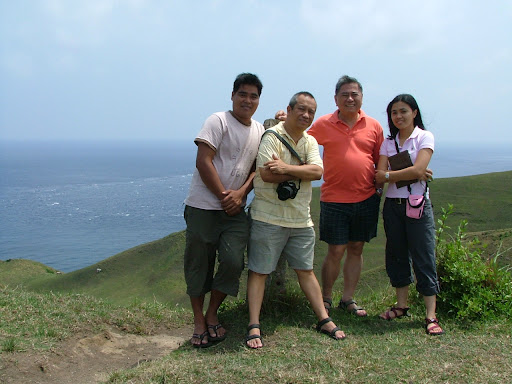 The Batanes team on Naidi Hills: Byron Peralta, our able and knowledgeable guide; Boy Martin, official photographer and cultural entrepreneur; Rio Alma, National Artist for Literature (and dean of the College of Liberal Arts at UP), in whose forthcoming poetry book some of the photos will be used; Eilene Narvaez, Rio's able & efficient student assistant. I, tag-along photographer for this trip, and translator of the forthcoming book, took the picture.
Ah, the magic of whitewash and the accidental perspective—silip—in our language.
The blue door above (second pic) is taken from inside Ivana church looking out to where the China Sea & the Pacific Ocean meet. The tranquility is deceptive (or just seasonal)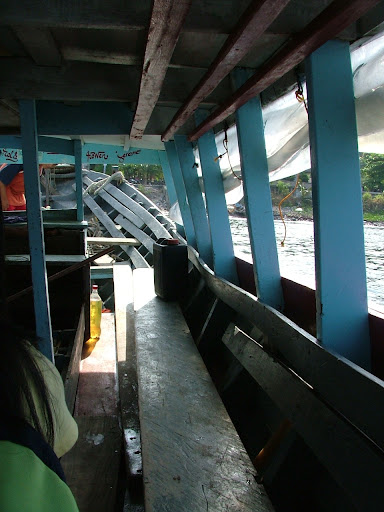
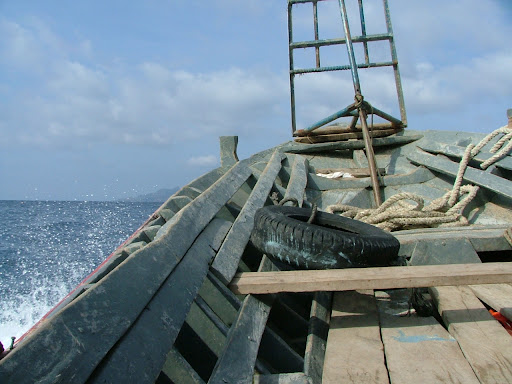
Inside our blue falua, decidedly Mediterranean in color, but I'm glad it's Filipino (perhaps partly Formosan). The picture above, of the falua bow, reminds me for some reason of Amergin's poem that goes: "I am a stag of seven tines/I am a flood across a plain,/I am a wind on a deep lake..."—from the infancy of English (Amergin was Irish) poetry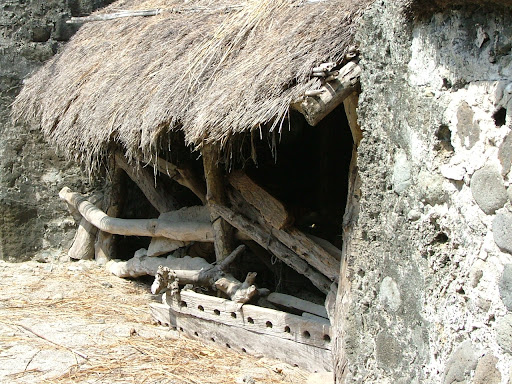
The vutsid—cogon—roof, here used in a fisher-man's tool shed. As used in the classic Ivatan stone house, cogon can last as long as 15 years, if well-maintained, while GI starts to corrode at the first rain after installation (faster in Batanes' brin y air?). The mane-like look of this cogon roof echoes the vacul, the classic Ivatan hair-dress (hat, cape, and raincoat rolled into one), of which I regret I failed to take a picture of.


2 Comments:
Manoy Marne, thanks for the info, magayon an mga pics!
Great, Zaldy! Thanks and Godspeed!
Post a Comment