Monday, May 28, 2007
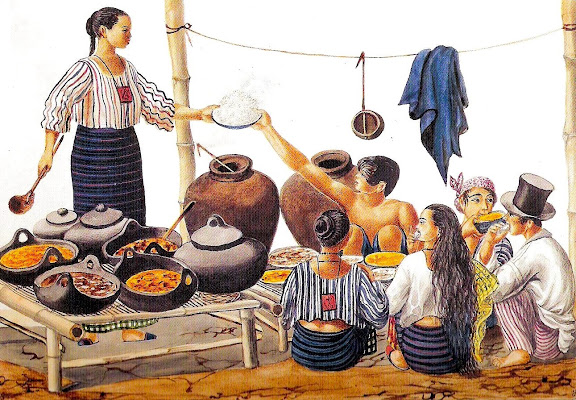
AT THE CARINDERIA BY LOZANO
God is always present among us.
We wear Him constantly on our breasts,
At our stiff backs slung with the scapular
We kiss before leaving for work
To feed the hungry, or helping at church
To feed the hungry reverend Padre,
Or as our fellow devotee sits
At our street-side stall, and before
We go to sleep to keep us from harm
And bad dreams. Among us He abides
By our industry and selfless devotion,
After our sins and our confessions,
And among the least of us: our barebacked
Men on a break from the obras pias,
Our well-dressed men fresh from the cockpit
And philandering. We are blessed
By the fragrance of white rice, newly
Harvested and supplied on credit
By the Chinese trader, my husband’s
Compatriot in exile. We are blessed
With as much rice as we can eat
From three large earthen pots, with viands
From four huge wooden bowls
Of caldereta and bringhe, arroz
A la Valenciana for the moneyed and finicky,
Plates of sweet glutinous rice cooked
In coconut milk, and dried salted fish
To taste. I dip from two tapayan
Of sweet water to slake our thirst,
And they never seem to dry up.
O God of our Lords the Friars,
Please do not allow our blessings
To run out, spare us from them
And we shall bring scented oils
At your wounded feet, spare
Our land, our daughters, and our harvest,
And we shall have enough to eat.
Marne L. Kilates
April 26, 2007
JOSE HONORATO LOZANO (1821-1885), of whose personal life scarce is known, is now acknowledged to be the foremost visual chronicler of 19th century Philippines. He became known mainly for his works in the unique manner called ‘letras y figuras’—an elaborately illustrated painting using the letters of a person’s name. Using Philippine scenes and people in daily life to compose the shapes of each letter, Lozano perfected the form. His paintings became like our postcards, and foreigners, including a British noble, commissioned him to do the letras y figures of their names when they visited the Philippines. 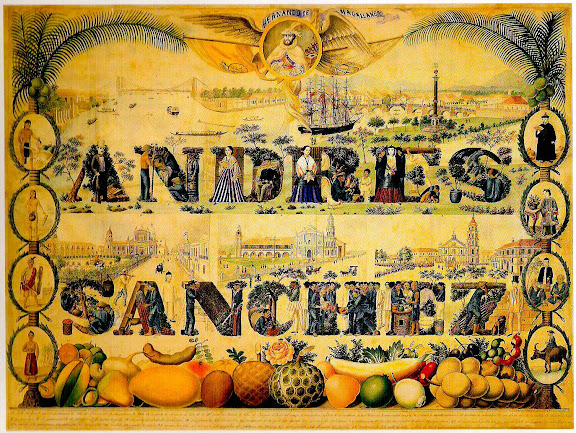 But Lozano’s even more significant work were still to be found in several ‘albums’ recently discovered. Albums consist of, according to the Lopez Museum, “sheets of paper with drawings in graphite or pen-and-ink sketches or watercolors bound together and serving as souvenirs or catalogs or illustrations to reports.” Both albums and letras y figures have been found in the houses of foreigners (in Spain, the U.S., U.K. and elsewhere), and in auction houses like Christie’s. The albums include the now called Ayala Album, the Nyssens-Flebus Album, the Broken Album. Another album, the Gervasio Gironella, is found in the Biblioteca Nacional de Madrid. The subject of the following poem comes from the handsomely produced, full monograph ‘Jose Honorato Lozano, Filipinas 1847,’ by Jose Maria Carino. It is a comprehensive compilation of his letras y figuras, sketches, watercolors and other paintings.
 (I changed my mind. These terra cota animals will also be my mascots for this series of blogs.)


0 Comments:
Post a Comment