Monday, May 28, 2007
Picture Poems. Or, Words On, About, From & After Art & Images. Or, Ekphrastics Kuno
Posted by Marne L. Kilates at 3:42 AM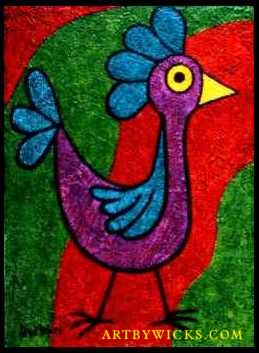
After images (from that fantastic destination, Batanes), back to words. Or is it words that create images? Or do images engender words? This is the chicken-and-egg question about this thing we insist on doing called poetry, or to be exact, the poetic process. Surely this is what I’ve been doing in this blog for some of the time, giving you poems and pictures.
But as we say in Filipino, “Ngayon paninindigan ko na!” (Read: I’ll give you more of it, heh heh.) But this time the pictures, the paintings, the images will provide the source for the poetry. Ok, dear friends, don’t be scared of that penultimate word above, which is Greek or from the Greek. (The 'kuno' in the title is the Filipino colloquial for "as if", or "after a manner"). "Ekphrastics" means exactly what the words in the first modifying "or" phrase say. Let me just cue you in on this not-so-new literary game of mine. I’m writing poems on, about, for, or from artworks, mainly paintings—classical, modern, Filipino, foreign, and images or pictures, “as is" or digitally modified. 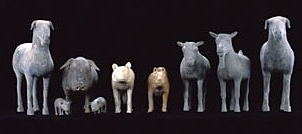 Some of them will be my favorites, from when I first fell in love with art as a boy (my late eldest brother, whom I idolized, was a fine arts student who became a comics illustrator), to when I thought I was having my own taste for what’s good visually, “texturally,” or whatever its is I like about art that cannot be described with words. Certainly the pieces of art will include those that made or make some kind of good impression on me, which I hope would do the same to you, especially when and if I could write poems about them, which I hope, too, you would like. (Just as I hope you be able to appreciate better the example poem below, after you know about its story and its origin in art.)
  ‘Ekphrastics’ (to give it some magic like chi gong or kung fu!) is my own coinage. Well, it just adds an ‘s’ to the adjective formation of ‘ekphrastic’ which in turn derives from the noun ‘ekphrasis’. It is listed as ‘ecphrasis’ in some dictionaries but I prefer the one with the ‘k’. I’ve always been intrigued by this word in past readings but when scoured my dictionaries (I have a small collection) for its exact meaning, to be safe before I use it here, it was nowhere to be found, not even in my so-called ‘specialist’s dictionaries’, e.g. a dictionary of literary terms. Of course one “last” resort is the largest library on earth, which hosts the largest (for want of a better term) earthly encyclopedia. Wikipedia, no other. The free and living encyclopedia which continues to be written as we read it.
  “Ekphrasis” says Wiki, “is the graphic, often dramatic description of a visual work of art. In ancient times it referred to a description of any thing, person, or experience. The word comes from the Greek ‘ek’ and ‘phrasis’, ‘out’ and ‘speak’ respectively. The verb ‘ekphrazein’ means to proclaim or call an inanimate object by name.” Not far from “expression,” eh? Technically it has been “generally considered,” says Wiki, to be a rhetorical device “in which one medium of art tries to relate to another medium by defining and describing its essence and form, and in doing so, relate more directly to ‘you’, the audience through its illuminative liveliness.” (Not my words, but I hope to come up to that.)
The process for me is best described as writing poetry ‘from’ art, not ‘about’ it. The poems do not attempt just to describe or ‘transcribe’ a work of art, but ‘take off’ from its particular ‘state of meaning’ or image. Thus a completely new work of art (a poem) is born, but one that is never entirely independent of its source. Thus, too, is inspiration also (re-)invention, or even a confrontation of art. Or, once again, a collision or collusion between two forms of art. The practice is as old as poetry itself, and poets have been doing it since they first saw a sculpture or a painting that they liked.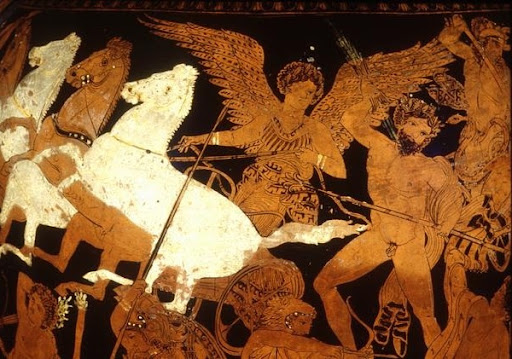 Apart from Keats’ “Ode on a Grecian Urn” which barely survives in my mind from high school literature, and W.H. Auden's "Musee des Beaux Arts" (peasants unmindful as Icarus falls into the sea below them), my other 'favorite' ekphrastic poem (which term I remember the author never used for this particular poem of his) is Yeats’ “Leda and the Swan.” Let me quote the sonnet in whole (indentions not reproduced):
LEDA AND THE SWAN
(W.B. Yeats)
A sudden blow: the great wings beating still
Above the staggering girl, her thighs caressed
By the dark webs, her nape caught in his bill,
He holds her helpless breast upon his breast.
How can those terrified vague fingers push
The feathered glory from her loosening thighs?
And how can body, laid in that white rush,
But feel the strange heart beating where it lies?
A shudder in the loins engenders there
The broken wall, the burning roof and tower
And Agamemnon dead. Being so caught up,
So mastered by the brute blood of the air
Did she put on his knowledge with his power
Before the indifferent beak could let her drop?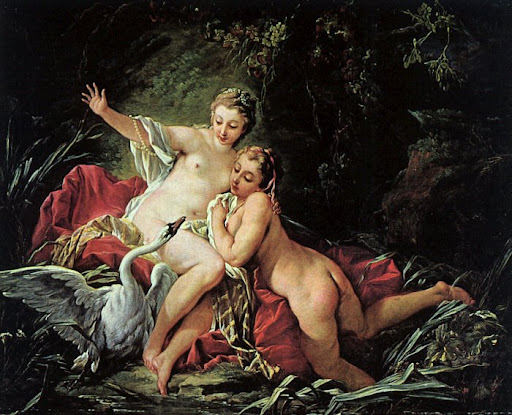 The process now is reversed. I tried to look for the painting that I remember best and which usually accompanied or was referred to when I first read this poem by the great Irish nationalist and classicist poet William Butler Yeats. I remember the ecstatic but averted face of Leda, the cottony white form of the swan in a frenzy between her legs. But I couldn’t find this painting on the Net, so all you see here are what I found through Google Images.
What intrigues me most, then and now as I read again this poem, is its images that take us back and forth through myth and history, and what specific events and actions (recorded in art) seem to have influenced what became of the world and us, what we call civilization. Take this mythical rape, for example, when a god (Zeus), source and symbol power, forces himself upon a mortal (Leda). Yeats asks the questions about its consequences. Yeats, in his huge overarching ouvre, wrote here the most erotic lines—“her thighs caressed/By the dark webs… How can those terrified fingers push/The feathered glory from her loosening thighs?” (‘thighs’, used twice here, are simply the most erotic words instead of the prosaic ‘legs’), but just as the sonnet begins its sestet (it is Petrarchan), so too Yeats insinuates his crucial questions: “A shudder in the loins engenders there/The broken wall, the burning roof and tower/And Agamemnon dead.//...Did she put on his knowledge with his power...?”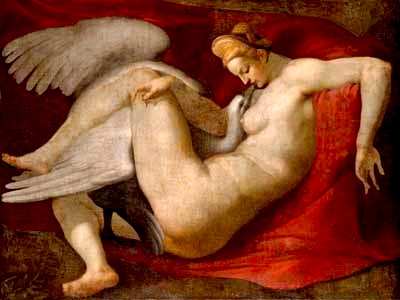
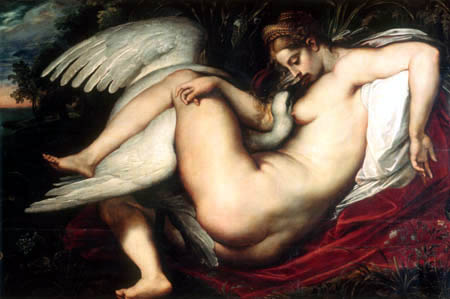 Critics identify two landmarks in Yeats’s poetic concept of history and his comment on it: “The Second Coming” (“Turning and turning the widening gyre/The center cannot hold/The falcon cannot hear the falconer…”), marks the end of modern history (maybe as distinguished for our contemporary times which Yeats could not have conceived) while “Leda and the Swan” seems to be a beginning—of the mythical, Helenistic, age. The history that Leda and her offspring represent (sired by Zeus in the guise of a swan), who include Helen and Castor, war-gods, unfolds for us the Trojan War (..Agamemnon dead), and everything that came after it, that we and our civilization inherited. Yeats, like any poet of real vision, saw the world and its narrative in human creation, such as art. Art chronicles not social or political history (despite epics and paintings of battles and heroes) but corresponds to the interior life of each man, race, nation, the internal layer of the world (and the cosmos as man sees it), which is, you guessed it, spiritual.
Now, not all of us don’t go too far into the underlying meanings and sources of each work of art (such as identifying the transition points in a large work and life such as Yeats’), although it would be fine if we took time to examine what we do (as persons, races, nations, planets). But taking some time to look at how we might find meaning, in small daily things or in big things such as history, through the use of such an ordinary thing as language, which is nearer to us because we speak it, might lead to something even more, well, meaningful. How language confronts daily life is of course how art confronts life (in all its paltriness or nobility), which is something to think about. That is, if we still enjoy or appreciate the act itself. I've fashioned for myself an exercise for it (a chi gong or kung fu of the mind of some sort), which I’m now calling ‘ekphrastics’. Let me share it with you. My ekphrastic poems will be in the next postings.
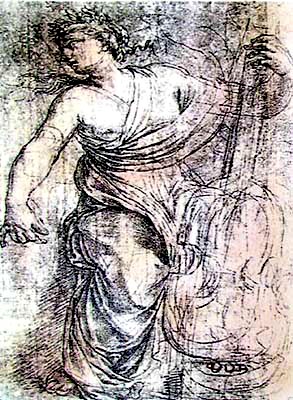
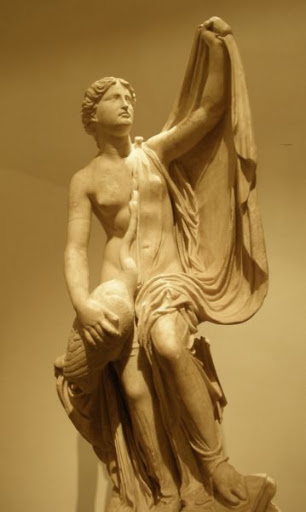
[THE ARTWORK, from Top: (1) The (quilt) chicken without the egg, words wihtout the image? (2) Pretty terra cota animals which, I'm sure, would make a good subject for a poem; (3) Let me pour a libation to the Lyric Muse, Erato, to guide me through ekphrasis; (4) classic Roman marble of Leda at the Prado in Madrid; (5) Grecian urn art similar perhaps to the ekphrastic subject of Keats; (6) Boucher's Leda: the Idyll before the Rape; (7 & 8) two Ledas I found, one supposedly a lost Michelangelo, the other by Reubens, note their similarities that lead back to their original source, a marble frieze somewhere; (9) the Poet Icon I am going to use for this series of posts]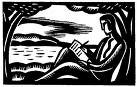


2 Comments:
sir, ganda ng mga photos. i'm sure you had a great time in Batanes.
i already responded to your comment re: Celan's poem in my blog, sir.
i'm looking forward to reading your ekphrastic poems. :)
K, Joel,
Pupuntahan ko na rin blog mo at sasagot din ako sa iyo doon. Heh heh.
Marne
Post a Comment