Friday, January 25, 2008
Lina Llaguno Ciani, noted painter from Bikol and Italy, opens show with my poems
Posted by Marne L. Kilates at 8:59 AM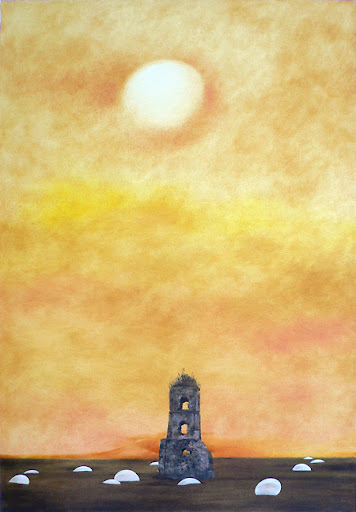
“After the Rain,” a One-Woman Show by Lina Llaguno Ciani, runs from February 2- 29, 2008 at Galleria Duemila, Inc., 210 Loring St., Pasay City (near the MRT Taft). (Tel. 831-9990; Telefax 833-9815. Email: duemila@mydestiny.net; website: www.galleriaduemila.com/.)
Lina, who lives part of the time in Italy, is a sister to two of my hometown friends who are also writers, the fictionist Frankie Llaguno, and the poet Toy Llaguno. Lina and I have never met previously, although I've long been a fan of her paintings, having seen one of her shows a long time ago in Legazpi City. Lina's close friend, my former speech teacher in high school, Cynthia Villanueva Cochon, who knows my work, referred her to me, and Lina called early this month to talk about her new show. She requested me to write poems based on her paintings. Inevitably entranced, I wrote six new poems on seven canvases of my choice, except "Noon Moon," which I paired with an earlier-written poem, "Bakunawa, the Moon Eater." I will read the poems at the show’s opening.
“Gloom is not perpetual,” Lina told me, “It is against nature. The sun must still come up." This is my review of her show as I wrote it (without reference to my poems), before it is trimmed for publication. My poems on the paintings are in the next postings.
How beauty confronts pain in Ciani’s “After the Rain”
by Marne L. Kilates
Luminous spaces, stunning colors, details, textures and symbols carefully chosen from the chaos left after a natural disaster, and the survival of beauty after extreme pain—these are what compose many of the new paintings of Lina Llaguno-Ciani, the noted Filipina painter based in Italy and Bikol, who experienced how her hometown and province were ravaged by Typhoon Reming in 2006.
Titled “After the Rain,” characteristic of the quiet contemplation of her paintings even if confronted by catastrophe, the one-woman show opens Galleria Duemila’s 2008 art season on February 2, on 21 Loring Street, Pasay City (near the MRT Station on Taft). The opening date marks two months after the first anniversary of the disaster.

 Ciani has her roots in Daraga, Albay, where she is a member of an old gentry family of merchants, writers and artists. Albay province is in the Bikol peninsula of south Luzon, in the Pacific storm path, where the prominent land feature is the conical peak of the Mayon Volcano. Reming’s biblical rains triggered rampaging floods and mudslides, dislodged the rocks and debris deposited by previous eruptions on the slopes of Mayon.
After graduating from the University of the Philippines School of Fine Arts, Ciani took advanced studies at the Accademia delle Belli Arti in Perugia, Italy, and has exhibited her work in various international venues. Since the late 1960s, with her marriage to an Italian, she has been spending her time between Rome and Manila, and a beach house in a little village facing the Albay Gulf, where she painted. This house and many of her paintings were not spared by Reming.
“After the Rain” is the 34th show in Ciani’s career, twelve of which were one-woman exhibits mounted in what can be considered her home gallery, Galleria Duemila. Ciani’s works have been exhibited in New York, Rome and various parts of Italy, Jakarta, Manila, and in various cities of her home province.
The art critic Alice Guillermo, in a long article in Asian Art News magazine, described Ciani’s work as being “of time beyond reckoning… mapped by the imagination.” Although referring to a different set of paintings, Guillermo’s words may well describe Ciani’s canvas in “After the Rain.” It is, Guillermo says, “first of all, a large open space stirred by the wind, which is one’s first experience of her painting.”
It is emblematic, then, that it was no small wind that stirred Ciani into creating this new series of contemplative frames.
Present in the new paintings are Ciani’s recurring motifs of the eggs, strings, flowers, birds, water, and the figure of woman in a vast monochromatic space, but this time they are there manifestly to reconfirm life amid the occurrences of grief and suffering wrought by a natural disaster.
“It cannot be all darkness,” she told this writer in a telephone interview, “the sun must still come up.” Always delicate, subtle, but very selective in the objects she renders in hyper-realistic detail, and choosing colors that have the tendency to stun the viewer in their unexpectedness, Ciani’s work has been described as surrealism without the angst. Her use of oil without impasto makes her surfaces acquire the shimmering qualities of watercolor. This gives her work their luminous magic without the “tincture of madness” of the surrealists immediately visible.
Still in “After the Rain,” Ciani’s paintings seem compelled to confront a real event—the havoc, death and grief wrought by the storm Reming. The delicacy of her colors, the subtlety of sentiment or emotion in the images of her subjects are her instruments of choice, her tools of the imagination, used not to conceal or deny but to have some degree (no matter how infinitesimal) of control.
Thus she musters the whole range of the spectrum to limn the atmosphere and aftermath of the storm, but choses two main hues: the purples and the blues on one hand, and the reds, oranges and yellows on the other. The one signifying the dark sorrows after the disaster, the other life reasserting itself.
But always these hues are somehow inward looking, as if the grief that beheld such destruction was guilty of itself, because it had only the tools of art and beauty to understand it.
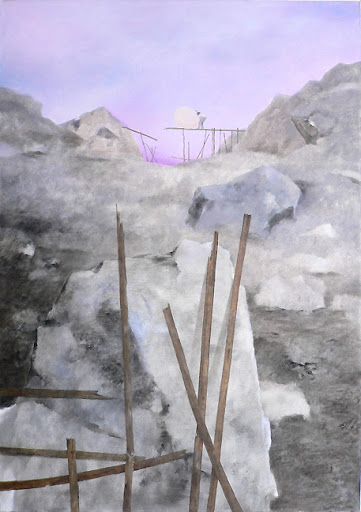
 In none of these paintings may be seen graphic images of the disaster except one, in “Sisyphus’ Hometown,” where she concedes to some drama and graphic description. But even Sisyphus absurdly rolling his rock almost vanishes into the purple horizon of diffused storm clouds. Sisyphus’ rock this time also becomes Ciani’s egg symbol, which he is rolling on a precarious and flimsy scaffold. In the foreground are huge boulders that seem to have overrun broken planks and boards, perhaps what remain of a human dwelling.
The other notable paintings done in these hues are the lonely apáy or gabi leaf rising gracefully in a desolate landscape of mud and rubble. The volcano can be barely seen in the distance, a conical point on the horizon (“After November”). A glistening drop of dew has slid down the fine hairs on the surface of the heart-shaped leaf, and delicately clings to the tip. Together the leaf other signs of life stir: the sprout in the puddle, the green lizard crawling among the rubble.
In “Eastern Wind,” white calla lilies sway hauntingly on their long stems in the middle of an ocean or a river, whose smooth surface belies a deceptive current. A school of silvery fish swims in unison just under the surface, in a rightward or eastern direction as the bending of the lilies, visually underscoring the movement of the big water.
Most of Ciani’s figures—ordinary things like pieces of wood, a child’s paper boat or kite, a piece of string—find themselves in strange places and thus assume their own strangeness. They also seem threatened with a sense of precariousness and fragility: clinging, floating, or about to fall.
Ciani’s surreal egg makes a more numerous appearance in a duo of paintings, each simply called “Tree.” In “Tree #1,” the eggs are uncannily perched, teetering on or falling from the branches of a grotesquely deformed tree. The branches have been bent by the wind in one direction, and the tree’s texture imitates that of the furiously swirling mist in the background. The eggs are mostly white or bluish, and in one or two one may glimpse through the translucent shell an embryonic red fish or other strange and diminutive creature.
“The egg is life within,” Ciani said in the aforementioned interview with Alice Guillermo, “which is always a mystery—we don’t know what’s inside or if there’s anything inside… a form that is beautiful and perfect, even its color is perfect.”
The woman figure in “Umbrella Day,” echoes the understatement of the title. She seems to be walking a dog, carrying an umbrella, on what appears to be a vast riverbank or seashore strewn with round stones (eggs), while high above her an egg-shaped sun or moon peers from among powder blue storm clouds. In a sort of reverse Romanticism from that of the great English painter Turner, “Umbrella Day” with its soft hues reminds us how, as Ruskin said, an artist might “stirringly…measure the moods of nature.”
Seemingly outside the context of the storm are the paper boats, kites and flying fish on the monochromatic purple field that looks like a seashore in “Eyes Closed Open.” But, as in the previous painting, it is the exact color of the storm, the cerulean or perhaps Picasso’s turnsole always darkening and turning into purple, the land, sea, and sky blending into each other. The title echoes the baby’s game of “close-open,” covering and uncovering the eyes for a surprise, or shutting the eyes against pain or disruption, such as the unreality of the terrible storm.

 Turning now to the group of paintings in the red spectrum, the viewer might observe more clearly the underlying opposition of the chromatic themes.
 “Noon Moon,” apparently the lead piece among the red-spectrum paintings, has an eerie yellow sky that still swirls with the vaporous turbulence of the storm. The sun is an oval disk suspended almost directly above the dark-ash belfry of the ruins of Cagsawa church, which had been buried in an earlier eruption of the volcano, in 1814.
When viewed more closely, however, the sun is not actually a disk but a bright rounded shape reversed against the sky, and of course it is an egg. Only then will the viewer possibly notice that the “rocks” around the ruined belfry are eggs as well, half-buried in the burnt loam around the ruin, and that again half-visible in the far horizon, is the tawny-tinged Volcano blending with the electric yellow sky.
The whole sinister composition, of a sun that looks like a moon at noon, because the elements had made time insignificant, and with the sun presiding over a desolate and bare landscape, reminds one of an eclipse, another portentous symbol. But perhaps it has been overtaken by the storm itself, which it can no longer portend. In the vertical space of the painting, the church tower, a man-made object, is a phallic but diminutive shape rising against the elements, while the eggs (because they are such in the symbology of Ciani’s paintings), defy the omens.
Wood and trees, planks and strips of wood broken or splintered, strings randomly wound around or hanging from objects upright or askew, and insects in various attitudes of quiet, inhabit the spaces of the rest of Ciani’s red-spectrum paintings.
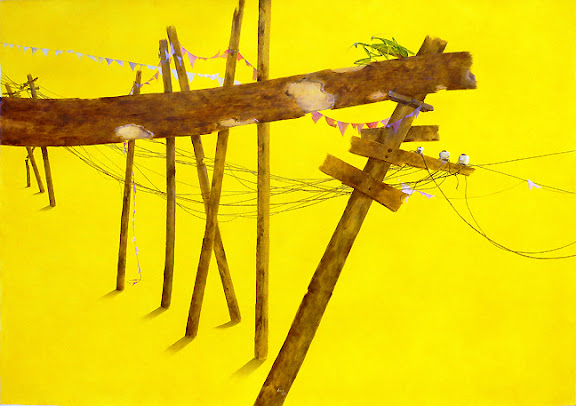
Yellow is both shocking and ironic as the color of space in “A Day After.” It is almost pure cadmium, or whatever chemical produces this pigment, and it is devoid of the swirling smudges of the storm. Against this yellow are the weighty, slanting shapes of the electric posts, jerked this way and that by the wind.
The almost solid colors and bold shapes give this and another painting, “After the Storm,” a pop and illustrational appeal, if one missed the details: the torn, multicolored fiesta buntings, a petty and frivolous adornment to the leaning posts, strung along with the slack power lines, bespeak the life interrupted by the storm. But mark, too, the pair of green mantises perched on the end of the heavy transverse beam of the tree trunk (snapped by the wind and slapped across the canvas): their alien-looking forms are frozen in an attitude of anticipation.
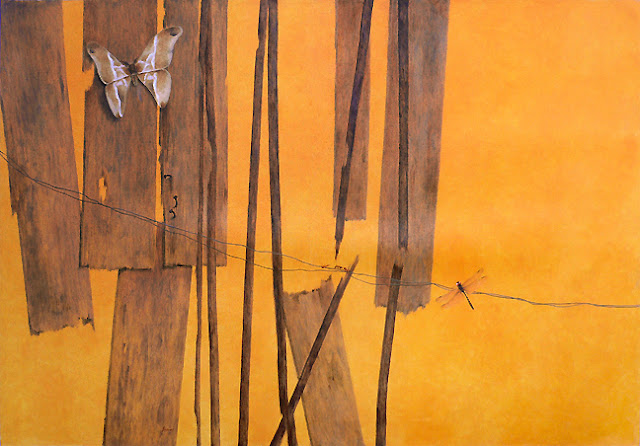
Two other insects populate the bright orange realm of the wooden boards or planks in “After the Storm.” The boards and sticks have been either broken by the wind, or just waterlogged. They are seen either from above, as if the boards are being dried out on a pavement, or stacked against wall, in which case some of the planks look suspended in mid-air or are attached to the orange wall. Three bent and rusty nails protrude from one of them.
A brown moth had attached itself to one of the planks, with coruscating blue markings on its wings, while a fragile dragonfly has alighted on the crooked diagonal line wire (another form of string) spanning the space of the canvas. Both still forms, flush with the suspended elements of the wood board, exude a palpable quality of serenity.
Ciani’s “Tree #2” is a metamorphosis of the first and now occupies a tangerine field that has defied all the swirling grayness and tenebrous purples of the storm. Only one egg remains on the vivid red ground. Perhaps the others had hatched and released the pale green butterflies that now flutter on the bare branches like young leaves.
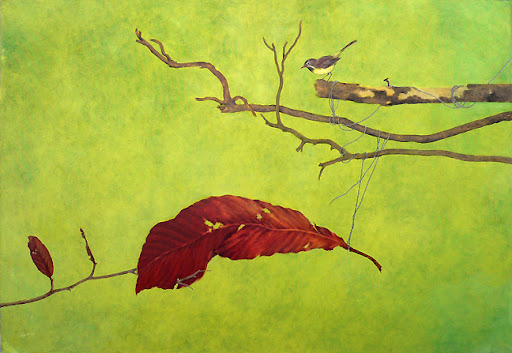
“Bird Song” announces the morning in a space that is green, mossy and glimmering with yellow, because all life had awakened after the dark dawn. The strings visually and figuratively tie up the whole narrative: the bare branches, the straight horizontal pole on which the sparrow perches (perhaps part of a house because it has a nail, bent, driven into it), the old red leaf, blown and caught in the twigs of another tree. Announcing renewal, the bird song is almost heard in the vibrant colors of the canvass.
Like a coda, the blue and purple return among the tall and slim trees of “Six Fifty-Nine P.M.” Butterflies and three dry leaves are superimposed, as if ornamentally, on the deep magnetic blue sky just after dusk, on a shimmering, transparent strip that takes up the vertical element of the rightmost tree trunk. An aura separates the purple ground from the blue sky, which reminds one of starry, moonless evenings deepening into night—timeless terrestrial seas of tranquility.
Ciani’s other pieces that may or may not derive from the experience of the storm include a series of monochrome leaves (“Foglia”) and flowers that look as if they had been pressed between book pages, although they neither look dry or pressed. Instead they are “preserved” in their vivid colors, and are “held” fast onto the canvass by strips of “tape.”
As in most of Ciani’s paintings, the extremely detailed rendering of the leaf veins, the fine fibers of the sinuous stems and petals (in “Pink Carnation”), creates an illusory image of reality that, paradoxically, transform leaf, petal and tape into their diaphanous, melancholic essences. And the essence that is common to everything the artist sees, including beauty and pain, is that of temporality.
Everything must pass, even the apparent randomness of destruction, suffering, and death in a natural catastrophe. The artist—painter, chronicler, poet—is both victim and witness, having been inflicted with the same suffering and loss as those of his or her community. But it is the latter role that imposes a different set of obligations.
It is in this aspect of temporality, this giving of all things fleeting the resonance of eternity—as if pain could be borne and understood with the creation of beauty—that Ciani’s manner of painting beget the qualities of its sister art, poetry. While poetry is even limited with its medium of words, Ciani’s art enter the rarefied territory of the vacant spaces between lines and words (textures and spaces created by words), and in her case, the textures and spaces between images, visual symbol and reality.
What the British intellectual, novelist, painter and art critic John Berger said about poetry might as well refer to Ciani’s paintings on the Bikol experience. “Every authentic poem,” Berger says, “contributes to the labor of poetry… to bring together what life has separated or violence has torn apart… Poetry can repair no loss, but it defies the space which separates. And it does this by its continual labor of reassembling what has been scattered.”
Ciani’s paintings in “After the Rain,” constitute poetic labor. In creating luminous spaces and reassembling in them the scattered pieces of memory (her own and her community’s), she and her paintings defy the space that separates.
Makati South Hills
January 16, 2008
SOME OF THE PAINTINGS: (from top) 1. Noon Moon, 2. Eastern Wind, 3. After November, 4. A Day After, 5.After the Storm, 6. Tree #2, 7. Sisyphus' Hometown, 8. Bird Song
p o e t s ❜ p i c t u r e b o o k
UPDATE


0 Comments:
Post a Comment