Thursday, January 10, 2008
Quiapo & the Finders of the Image:
2 Poems dug up from an earlier time,
in Children of the Snarl
Posted by
Marne L. Kilates
at
1:00 PM
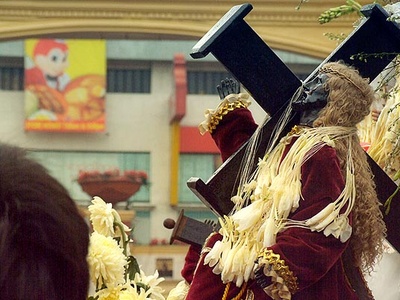
"My Jollibee, Your Nazarene" by Ben Razon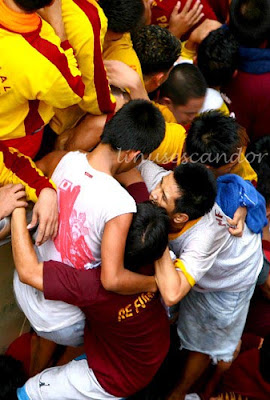
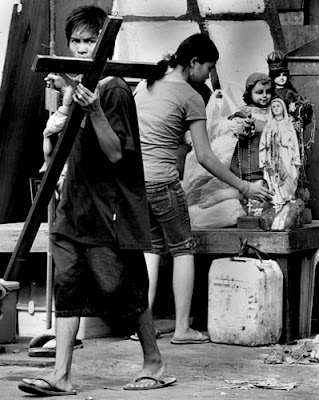
The Quiapo frenzy during the January 9 rites, and another kind of frenzy, at a Quiapo slum demolition. Lots of thanks to photographer & extreme sports enthusiast, Linus Guardian Escandor, who opened his blogsite to us for the generous use of his magnificent pictures, at http://mtxrtemist.blogspot.com/.
If I wasn’t nodding already I would have written and posted this blog last night. It was begging to be written. It was all over and around me. The whole afternoon (and morning) it was on the TV. I was watching it intermittently, between chores and writing assignments—breakfast and sitting in the toilet and continuing my reading of a novel on Sor Juana Inéz de la Cruz or the stories of Jumpa Lahiri, proofreading the print-out of a long-delayed translation book, reviewing and tinkering with some new work of my own, monitoring Hillary Clinton and Barack Obama, checking the mail, and struggling with a cold, armed with paper napkins. My partner Pam watched or attended the TV mass as I tapped on the keyboard of my laptop on a corner table, and stole glances at the TV. Everything seemed to be swirling: what was happening to the world on the TV, what was happening in and to my manuscripts, and what was happening to world on the Net on my computer screen. The sounds of the world outside—the sputter of the water deliveryman’s motorcycle, a car stopping at the next-door neighbor’s, the beagle Prince barking at a cat—mingled with snatches of the news, Iraq, the weather, commercials for shampoo and cell phones, the echo of chanted responsorials on the TV mass. As the day wore on I pointed to Pam the growing intensity and anticipation from outside the Quiapo Church, the “sea of humanity,” so goes the cliché, swelling and swirling around Plaza Miranda. I remarked that the Plaza looked too small—not just on TV but during the few times I’ve been there recently. For a provinciano then, Quiapo was Manila—this disorderly, smoky hinterland of concrete, electrics wires, vendors, where one took a bus ride for any point in the metropolis (I used to live in Quezon City), or where one went if one was lost. (The instruction then was that if you lost your way and found yourself in some strange neighborhood, look for a jeepney or bus that said “Quiapo” on its route boards, and from there you could find your way anywhere.) I found my way in the swirling day around the Net as I searched for good pictures in my photographer friends’ weblogs, to use in the ezine I’ve recently started. And this picture here greeted me in Ben Razon’s “Fat Albert” in Multiply. It is not the Nuestro Padre Señor Nazareno Himself, resident of the Quiapo Basilica Menore, brought from Mexico in the 17th century, but a devotee’s personal replica joining the other minor processions swirling around the Quiapo area (the TV announcer read the route: “from Hidalgo right to Carriedo, right to Zobel… left to Sinibaldo de Mas, etc.”—actually there is no such street as the last, I can’t recall the names of the small and swirling Quiapo streets). Finding that image in Ben’s blog, I looked for an old poem that I submitted to the UP Workshop in 1984, perhaps my first “successful” one in terms of being able to do what I wanted in the poem’s own terms. I was fresh from college in the province (but not too fresh in the my old man’s mind) and I thought poems could change the world.
Quiapo: The Procession of the Black Nazarene
On the ninth day of January
In the sober days that follow the intoxicated season,
The prophets descend like tongues of fire
Upon the streets of Quiapo.
The sun bleeds its flesh of asphalt,
Scorches its bones of concrete,
Fumes issue form its pores in a heady breath,
And the air is thick.
Men, their headbands filled with sweat,
Their eyes wild with lightning,
Bare their backs tumid with pain and illusion,
Amoks for a day’s season. In a frenzy,
They struggle to keep on their shoulders
Some splinter of Calvary, some chafe of the rope
That will deepen the wounds of the flesh, draw blood
To cleanse the wounds of the spirit.
In their drunken vigor, madness expiates.
God, clad in maroon, lace, gold-leaf and brocade
(Men’s lame imitations of the Eternal),
His eyes wild with lightning,
Stumbles forward in all directions.
But in the demented martyrdom of mortals,
Aching shoulders and bleeding flesh
Bear him an eternity aloft.
And the prophets descend like tongues of fire
(The planets tilt in their ancient dance)
Upon the streets of Quiapo,
Upon the heedless multitude of the orange fire,
The sacred soot that asphyxiates the soul,
The spears of sun that transfix the flesh.
Our Father,
In the drug of incense,
In the burning fever of flowers,
In the heady camphor of our endless ardor,
In our faith in the Apocalypse,
In the grime on the ginseng root,
The soot on the novena,
In the wax of the bronze amulet,
The soiled sampaguita—
Heal
All these wounds You inflict on us,
On our shoulders that bear
The weight of Rulers and Nations,
On our side speared by their Centurions,
On our knees scraped in ignorance and submission,
On our ankles numb in the clamp of shackles,
On our palms pierced with nails of myriad metal,
Dipped in perfume and arsenic,
Bile and vinegar,
Mud and myrrh.
(1984)

I put the Quiapo poem here together with “Finders of the Image,” my meditation on one of the last modern emblematic artistic inventions, photography. (The references to old photographic techniques or technologies in the poem have, of course, become anachronistic.) Of the latter, Franz Arcellana said something about the orchestration of words, which elated my young poet’s heart; of “Quiapo…” Ricaredo Demetillo, the “terror” of the workshop, said it was a not-bad “public” poem, though he didn’t always like public poems, which toughened it. He didn't explain what a "public" poem was. Both of them, mentors to many of us, more or less sealed my fate to poetry. Both poems finally found their way to my first book, Children of the Snarl. I read (and typed) them again, like writing them for the first time. I was afraid if I might find fault with them. I don’t know if I write differently now, but the feelings that led me to writing them haven’t changed, just as perhaps the corresponding realities haven't. After the firecrackers, the procession in Quiapo reminds us of a lot of other things. The images we see caught by the camera, in still pictures, on TV, or the movies, still stun us into poetry.
Finders of the Image
The colors of our time are only tones of black,
Gray and its gradations, the failing of light.
Sometimes there are smudges of crimson,
But these turn the color of earth as they dry;
Green faces, begrimed with soot and dust,
Debris and gunpowder, splintered glass, torn flesh.
Watch, for instance, the child fingering
The baubles of the holiday display. His is
The color of earth: mud on the frayed sleeve,
Sore of hunger at the corner of mouth,
Soiled being against the laughter of the store
Shelf: “There is no place for you're here.”
Supposing a bomb goes off (it is ordinary
Do not be shocked), how long does the explosion
Last? What is its color? Does it punctuate
Our epiphanies when the apertures of our
Devices flutter, the point of light
Piercing the crystal to become the Image?
Can we freeze fear? Do we arrest the scream
Or liberate it when the shutter blinks
And debris rains around us, as we urge
The motor-drive before diving for cover,
Ourselves transfixed by the splinter of the moment?
Does fear freeze, can hunger cease
Its persistent gnawing when we seize
Its echo, fix it on the emulsion of the film?
We register our angers in negatives.
We can only imitate to create, we appropriate
Shadows. We agitate water in the scarlet
Womb of our darkrooms, and hope
That in preserving the apparitions of terror
We can keep touch with the Decisive Moment
And conjure the stasis in the burst,
Hold the trembling of a tear. Only then
Do the colors of our time appear, after
They had passed the frame of our viewfinders.
(1979, 1984)
I don’t think I write differently now, the poem—its conception and shaping—goes through the same process. As the poet Gémino H. Abad says, it is the “poet’s task to reinvent the language” (whatever language one is using). I couldn’t add to the poems, I don’t know if I could have written them differently… except one vain, irresistible addition. It’s one line in the last stanza of “Quiapo.” I don’t expect that your are familiar with these poems (two landmarks of sorts in my writing), but if you are, write me where that additional line is, whether it does any good, if you’re indifferent to it, or appreciate or protest it. Happy reading, happy blogging!


2 Comments:
pa-tag manoy.
Yes, Vic. Visit too the ezine, poets'picturebook at http://marnescripts.blogspot.com/
Dai na ako nakaduman sa signing mo, medyo busy, habol ki hanapbuhay. Pero, nagrarawitdawit pirmi.
Marne
Post a Comment